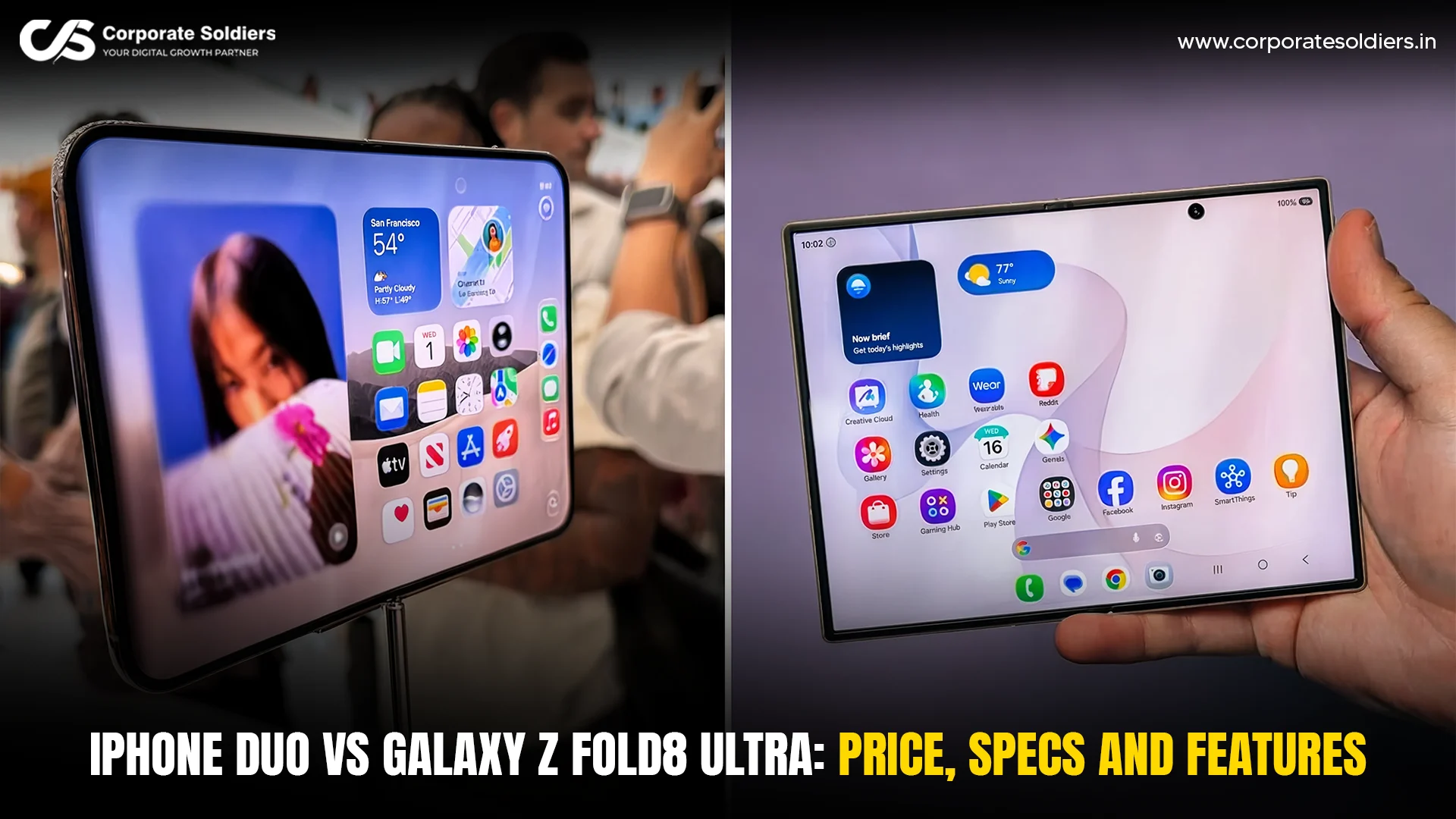
The iPhone Duo is Apple’s first foldable iPhone, bringing the company into direct competition with Samsung’s premium Galaxy Z Fold8 Ultra, launched by Samsung. The time is important: Samsung has been working on book-style foldables over the years, and Apple is entering the category with a mix of its iOS ecosystem, custom silicon and foldable-specific software.
The two gadgets appeal to the same high-end market but adopt contrastingly different strategies on the screen size, cameras, performance, software and pricing. iPhone Duo by Apple will have a much higher price in India, whereas Samsung has a bigger main screen, a separate telephoto lens and up to 16GB of memory.
The following is a comparison of the two flagship foldables in terms of specs as published by the companies.
iPhone Duo vs Galaxy Z Fold8 Ultra: Price in India
The iPhone Duo in four storage options are available in the official Apple store in India. The 256GB model starts at ₹2,99,900, followed by ₹3,24,900 for 512GB, ₹3,74,900 for 1TB and ₹4,49,900 for 2TB. The available colours are Star White and Night Sky listed by Apple.
Samsung’s India newsroom lists the Galaxy Z Fold8 Ultra at ₹1,99,999 for 12GB RAM + 256GB, ₹2,19,999 for 12GB + 512GB and ₹2,59,999 for 16GB + 1TB. Its Indian colour options are Graphite, Cream, Violet Shadow, Green Shadow as a Samsung.com exclusive.
| Variant | iPhone Duo | Galaxy Z Fold8 Ultra |
| Base | ₹2,99,900, 256GB | ₹1,99,999, 12GB + 256GB |
| Mid | ₹3,24,900, 512GB | ₹2,19,999, 12GB + 512GB |
| High | ₹3,74,900, 1TB | ₹2,59,999, 16GB + 1TB |
| Top | ₹4,49,900, 2TB | — |
That produces a large price gap at the entry-level. The iPhone Duo costs ₹99,901 more than the base Galaxy Z Fold8 Ultra in India. More than specifications is reflected in the difference, but Apple is also selling the device as its first foldable as part of the larger premium iPhone ecosystem.
The availability schedules are dissimilar too. Apple claims that iPhone Duo pre-orders in India start on October 16, 2026, and it will be available on October 23. Samsung began rolling out the Galaxy Z Fold8 Ultra on August 7, 2026, with India among the launch markets.
Design and Build
The two phones have a book-like folding design although their physical sizes differ significantly.
The iPhone Duo has a thickness of 5.2mm when it is open and 11.3mm when closed and has a weight of 254 grams. It has a frame made of grade 5 titanium and the outer display is covered by Ceramic Shield 2 and the back by Ceramic Shield. Another technology employed by Apple is a precision hinge consisting of over 100 parts and a strengthened inner display frame.
The Galaxy Z Fold8 Ultra weighs much less and is even less bulky. Samsung puts it at 4.1mm unfolded, 8.9mm folded and 215 grams. It is made up of an Armor Aluminum frame, Gorilla Glass Ceramic 3 on the cover and Gorilla Glass Victus 2 on the back, two titanium layers under the display and an Armor FlexHinge.
Official water- and dust-resistance ratings are also assigned to both devices, but are not the same. The iPhone Duo is an IP68 device, and Apple claims that it is protected up to a depth of six metres in a thirty-minute test on the IEC 60529 standard. Samsung also provides an IP48 rating and specifies that the Galaxy Z Fold8 Ultra is protected against freshwater immersion to a depth of 1.5 metres in the laboratory in 30 minutes.
In practice, the Samsung is the lighter and skinnier device whereas Apple has chosen a heavier titanium body and a greater IP. Specification in itself does not determine long-term foldable durability.
Display Comparison
The Galaxy Z Fold8 Ultra possesses the bigger screens.
The iPhone Duo has an inner Super Retina XDR OLED folding display, which has 1,878 x 2,670 resolution with a 5.4-inch outer display, which has 1,398 x 2,034 resolution. They both have ProMotion adaptive refresh rates up to 120Hz, Always-On display features, HDR, True Tone and up to 3,000 nits outdoors peak brightness. The nano-texture finish that is put on the inside screen to minimize reflection and make the crease less apparent is also present on the inside of the screen.
The Galaxy Z Fold8 Ultra is expanded to 8-inch QXGA+ Dynamic AMOLED 2X principal display with 2,504 x 2,256 resolutions and 6.5-inch FHD+ cover display with 2,520 x 1,080 resolutions. The two displays can accommodate a maximum adaptive refresh rate of 120Hz with a maximum brightness of 3,000 nits. An anti-reflective treatment and Vision Booster are also applied to the main display of Samsung.
Its bigger Samsung inner screen provides it with an edge in raw display area. That may be important to documents, spreadsheets, video editing and side-by-side programs. Instead, Apple places a visual consistency between the two displays: both displays have the same aspect ratio that the content can be scaled to between the folded and unfolded display.
Later in 2026, Apple is also introducing Apple Pencil support over USB-C to enable users to write, sketch and annotate on either display.
Performance: A20 Pro vs Snapdragon 8 Elite Gen 5 for Galaxy
The iPhone Duo has an A20 Pro, which is manufactured on a 2-nanometre process. Apple indicates a six-core CPU comprising two performance cores and four efficiency cores, a seven-core graphics chip with Neural Accelerators, ray tracing that is hardware-accelerated and a dual 16-core Neural Engine. Apple claims that the A20 Pro provides up to 35 percent sustained performance compared to the iPhone 17 Pro, and its CPU is up to 20 percent faster than A19 Pro and its graphics card is up to 40 percent faster.
Apple has also developed a tailor-made vapor-chamber thermal system of the foldable. The thermal system is directly connected to the chip package, which enables the device to maintain performance during gaming, multitasking and AI workloads.
The Snapdragon 8 Elite Gen 5 is used in Galaxy by Samsung. The platform is a combination of next-generation CPU, Adreno G.P.U and Qualcomm Hexagon NPU. Samsung claims that Fold8 Ultra provides 16 percent faster CPU performance, 15 percent higher GPU performance and 21 percent higher NPU performance than the Galaxy Z Fold7. It also employs a cooling structure that is made of expanded graphite in order to dissipate heat.
The processors thus vary in platform philosophy and architecture. Apple focuses on highly integrated custom silicon and on-device AI, whereas Samsung leverages a customized Snapdragon platform with a heavy emphasis on GPU, NPU and Android-based AI-based workloads.
To state that there is a winner just because it has a smaller size in its process or more core processors would be wrong. Other factors that influence real-world performance include operating-system optimization, thermal limits, applications and sustained workloads. There are no benchmark figures in this case since the manufacturer claims cannot be taken as an alternative to the independent comparative testing.
RAM and Storage
Apple officially offers the iPhone Duo with 256GB, 512GB, 1TB and 2TB of storage.
In its official iPhone Duo technical specifications, Apple does not mention the RAM capacity. Other third-party databases give a RAM value, but that cannot be claimed as a specification confirmed by Apple.
Samsung is far more open. The Galaxy Z Fold8 Ultra comes with:
- 12GB RAM + 256GB storage
- 12GB RAM + 512GB storage
- RAM: 16GB + storage: 1TB
The 16GB version of Samsung is thus more targeted towards the customers who anticipate having a wide range of applications and huge creativity files on the device.
Storage capacity is easier to consider, particularly by most buyers, than RAM. Apple can attract buyers who capture a lot of high-resolution video content with the 2TB model of the iPhone Duo, whereas Samsung offers a 1TB/16GB model that has the largest storage with the largest memory capacity.
Camera Comparison
One of the most evident differences of the two foldables is the camera philosophies.
iPhone Duo
Apple provides the iPhone Duo with 48MP Dual Fusion camera, with 48MP Fusion Main camera and a 48MP Fusion Ultra Wide camera.
The primary camera has sensor-shift optical image stabilization, and has a 12MP optical-quality 2x telephoto mode. The ultra wide camera features a 120degree field of view and a 48MP macro photography. Photographs have a digital zoom of up to 10x.
The phone also features a 12MP Center Stage outer front camera and under-display FaceTime camera on the inner display. There are various fold-related camera functions that Apple has developed using the two screens such as Smart Take, Duo Preview, Dual capture, Kid Cue and Duo FaceTime.
Video is a significant emphasis. The Fusion Main camera is capable of recording 4K Dolby Vision at 120fps and the Cinematic mode is capable of recording up to 4K Dolby Vision at 60fps. Audio Mix, Action mode, macro video and better low-light video are also available in Apple.
Galaxy Z Fold8 Ultra
Samsung is more traditional in approach to flagship-camera, and has a triple rear system:
- 200MP Wide, f/1.7, OIS and 2x optical-quality zoom
- 50MP Ultra Wide, f/1.9 and 120-degree field of view
- 10MP Telephoto, f/2.4 with OIS and 3x optical zoom
It has 10MP cover-screen and 10MP main-screen cameras as well.
Samsung has improved the ultra-wide camera of the Ultra to 50MP and can record in 8K with the APV codec. Cine LUT tools are added to give more colour and tone options to the video processes and Nightography and the ProVisual Engine of Samsung are applied to the image processing.
The higher megapixel count of Samsung’s main camera does not necessarily translate to superior photos. The quality of images is based on sensor qualities, optics, stabilization, computational photography and video processing. Instead, Apple has more focus on computational photography and video capabilities in its system, whereas Samsung offers its users a dedicated telephoto lens and higher-resolution main and ultra-wide sensors.
Software and AI
The iPhone Duo will be shipped with its own version of the iOS 27, but tailored to fit its folding design. To enable two applications to be displayed side by side, Apple has added Split View, and two windows of one application can be opened, like Safari. It is possible to save app pairs to be used later.
The experience is designed to have Apple Intelligence built into it, and Siri AI is in beta. Apple claims that Siri is capable of leveraging personal context, comprehending onscreen content and engaging with content in supported apps. Apple Intelligence is a mix of On-device processing and Private Cloud Compute of supported workloads.
Android 17 (One UI 9) is installed on Samsung Fold8 Ultra. Its collapsible interface features multi-window productivity and can support a desktop-like experience when it is connected to compatible external screens and devices, which is offered by Samsung DeX.
Galaxy AIs have Now Nudge, Now Brief and Photo Assist among other context-aware capabilities. Samsung also incorporates experiences related to Gemini and offers an AI Assistant Activity dashboard to One UI 9 to allow users to overview AI activities. Knox security platform, Personal Data Engine, Knox Enhanced Encrypted Protection and Knox Vault, offered by Samsung should be aimed at giving more control over the processing of personal data and AI.
The distinction is very philosophical. Apple is adopting the proven iOS experience into a foldable user experience and Samsung is leveraging the bigger foldable screen to add more multitasking, Android automation, and desktop-like workflows.
Battery and Charging
In the official specifications, Apple does not list a mAh capacity of the iPhone Duo. Instead, it talks of the device taking two inbuilt lithium-ion batteries, one on either side of the foldable design.
Apple boasts as much as 24 hours of typical usage, as much as 31 hours of video playback with the inner display and 44 hours with the outer display. Charging at 50% can take approximately 20 minutes with a 60W-capable adapter or more with wired charging, or 30 minutes with MagSafe and a 35W adapter or more. Wireless charging of up to 25W is supported on MagSafe, and Qi2.
Galaxy Z Fold8 Ultra is specified to have a 5,000mAh typical dual battery. Samsung claims that with a 45W adapter and a 3A USB-C cable, the company has a dual-path charging system that can charge to up to 67 percent in approximately 30 minutes. The device also embraces wirelessly charging of 20W and Wireless PowerShare.
The comparison is not just a battery capacity, however. Apple focuses on energy control between two battery parts and releases video-playback rates, whereas Samsung merges a bigger claimed battery capacity with quicker 45W wired charging and reverse wireless charging.
Connectivity and Other Features
iPhone Duo is based on eSIM-only design, and does not support SIMs of any kind. Apple claims to be compatible with dual active eSIMs and has the ability to store up to eight or more eSIMs. The phone has the Apple N1 wireless networking chip, Wi-Fi 7, Bluetooth 6, Thread, NFC, second-generation Ultra Wideband and C2 cellular modem.
This foldable design is equipped with Touch ID instead of Face ID in the side button. Camera Control and USB-C connectivity (USB 3 data transfer and DisplayPort) are also still present in Apple.
The Galaxy Z Fold8 Ultra by Samsung is 5G, Wi-Fi 7, Bluetooth 6.0 NFC, UWB and USB-C. It also has fingerprint authentication. The foldable does not support the S Pen even though it has a large display that is productivity-oriented.
Samsung software is also compatible with cross-device workflows, such as Smart Switch migration (iOS) and compatibility with Quick Share on Apple devices (under supported conditions).
iPhone Duo vs Galaxy Z Fold8 Ultra: Key Differences
| Feature | Apple iPhone Duo | Samsung Galaxy Z Fold8 Ultra |
| Starting India Price | ₹2,99,900 (256GB) | ₹1,99,999 (256GB) |
| Inner Display | 7.6-inch Super Retina XDR OLED (1878×2670) | 8.0-inch Dynamic AMOLED 2X (2256×2504) |
| Cover Display | 5.4-inch Super Retina XDR OLED (1398×2034) | Dynamic AMOLED 2X (1080×2520) |
| Refresh Rate | 120Hz ProMotion (Adaptive) | 1–120Hz Adaptive |
| Processor | Apple A20 Pro (2nm) | Snapdragon 8 Elite Gen 5 for Galaxy (3nm) |
| RAM | Not officially disclosed | 12GB / 16GB |
| Storage Options | 256GB, 512GB, 1TB, 2TB | 256GB, 512GB, 1TB |
| Rear Main Camera | 48MP Fusion (f/1.6, Sensor-Shift OIS) | 200MP (f/1.7, OIS, Multi-directional PDAF) |
| Ultra-Wide Camera | 48MP Fusion (f/2.2, 120° FOV) | 50MP (f/1.9, 120° FOV) |
| Telephoto Camera | None (2x Optical Quality Sensor Crop) | 10MP (3x Optical Zoom, OIS) |
| Battery Capacity | Dual built-in lithium-ion batteries; up to 31 hrs inner-display video playback | 5,000mAh |
| Wired Charging | Up to 50% in ~20 mins with a 60W-capable adapter | 45W Fast Charging |
| Wireless Charging | MagSafe / Qi2 | 20W Wireless + Wireless PowerShare |
| Operating System | iOS 27 | Android 17 with One UI 9 |
| Biometrics | Touch ID (Side Power Button) | Side-Mounted Fingerprint Sensor |
| Weight | 254 grams | 215 grams |
| Thickness (Open / Closed) | 5.2 mm / 11.3 mm | 4.1 mm / 8.9 mm |
| Ingress Protection | IP68 | IP48 |
| Official Colors | Star White, Night Sky | Graphite, Cream, Violet Shadow, Green Shadow |
Which Phone Has an Advantage in What Area?
No specification is universal which renders a particular device better.
The iPhone Duo can be interesting to the users who focus on:
- Apple ecosystem and iOS.
- Pro custom silicon A20 Pro.
- Apple Intelligence and Siri Artificial Intelligence.
- iOS-specific foldable multitasking
- Video recording capabilities of Apple.
- Dual-display camera features
- Apple Pencil support
- Titanium building and IP68 protection.
- 2TB maximum storage
Galaxy Z Fold8 Ultra could appeal to users who are more concerned with:
- A bigger inner display of 8 inches.
- A bigger cover screen of 6.5 inches.
- Less initial price in India.
- Up to 16GB RAM
- A special 3x telephoto camera.
- 200MP main camera
- 8K video recording
- Android and One UI flexibility
- Galaxy AI features and Gemini related features.
- Samsung DeX
- 5,000mAh battery
- Wired charging 45W and Wireless PowerShare.
- A less heavy and lighter foldable design.
These variations are especially topical since the two companies are not merely selling the same hardware but under different brands. Apple is leveraging the iPhone Duo to take the current hardware-software ecosystem into a new form factor, and Samsung is adding to a history of many years of foldable development and is positioning the Fold8 Ultra as a productivity and content-creation product.
Price Difference and Market Positioning
The largest short term difference is price.
The starting cost of the iPhone Duo is ₹2,99,900, nearly 1 lakh higher than the starting price of the Galaxy Z Fold8 Ultra 1,99,999 in India. This disparity is even further extended when the 512GB and 1TB on the iPhone Duo are compared to the same on Samsung.
Such a price difference implies that the two devices will be placed differently despite them being in the same premium foldable category. The disadvantageous starting price of Samsung allows its high-end foldable to be more affordable in the flagship segment, whereas the Apple pricing corresponds to the high end of the first foldable iPhone.
Other priorities are also brought out in the comparison. Samsung offers additional hardware in the camera, a bigger unfolded display, higher RAM in the top and faster wired charging. Apple specializes in custom silicon, integration of iOS, fold specific changes in the interface, computational photography and the continuity of the Apple ecosystem.
Final Takeaway
Apple’s arrival changes the premium foldable market by giving consumers an iPhone-based alternative to established Android foldables. The iPhone Duo combines a 7.6-inch foldable display, A20 Pro, iOS 27, Apple Intelligence, dual 48MP rear cameras and Apple’s ecosystem, while introducing a new two-battery architecture and fold-specific multitasking features.
The Galaxy Z Fold8 Ultra takes a different route. It offers an 8-inch inner display, 200MP triple-camera system, up to 16GB RAM, Snapdragon 8 Elite Gen 5 for Galaxy, a 5,000mAh battery and 45W charging, alongside Android 17 and One UI 9. Samsung’s established foldable design also makes the device thinner and lighter than Apple’s first foldable.
For buyers, the more relevant question is therefore not which phone wins every specification category. The iPhone Duo is more closely tied to Apple’s software ecosystem and custom silicon, while the Galaxy Z Fold8 Ultra puts greater emphasis on display area, camera hardware, memory, charging and Android-based productivity.
The better choice ultimately depends on whether the priority is Apple’s ecosystem and foldable iOS experience or Samsung’s larger display, broader hardware configuration and lower entry price.