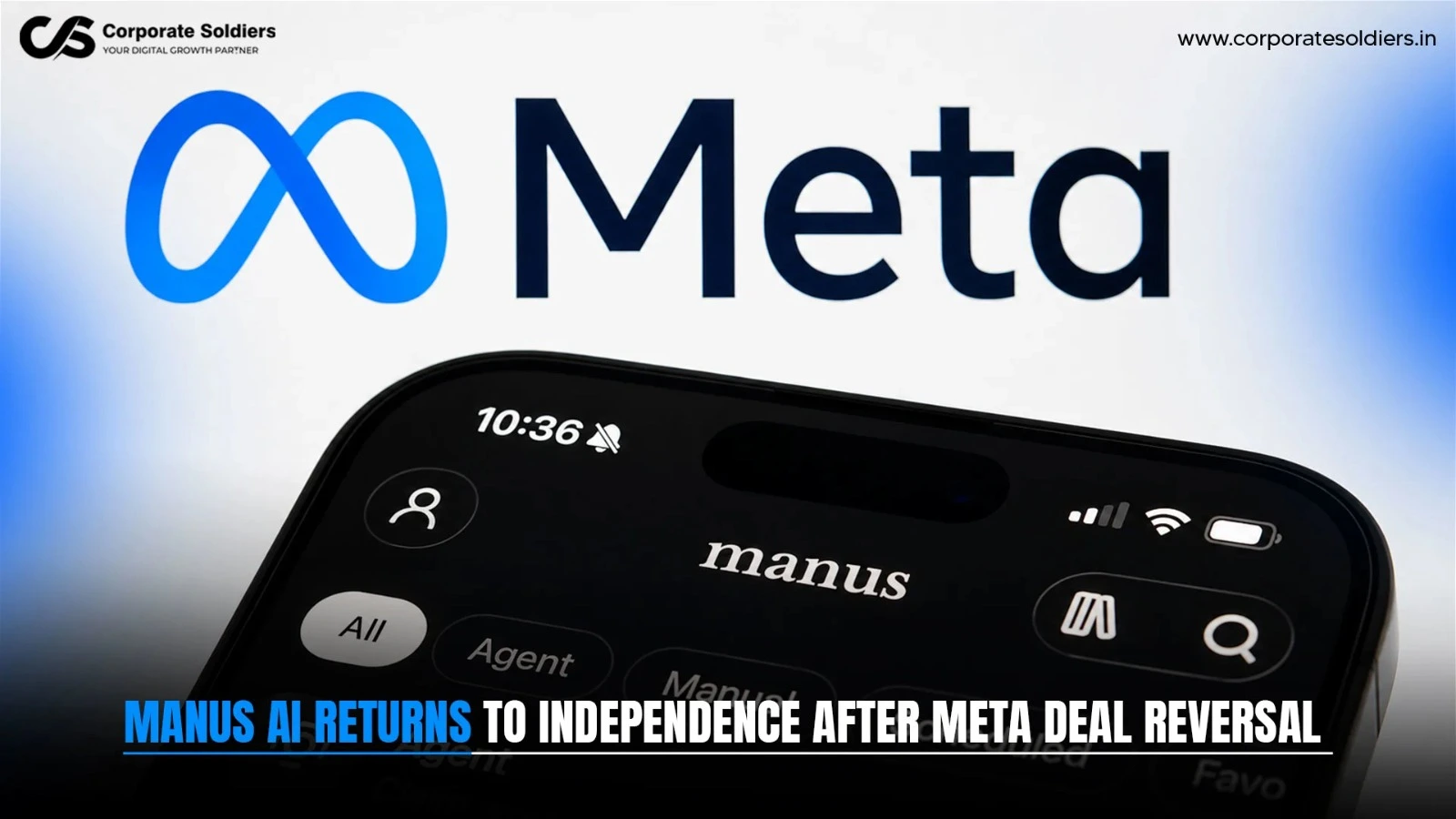
Manus AI is set to resume independent operations after its acquisition by Meta was unwound, marking a major reversal in the AI startup’s corporate trajectory. On August 11, the Singapore-based AI startup announced that it would operate independently again as it completes its separation from Meta, while warning that some data generated by certain users on or after December 29, 2025, will be deleted during the transition.
The announcement comes after China in April ordered the foreign acquisition of Manus to be prohibited and required the parties to withdraw from the transaction. Meta announced the acquisition, which was widely covered, as being over $2 billion, though the financial terms were not publicly announced.
For Manus users, the corporate reversal has immediate practical implications. Manus will inform the affected users via the app and via email and will provide them with a chance to back up their data before the deletion process occurs.
Manus AI to Return to Independent Operations
As its separation from Meta progresses, Manus has announced that it will become an independent business again. According to Reuters, the company explained that the change was a shift to an independent operation and that the erasure of some user data is part of the dislocation.
The development reverses the corporate direction announced in December 2025, when Manus stated that it was becoming a part of Meta to hasten the creation of general-purpose AI-agent features. Manus at that time said that its priority was to keep on serving customers and leverage on the resources of Meta to grow its technology.
The latest announcement does not mean that Manus is shutting down. Rather, the company is separating from Meta and returning to independent operations.
It remains of interest whether the long-term ownership structure will be exactly as such. In July, Reuters announced that Tencent was engaged in negotiations to be the biggest shareholder in Manus, in addition to current investors thinking of a buyback by Meta. Those negotiations were not considered final.
What Happened to the Meta-Manus Deal?
The Meta-Manus acquisition came as the startup was rapidly attracting attention for its AI-agent technology.
According to Bloomberg, the deal valued Manus at more than $2 billion, based on people familiar with the matter. Meta did not officially disclose the exact financial terms.
Meta’s interest in Manus was closely tied to its broader expansion into AI. Rather than focusing solely on conversational AI, Meta was looking to strengthen its capabilities in AI agents, systems designed to go beyond generating responses and perform multi-step actions.
The acquisition was thus not just a traditional startup acquisition. Manus was now one of the more prominent companies that specialized in agentic AI, which large technology companies are increasingly considering strategically valuable.
During the acquisition, the Associated Press had reported that Manus had created a general-purpose AI agent that was able to work on such fields as research and coding. The company had already enjoyed quick commercial momentum as well as attaining reported annual recurring revenues of up towards 100 million a few months after the launch.
In December, Manus itself claimed that its agent had already processed over 147 trillion tokens and enabled the creation of over 80 million virtual computers, and this level of activity was an indication of the scale of its activity it said it had achieved prior to joining Meta.
The acquisition seemed to expose Meta to technology, engineering talent and experience in creating systems that can perform tasks, as opposed to taking questions and responding.
That arrangement however, failed regulatory scrutiny in China.
Why China Blocked the Meta Acquisition
Even though Manus has its operations later set its operations in Singapore, it has Chinese origins. Reuters has reported that the start-up was started in China by Chinese engineers such as Xiao Hong and Ji Yichao and later relocated its activities to Singapore.
Such a background became important as soon as Meta announced the acquisition.
In April 2026, China’s National Development and Reform Commission ordered the foreign acquisition of Manus to be prohibited and required the parties to withdraw from the transaction. The decision was made through China’s foreign-investment security-review mechanism.
The Chinese government did not give an elaborate publicity about the exact technology or business factors that led to the action. This official move must be separated then, as compared to a wider discourse concerning technology competition between the US and China.
According to Reuters, the decision came as Beijing was clamping down on US investment in Chinese startups developing frontier technologies.
This case is especially noteworthy since by the time of accepting to acquire it, Meta had already incorporated and operated out of Singapore, and Manus was already in operation. However, its Chinese roots, human and technological background was still pertinent to the regulatory review.
The episode illustrates that the corporate structure and location of headquarters are not always the reasons to give up on regulation in case the technology company is subject to a substantial connection with another jurisdiction.
Meta Began Separating From Manus
The regulatory ruling failed to overturn the transaction in one fell swoop. The companies were already in the process of integrating their operations prior to the announcement in December, and thus the unwinding was more complex.
In June, TechCrunch reported that Meta had begun to unwind the acquisition and had completed an operational separation between Meta and Manus, including stopping data sharing between the two businesses. The report also indicated that Meta disconnected Manus to its internal systems as well as barring the use of Manus tools on internal projects by the employees.
This functioning division was a significant step in the even greater process of dissolution.
It was not merely a matter of changing the ownership on paper. Some of the aspects that can be included in an acquisition of an AI company include software, infrastructure, employees, intellectual property, data systems and internal tools. Isolating those elements will cause the companies to decide what systems, information and assets they can still use on their own.
According to the recent announcement of Manus, it is now at the stage of customer-data separation.
Manus Warns Users About Data Deletion
The most pressing problem this will bring to Manus customers is that the company has announced that some user-generated data will be deleted.
Manus states that the data that will be produced by some users on or after December 29, 2025, will be covered by the transition. The company indicated that the deletion is being done as part of the requirements in certain jurisdictions as dictated by the regulations and it is part of the separation with Meta.
This is a significant difference.
The announcement does not prove that every Manus user will be deprived of all his/her data. Rather, Manus has announced that information created by some of the affected users in the time frame is liable to deletion.
The affected users would be notified via Manus application and email. The company has also claimed that such users will be able to back up their data prior to the deletion.
The notification needs to be treated as a data-preservation problem by the users, instead of an announcement that Manus itself is evaporating.
The crux of the matter is simple: in the event that Manus determines that an account is impacted, then users must complete the official backup procedure provided by the company within a specific time frame.
What Manus Users Need to Know
The three issues of data transition that cannot be mixed up by users are: data deletion, account continuity and temporary service availability.
To begin with, the targeted data is not moving automatically and without the participation of users. Manus has mentioned specifically that there will be an opportunity to back up the data of affected users.
Second, the deletion of data does not necessarily mean the cancellation of accounts of all Manus customers. The change has been termed by the company as one of its retreat to independent operations and has even informed the affected users individually.
Third, users may experience a temporary service interruption while Manus separates its underlying systems and completes the data deletion process. Manus’ current transition schedule gives affected users until August 23, 2026, at 7:59 a.m. Singapore Time to complete their backups. The affected data will be deleted from August 23 at 8:00 a.m. through August 24, 2026, with users able to restore their backed-up data starting at 8:00 a.m. on August 25. Unaffected users can continue using Manus as usual during this period and do not need to take any action.
Since the exact recovery procedure may be contingent upon the account of the user and the kind of information he or she keeps, one must take the guidance of Manus instead of a third party manual or guesses of what will be recovered.
The safest method to an impacted customer is to:
- Examine the Manus notification in the application.
- Check the email account of Manus.
- Decide on whether the account is part of the transitioning of the data.
- Email vital projects, task data as well as other deserving data prior to the mentioned deadline.
- Make copies of the files in a safe place not involving Manus.
- Go through the instructions of Manus, after the service transition.
Manus has indicated that the affected users will be given notice and be given the chance to save their data.
It is also important that users should not assume that the account backup and the full copy of all the pieces of project infrastructure are one and the same. In case a Manus workflow contains hosted websites, linked services, external databases or third parties integrations, the customers ought to refer to the instructions of the particular service offered by Manus.
Manus AI’s Journey From Startup to Meta Deal
In early 2025, a case in point of the movement of conversational AI to systems capable of running tasks emerged in the shape of Manus.
The technology of the company was developed based on the concept of an AI agent that was able to accept a high-level task and divide it into smaller steps, utilize tools and computing environments and create a finished product.
The latter strategy contributed to Manus gaining a great deal of attention in a market where more and more people are willing to consider AI systems capable of more than text generation.
Manus grew rapidly. In December, the company said its agent had processed more than 147 trillion tokens and enabled the creation of over 80 million virtual computers. By April, the startup said it had surpassed $100 million in annual recurring revenue within eight months of operation.
The company then diversified Manus to a range of activities such as browser functionality, software development, presentations, research, web development and integrations with other services. Its product releases throughout the first half of 2026 demonstrate that the firm did not cease the development of its agent platform as the regulatory environment with regard to its ownership was changing.
The purchase of Meta thus came at an opportune time when AI agents were emerging as one of the biggest sources of competition in the technology sector.
What Are AI Agents?
The importance of the Manus case can be explained more simply by the fact that the AI agents can be differentiated in relation to traditional chatbots.
An ordinary AI chatbot will be created with the purpose of reacting to a prompt. It is able to elucidate a subject, compose text, respond to queries or develop code, but the interaction normally focuses on creating a reply.
An AI agent, on the other hand, is the agent that is programmed to execute a set of actions towards a specified goal.
Based on the permissions of the system and the system itself, an agent can:
- Dividing a complicated goal into smaller tasks.
- Determine necessary steps.
- Take advantage of software or related services.
- Read or access information.
- Write or edit files or code.
- Run multi-stage workflows.
- Provide a finished product and not just a description.
The model of execution that Manus has surrounded itself with is this. Its own definition of the product focused on research, automation and complicated tasks, and defined Manus as an execution layer that is able to execute end-to-end work.
This does not imply that an AI agent is totally autonomous or infallible. Its capabilities are based on its underlying models, tools, integrations, permissions, safeguards as well as the task it is being requested to carry out.
What the Deal Reversal Means for Manus
Going back to being independent offers Manus with opportunities as well as challenges.
Now, the company must sustain and scale an AI platform but not stay within the corporate framework of Meta. It implies remaining in the fast-paced agentic-AI market, and dealing with infrastructure, product development, customer support, and regulatory requirements on its own.
The isolation also emphasizes more on user trust.
In the case of an AI platform, customer information is directly related to the product. The user can also have trust in an agent to do research, develop software, create websites, prepare presentations or do other related workflows. The loss of access to historical task data can thus not only impact convenience, but also on-going projects and business operations.
Data portability is particularly critical with the current transition. Manus is also providing impacted users with a window of grace, but the fact that users have to take it upon themselves to save their own data also reflects the potential practical harm that may be caused by a significant corporate reorganization of an AI service.
Another question that remains open is ownership. In July, Reuters reported that Tencent was discussing becoming the biggest shareholder in Manus as former investors discussed repurchasing the company back to Meta at least at the reported $2 billion valuation. According to Reuters, the talks were still in progress.
Manus’ return to independence should not be conflated with a finalized long-term ownership structure.
Why the Manus Case Matters for the AI Industry
The Manus episode is much more than a single acquisition of a company.
First, it demonstrates that AI acquisitions may turn into regulatory issues in case the technology is regarded as a strategic one. It was a deal between a Chinese based company and a Singapore based and US based technology acquirer, which formed a cross-border formation that raised eyebrows of the Chinese authorities.
Second, it brings to the fore the increased significance of agentic AI. The strategic importance of technology, which was able to perform tasks and not just generate conversation responses, was one of the reasons why Meta was initially interested in Manus. The following interest of Tencent also implies that AI agents are still considered as being a strategic value to the large technology firms.
Third, the case illustrates that data governance may turn into the key operation issue in the case of an acquisition reversal. Integrating systems in two technology companies and then being forced to divide them, what data can be kept and what must be transferred and what must be deleted can have a direct impact on customers.
Lastly, the episode presents the growing interdependence between AI development and the national technology policy. Cross-border AI transactions are now required to be looked at not only in a commercial context but also in the context of foreign-investment regulations, technology regulation, data management as well as strategic national interest.
The Manus case alone does not create a universal rule that should be followed in the future when acquiring AI. It does give, however, a vivid picture of how fast the business path of an AI company can shift, when regulatory demands come into play.
Manus AI Timeline
December 29, 2025
Meta announced that Manus would become part of the company. The deal was widely reported to be worth more than $2 billion, although the financial terms were not officially disclosed.
April 27, 2026
China’s National Development and Reform Commission prohibited the foreign acquisition of Manus and required the parties involved to withdraw from the transaction.
June 2026
According to TechCrunch, Meta began unwinding the deal, including separating operations and ending data exchange between Meta and Manus.
July 10, 2026
Reuters reported that Tencent was negotiating to become Manus’ largest shareholder, while previous investors were considering a buyback. At the time, the discussions were still taking place.
August 11, 2026
Manus declared that it would resume independent operations and announced that certain user data generated on or after December 29, 2025, would be deleted as part of the separation process. Affected users would be notified and given an opportunity to back up their data.
Key Takeaways
- Manus AI is returning to independent operations after its acquisition by Meta was ordered to be unwound.
- China’s National Development and Reform Commission blocked the foreign acquisition in April 2026, requiring the parties to withdraw from the transaction.
- The Meta Manus acquisition was widely reported at more than $2 billion, but Meta did not publicly disclose a precise transaction value.
- Meta and Manus had already begun operational separation, including stopping data sharing, before the latest announcement.
- Certain user-generated data from December 29, 2025 onward is subject to deletion as part of the separation and regulatory requirements.
- Affected users will be notified through the Manus app and email and will have an opportunity to back up their data.
- Users should follow Manus’ official backup and restoration instructions rather than assuming that all account or project information will automatically remain available.
- Tencent has been reported to be in talks to become Manus’ largest shareholder, but those discussions were not described as finalized in the latest Reuters reporting.
- The episode underscores the growing importance of AI agents, cross-border technology regulation, data governance and strategic control of advanced AI technology.
In the case of Manus, the termination of the Meta relationship symbolizes that the company is back to the independent course. To its customers, data continuity is the more immediate concern, however. The transition renders the following few weeks especially significant to the affected users, as they will need to see their notifications in Manus and attempt to back up the information they can prior to the deletion period stated by the company.