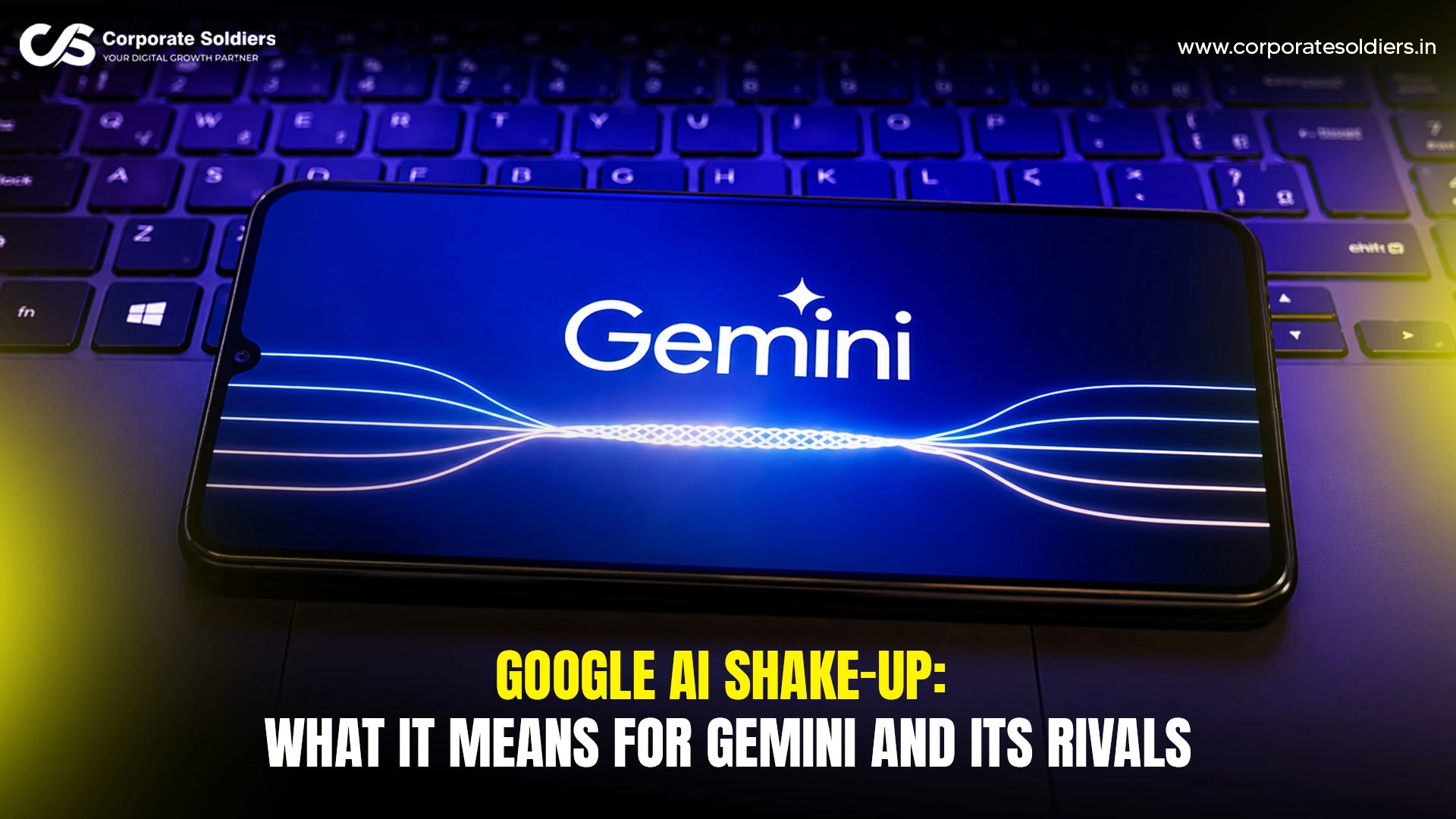
Reportedly, the primary technology company of Alphabet, Google, is in the process of a significant organisational restructuring of its artificial intelligence operations as the tech giant attempts to serve its flagship model, Gemini and to counter intense market competition brought about by its competitors including OpenAI and Anthropic.
It has been characterized by internal leadership transitions, model delays and Google co-founder Sergey Brin has been a part of it. As generative AI has become central to the technology of businesses and services related to consumers, internal changes at Google focus on the strategic urgency of its projects based on generative AI and the challenge of being ahead of the market in a rapidly evolving sector.
What Is Happening Inside Google’s AI Organisation?
A report by Reuters has suggested that Google DeepMind, which is the AI unit of Google, is undergoing structural changes that will assist in making development simpler and faster when it comes to implementing products.
The main developments in the organization are:
- DeepMind Leadership Change: On August 5, Demis Hassabis relinquished daily management to become the chairman of Google DeepMind and the head of science at Alphabet. His deputy, Koray Kavukcuoglu replaced him in charge of day-to-day operations.
- Executive/Technical Departures: Two of the co-technical leads of Gemini, Jeff Dean and Oriol Vinyals, also departed Google in the shake-up. They became part of a new AI venture along with Sanjay Ghemawat and Quoc Le named Discovery Loop.
- DeepMind Traditional Autonomy Loss: DeepMind is losing some of its traditional autonomy to Google core corporate structure. At an all-hands meeting on August 6, they allegedly told employees that some of their operational and engineering teams would be moved straight into the main corporate body at Google.
- Co-Founder Intervention: Google co-founder Sergey Brin has been reportedly more involved in the AI work of the company. According to Reuters, at an April town hall, with hundreds of DeepMind employees present, Brin urged the team to move quicker and put much emphasis on Gemini as Google aimed to bridge the gap with its competitors.
Reports will have a tendency of referencing sources who imply that such decisions will have a natural correlation to the overall goal of Google to gain model capability supremacy in a very competitive business environment.
Why Gemini Is Under Pressure
Although Gemini 3 briefly overtook competing models following its November release, subsequent updates from Anthropic and OpenAI put Google back in a catch-up position.
Reporting pressures include internal and structural pressures:
- Late Flagship Release: Google reportedly delayed its new flagship Gemini model by about two months after internal testing showed that its performance continued to lag behind competitors, particularly in coding.
- Research vs. Commercialization Balance: DeepMind’s foundational focus on pure scientific research is facing growing pressure to align with Google’s immediate commercialization objectives, creating internal tension over product priorities.
- Resource and Output Scrutiny: Internal stakeholders have demanded quicker deployment and closer integration among Google consumer and enterprise software suites, even though it is a big capital investment and consumption of compute resources.
The Competitive Challenge From OpenAI and Anthropic
The announcements of the changes within Google are made in the context of the long-term product momentum of the main competitors in the industry.
- Anthropic Claude Ecosystem: Anthropic has amassed significant momentum in other areas such as coding and enterprise AI, straining Google Gemini. Newer Anthropic models (and the publication of OpenAI) also assisted Gemini in returning to a position of catch-up, having temporarily overtaken its rivals last November, according to Reuters.
- Market Position of OpenAI: OpenAI is gaining a steady number of consumers through ChatGPT and introducing new frontier models that are at the forefront of coding, multi-modal reasoning and API integration.
This rivalry between Google and two other major AI competitors, OpenAI and Anthropic, has increased the pressure on Google to be on the frontier of AI development.
What the Reported Shake-Up Could Mean for Google’s AI Strategy
The reorganization mentioned may signify a turning point in the manner in which Google deals with its cutting-edge technology research:
- Increased Business Interaction: Making DeepMind teams a part of the Google umbrella would help ease the tension of its management, enabling AI to be more quickly introduced to Search, Workspace, Cloud, and Android.
- Refocused Engineering Concerns: Re-allocating technical talent to Gemini implies a refocused concern to the quality of models and the latency, and the competence of the code, not a hypothetical research.
- Better Corporate Control: A good sign of more operational control over product roadmap and deliverable schedule would be to hand over the day to day leadership to Koray Kavukcuoglu and establish a closer correlation with the Google corporate leadership.
Google’s Larger AI Challenge
The role that Google can play in artificial intelligence is an odd one since the company is one of the most technically and financially strong players in the industry.
It boasts the research interests of DeepMind, its own AI accelerators, Google Cloud, Search, Android, Workspace and a massive global software ecosystem. Gemini has already been implemented into some of the Google products and the company has gone ahead to increase its AI offerings.
The issue lies in transforming those benefits to enduring leadership on the frontier.
The new reporting demonstrates the reason why this is challenging. The development of models demands huge computer power, highly-specialized researchers and big-scale experimentation. Meanwhile, business organisations need to make decisions about priorities in their capabilities, how to handle product launches and react to their competitors who might have less organisational levels.
According to Reuters sources, there were issues of resource allocation and priority within Gemini, and other reports have noted delays and worries among employees. Google, on its part, has indicated that it is still dedicated to the AI frontier and is still building out infrastructure.
The difference between research leadership, on the one hand, and product leadership, on the other hand, is thus becoming more and more important.
Producing powerful scientific research can be achieved by a company without necessarily controlling consumer AI products. On the other hand, a firm that has a good product can be able to progress much quicker than organisations that have bigger research activities. In the case of Google the strategic challenge is to integrate the two strengths and not to make the organisational complexity undermine either of them.
Why This Matters Beyond Google
Changes in the organization of Google are a reflection of the general tendencies in the tech sector as the large companies have to adjust to the dynamics of generative AI:
- Enterprise Software Standards: Corporate customers are considering foundation models that are judged on the accuracy of code output, reliability of context windows and enterprise level security.
- Infrastructure Investment: Hyperscale cloud providers have to defend enormous capital investment in AI hardware by moving model access to increased recurrent cloud income.
- Talent Mobility: The high-profile exits of significant AI labs show that there is an active venture ecosystem in which top technical researchers often switch to start new agile and specialized startups.
What Happens Next?
The following are some of the indicators that will be tracked by industry observers and corporate analysts in the next few months:
- Results of Future Gemini Releases: Will the delayed flagship Gemini model exhibit quantifiable improvements in the coding and reasoning benchmark scores at the time of release?
- DeepMind Organization Integration: How can research teams seamlessly migrate into the main corporate structure of Google and still retain technical abilities and long-term innovation capacity?
- Enterprise Cloud Adoption: Market share data of the Vertex AI platform of Google Cloud compared to Microsoft Azure OpenAI Service and AWS Bedrock.
Final Thoughts
The mentioned rearrangement within the AI structure of Google highlights the inexorable speed of the worldwide AI proliferation. Although Google has vast computing infrastructure, information assets, and expertise in science, the quick performance of OpenAI and Anthropic has fueled the necessity to achieve rapid alignment of operations.
The next step at Google will rely not just on training frontier AI models, but also on the seamless execution, reliability of the models as well as the capability to translate breakthrough research into enterprise and consumer products on a global basis.