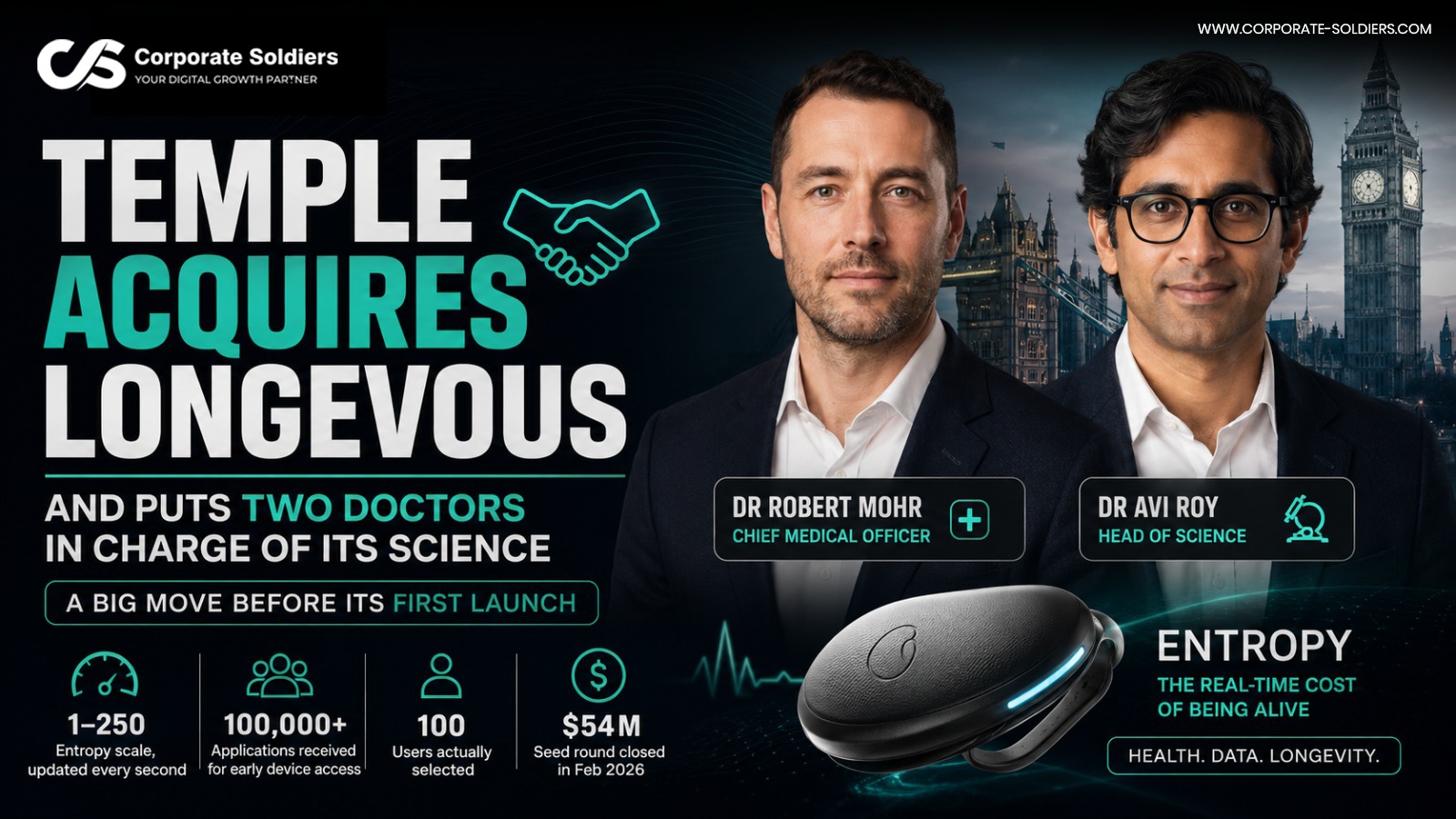
Deepinder Goyal’s wearable startup is buying a London longevity practice months before its first commercial launch. The two founders join as Chief Medical Officer and Head of Science. The timing tells you what Temple still needs.
Reported and written for the Temple newsroom · 6 min read
Entropy trace / how the deal happened
Scale 1–250 / illustrative
London
Goyal almost skipped it. Rob and Avi noticed the device on his temple and asked what it was.
2 months
Both doctors wore Temple as a daily driver and pressure tested Entropy against the science team.
First papers
They ended up reviewing Temple’s first scientific manuscripts before submission.
Full time
Longevous joins Temple. Terms were not disclosed. The practice keeps serving its own clients.
Temple has acquired Longevous, an evidence-based longevity medicine practice based in London. Its two founders and their team are joining full time. Dr Robert Mohr becomes Chief Medical Officer. Dr Avi Roy becomes Head of Science.
On paper this is a small acqui-hire. In practice it is one of the most important hires Temple has made, because it lands at the exact point where the company is most exposed.
Temple is a wearable device that reads blood-flow signals and turns them into a live metric called Entropy. The company describes Entropy as the real-time metabolic and sympathetic demand on the body.
That claim is unusual, and unusual claims need proof. Temple now has two people whose full-time job is to produce it.
A clinician and a scientist, not two more executives
Dr Robert Mohr
A board-certified physician with close to two decades in clinical practice who moved from emergency medicine into evidence-based longevity medicine.
Dr Avi Roy
An Oxford-trained biomedical scientist who has worked at the intersection of longevity science and business.
The gap Temple is buying its way out of
When Temple announced Entropy, the reaction split cleanly in two. The technology press treated it as a new biomarker, while parts of the medical community treated it as an unproven marketing metric.
The criticism was specific. There was no peer-reviewed validation, the methodology was not public, and questions remained about signal distortion and real-world measurement.
That is exactly what this acquisition is designed to address. Mohr and Roy had already spent time pressure-testing the assumptions behind the product and reviewing Temple’s scientific work.
Valuation has moved faster than the evidence
A clinic is not a lab, and that is the point
Most hardware companies that want scientific weight hire a research team. Temple bought a working clinic instead, and it is keeping it open.
A longevity practice sees real patients over time, with real bloodwork and real outcomes. It provides a clinical environment that a conventional research budget cannot replicate.
The acquisition also gives Temple a London base and a European clinical footprint as the company prepares for a broader global audience.
Four things that will show whether this worked
- 01
The first paper, and where it lands
The test is the journal, sample size and whether the comparison method is independent.
- 02
Whether the methodology goes public
Greater transparency around how the score is derived could answer major criticism.
- 03
How Temple positions itself on regulation
Today it is positioned as a wellness device rather than a diagnostic instrument.
- 04
Pre-orders and the shipping date
The commercial launch and actual delivery timeline will be a major test of execution.