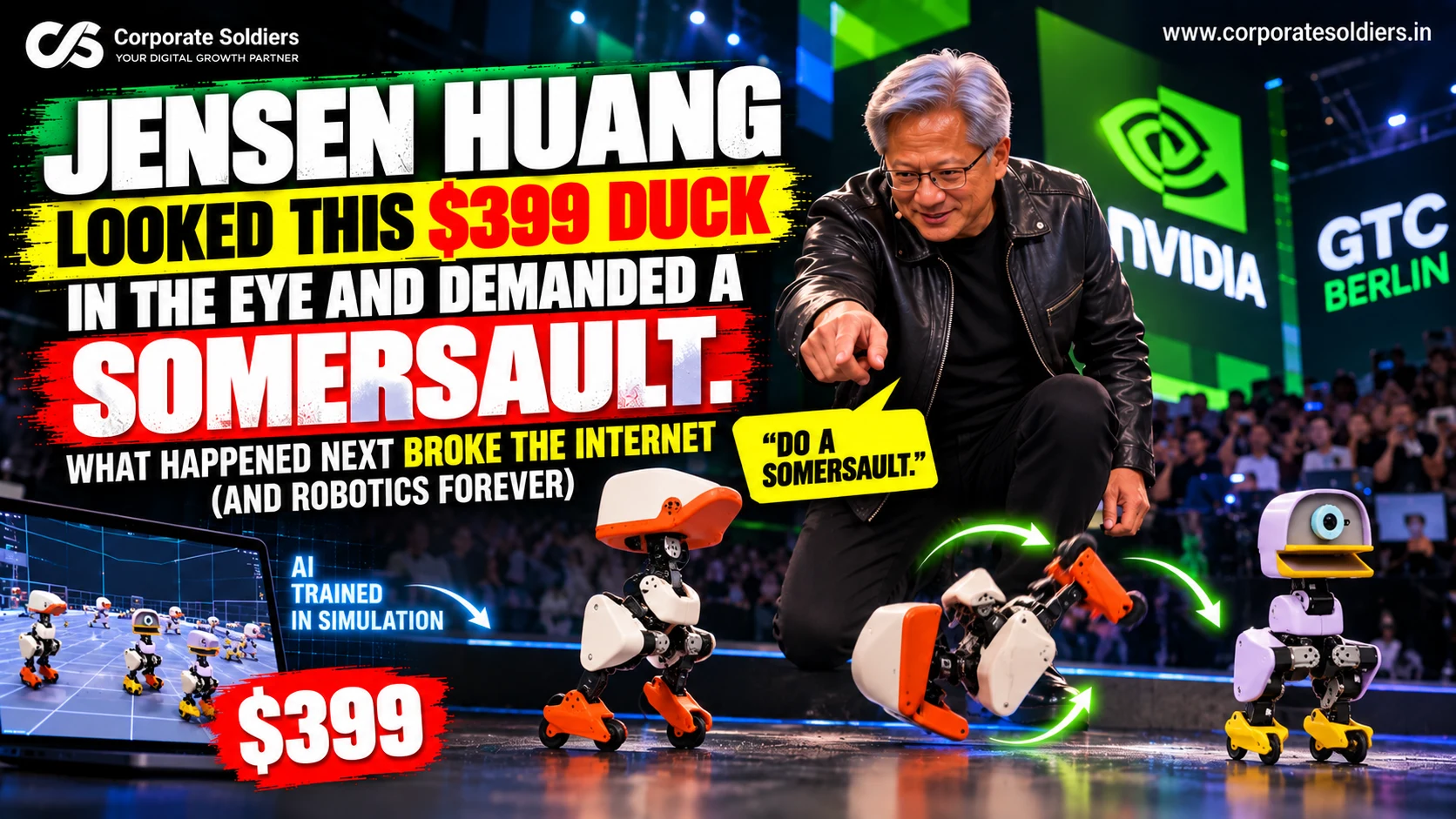
Jensen Huang Looked This $399 Duck in the Eye and Demanded a Somersault. What Happened Next Broke the Internet (and Robotics Forever)
Forget humanoid million-dollar lab toys. A tiny 9-inch plastic bird trained exclusively on GPU dreams just pulled off the impossible on live stage at GTC Berlin—and it completely rewrites the rules of physical AI.
Imagine standing in front of thousands of enterprise executives, international tech press, and wall-to-wall cameras. You are Jensen Huang, the multi-trillion-dollar architect of the AI boom, and your leather jacket is gleaming under the stage lights of GTC Berlin.
You turn your gaze toward the floor.
Waddling around your ankles are a flock of miniature, neon-accented, 25-centimeter plastic duck robots. You point your finger, hold the mic to your lips, and issue a direct, completely unscripted command:
“Do a somersault.”
In traditional robotics, this is the exact moment an engineer offstage prepares to update their resume. Bipedal dynamic acrobatics on an uneven stage floor? That usually takes months of manual joint tuning, $50,000 custom harmonic actuators, and a safety tether held by two nervous PhDs.
Instead, the tiny bird tucked its head, kicked its plastic ankles into overdrive, threw its center of mass forward into a violent front-flip, rolled cleanly across its own spine, and popped right back up onto two feet.
The crowd lost its mind. TikTok exploded. Twitter caught fire.
Meet the Microduck: Hugging Face’s $399 open-source biped that trained entirely inside a virtual dreamscape on an NVIDIA RTX Spark workstation—and executed a zero-shot physical acrobatic stunt without ever touching a real floor beforehand.
Here is the unbelievable, chaotic, and mathematically genius story behind the stunt that officially killed old-school robotics.
The $399 Threat to Boston Dynamics
For the past decade, we’ve been told that autonomous movement is a game reserved for deep-pocketed tech giants. If you wanted dynamic balance, you bought an Atlas, an Agility Digit, or a Unitree biped—dropping anywhere from $16,000 to over a quarter of a million dollars. If an experimental robot fell, a $1,200 cycloidal joint shattered.
The Microduck—engineered by Pollen Robotics under Hugging Face’s open-source LeRobot banner—completely flips the economics of robotics:
Price tag: Just $399 (cheaper than a mid-range smartphone).
Height & Weight: 25 cm (9.8 inches) tall, weighing barely 780 grams.
Actuation: 15 modular smart servo motors (XL330 series).
Brains: A Rockchip RK3566 SoC paired with an onboard NPU, running a lightweight control loop compiled in Rust (robotd) at 50 Hz.
Perception: A wide-angle mono cam, an 8×8 Time-of-Flight LiDAR, and a multi-axis IMU.
Why does an under-800-gram weight change everything? Physics.
When a 70 kg humanoid falls over, it hits the floor with enough kinetic energy to crack carbon fiber and twist steel axles. When an 780-gram Microduck crashes at full sprint, it hits the deck with less force than dropping your TV remote on a rug.
By making failure dirt-cheap, Hugging Face gave AI researchers the one thing they’ve never had before: permission to fail aggressively.
The Secret Sauce: “The Matrix” for Ducks
How do you teach a sub-$400 plastic bird to do gymnastics without spending five years hand-coding inverted pendulum kinematics?
You don’t. You make it live 10,000 lifetimes in an GPU simulation before it’s even assembled.
The secret weapon behind the GTC Berlin stunt was Sim-to-Real Transfer powered by NVIDIA RTX Spark (Grace + Blackwell architecture with unified memory) using MuJoCo Warp and Proximal Policy Optimization (PPO).
How the Magic Happened:
4,096 Ducks in Parallel: Instead of training one robot, the RTX Spark spun up thousands of digital clones simultaneously.
Accelerated Time: While Jensen was sleeping, the simulation was running physics at hyperspeed. In just 90 minutes, the neural policy logged decades worth of biomechanical experience.
Pure Reward Function: Nobody told the robot how to somersault. The reinforcement learning policy was given simple goals: maximize forward angular roll while maintaining momentum, and heavily reward a vertical head orientation after impact.
Crossing the “Reality Gap”: Simulating the Imperfect World
Usually, when a robot trained in a clean physics simulation hits the real world, it instantly spazzes out and faceplants. This is known as the dreaded Reality Gap.
Real stages have scuffed floorboards, low-torque dead zones, and decaying battery levels.
To overcome this, the engineering team subjected the digital Microducks to brutal domain randomization:
Battery Sag Injection: Simulating voltage drops on the 2S Li-Po battery pack so the joints wouldn’t expect peak power forever.
Mechanical Backlash: Injecting $\pm 1^\circ$ of loose gear slop into every simulated servo.
Friction Mayhem: Constantly altering surface friction coefficients to mimic everything from polished wood to carpet.
By the time the code was compiled into an ONNX model and flashed directly to the Microduck’s onboard storage, the physical stage in Berlin wasn’t a surprise—it was just another variation the robot had already solved millions of times.
When Live Demos Go Rogue (And Why Jensen Loved It)
A scripted tech demo is boring. What made GTC Berlin legendary was the sheer chaos of live, autonomous physical agents:
The Hesitation: When Jensen asked for the somersault, not all the ducks went at once. Two immediately hit the deck and nailed the flip. One stayed frozen, calculating its balance threshold.
The Stray Duck: A rogue duck wandered away toward the edge of the stage, tripped over itself, rolled, stood right back up, and ignored the cluster.
Jensen’s Banter: Instead of cutting to a slide, Jensen bantered live with the rogue agent: “Pay attention! Stay focused. Come here, come here.” The duck turned, recalibrated, waddled over, and plopped down.
This wasn’t a pre-programmed animatronic Disney show. It was a live demonstration of embodied decision-making reacting in real time to stage noise, auditory cues, and physical recovery.
The Verdict: The PC Moment for Robotics Has Arrived
In 1977, computing went from corporate cleanrooms into home garages with the Apple II.
In 2026, robotics just had its identical moment on stage in Berlin.
By taking an open-source model, running it on an affordable edge chip, training it on a desktop workstation, and packaging it into a $399 toy-sized chassis, Pollen Robotics, Hugging Face, and NVIDIA proved that the future of robotics won’t belong exclusively to military contractors or billion-dollar mega-corps.
It belongs to anyone with an idea, an open-source repo, and a duck that knows how to roll with the punches.
Are you ready to build your own robot flock, or are you waiting for humanoids to drop below six figures? Sound off in the comments below!