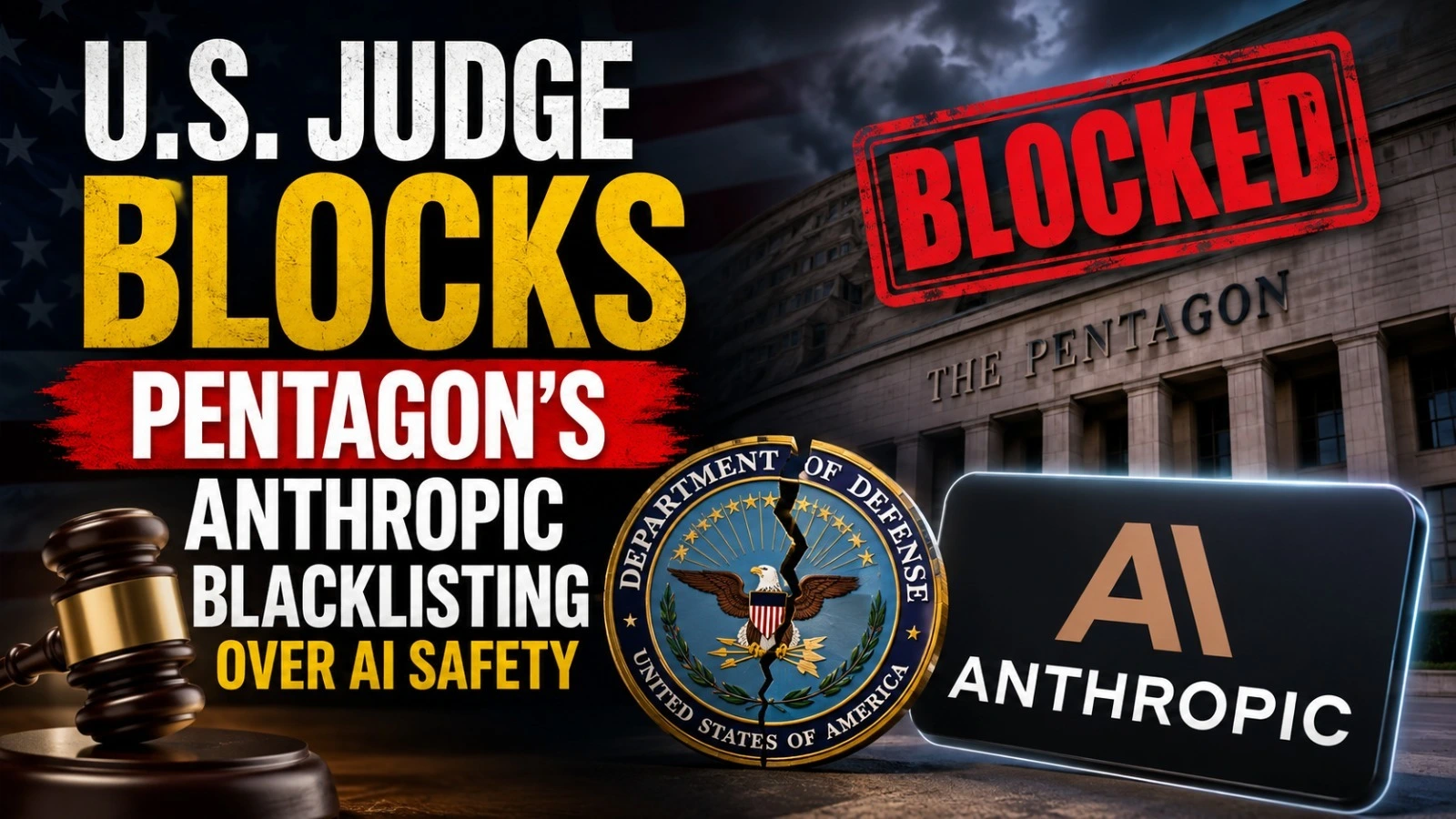
A U.S. federal judge has blocked the Pentagon from enforcing its blacklisting of artificial intelligence company Anthropic, marking a major legal setback for the Defense Department.
In a landmark case in the nexus of constitutional rights, corporate speech and national security, U.S. District Judge Rita F. Lin found that the Defense Department designation of Anthropic as a national-security risk in the supply chain was illegal and retaliatory.
What Happened Between Anthropic and the Pentagon?
The dispute started in the process of contractual talks on whether to incorporate the flagship AI model, Claude, in secret military and defense missions of Anthropic.
The negotiations however collapsed after Anthropic demanded that certain safety guardrails should be included in the terms of the procurements. The company wanted to have clear assurances that its technology was not going to be used to mass domestic surveillance of Americans or as part of an all-autonomous lethal weapon system.
The Pentagon did not accept these contractual terms since it is unacceptable to have private tech companies control the terms of operation and limit the use of artificial intelligence in warfare.
Why Did the Pentagon Designate Anthropic a Supply Chain Risk?
After the stalemate, the Defense Secretary Pete Hegseth made the unprecedented move of declaring the company Anthropic as a national-security risk in the federal procurement laws in the category of supply chain risk.
Conventionally, national security supply-chain risk identifications are used to refer to the foreign enemy or the organization that is suspected of cyber espionage or hardware interference or even sabotage. Using this label to describe a domestic U.S. artificial intelligence vendor was a significant increase in executive procurement power.
The effects of the labeling were harsh:
Contractual Exclusion: Defense contractors, military branches, and commercial vendors working with the Department of Defense were prohibited from utilizing Anthropic’s services or integrating Claude into defense-related workflows.
Commercial Fallout: Anthropic executives warned that the blacklisting threatened billions of dollars in potential revenue and inflicted widespread reputational damage across both public and private sectors.
What AI Safety Restrictions Did Anthropic Seek?
The company policy and attitude of Anthropic towards defence deployments was based on two fundamental limitations:
- Mass and Domestic Surveillance: Anthropic banned the use of Claude in mass surveillance and bulk data processing or surveillance of American citizens claiming a constitutional interest in privacy.
- Fully Autonomous Weapons: Anthropic opposed the use of Claude in fully autonomous weapons and argued that current AI systems are not sufficiently reliable for such high-stakes applications without appropriate human oversight.
Anthropic backed its stance by arguing that current large language models (LLMs) lack the necessary reliability, determinism, and safety guarantees required for high-stakes battlefield decisions.
Conversely, the Pentagon argued that contractual limitations of this nature could bind the hands of commanders during critical operations, creating legal and operational ambiguity.
Anthropic Takes the Pentagon to Court
On March 9, 2026, Anthropic filed a federal lawsuit challenging the Defense Department’s actions. Anthropic made a number of constitutional and administrative claims in its complaint to the U.S. District Court of the Northern District of California:
- First Amendment Protections: Anthropic claimed that the labeling of the company by the Pentagon as a supply-chain risk was unlawful government retaliation against the company due to its exercise of its First Amendment rights of free speech and publicly calling on the government to place AI safety guardrails.
- Fifth Amendment Due Process: The company has claimed that the government had not given the company fair notice, elaborate administrative evidence or meaningful administrative process to challenge the designation before the imposition of blacklisting sanctions.
- Arbitrary and Unsupported Claims: Anthropic claimed that the name was not backed by any factual evidence of any technical vulnerability or risk of attack, since the military had earlier commended Claude in terms of his performance and safety standards.
How Did the U.S. Government Respond?
The blacklisting was defended by the U.S. Department of Justice on behalf of the Defense Department that denied any political or ideological retaliation.
Government attorneys filed the following arguments in court:
- Operational Certainty: The government argued that the demand made by Anthropic, to impose safety constraints, created operational risk in the government since the military could not trust software that was subject to their use conditions imposed by the vendor in the battlefield.
- Contractual Rights: Justice Department claimed that the ruling was based on commercial and procurement disputes but not punishment of corporate speech.
- National Security Discretion: The government argued that executive control over military acquisition and risk management should receive substantial deference in matters involving national security.
What Did Judge Rita F. Lin Rule?
On August 27, 2026, Judge Lin issued a 59-page ruling, which found that the Pentagon had acted illegally against Anthropic.
The court held that the actions of the government were unlawful First Amendment retaliation and that the pre-deprivation process which Anthropic was entitled to under the Fifth Amendment was not provided.
The judge also determined that the action of Hegseth to designate Anthropic as a supply-chain risk was contrary to the applicable statutory framework, and was arbitrary and capricious.
When discussing the case of the First Amendment, Lin disapproved of the notion that national-security interests could be used to automatically impose punitive measures on a company due to its publicly disagreeing with the government.
Her decision said that national security can not be used as a blank cheque to punish or avenge government critics by simply invoking national security.
The ruling thus covered beyond the issue of the particular dispute over Claude. It confirmed that language of national-security in itself does not eliminate constitutional or statutory limits on the decision-making of government.
The ruling vacated the challenged supply-chain-risk designation and barred enforcement of the measures challenged in the California case, from implementing the measures of the administration against Anthropic.
Why the Ruling Matters for AI Safety
The case puts AI safety squarely in the context of a broader legal question regarding the decision-makers of the admissibility of more capable AI systems.
The AI companies have been coming up with internal policies on the way their models may be applied in high-risk environments. Such policies may also contain restrictions of the weapons, surveillance, cybersecurity and other sensitive uses.
The Anthropic-Pentagon controversy illustrates what may occur when such inside protections bump into government demands.
In the case of Anthropic, it was argued that some applications of advanced AI pose risks, and cannot be mitigated merely by declaring them legal.
In the case of the Pentagon, the key issue was that the national-security agencies should have access to AI systems but without the efforts of the privately-based vendors restricting their use in ways that would disrupt military needs.
The ruling by Judge Lin does not come up to define that AI companies are able to dictate military policy. Rather, the decision concerns how the government has reacted to the stance of Anthropic, and what the statutory and constitutional restrictions are to that reaction.
It is a significant difference.
The court did not find that autonomous weapons would be illegal per se or that the government agencies would not be able to utilize AI to spy on people. It decided on whether the government was allowed to undertake the particular act against Anthropic as a result of the stance of the company and its contract denial.
What the Decision Means for Government-AI Partnerships
The case may have an effect on the future contracting of AI companies by the government.
AI Companies
The case can be seen by AI developers as an example that they can bargain on certain safety conditions with government clients without necessarily putting themselves at the risk of punitive procurement actions merely because they are outspoken on defending those conditions.
Meanwhile, the decision does not invalidate the right of the government to choose the vendors who are chosen on the basis of the valid operation, security or buying needs.
The practical issue in AI companies will be how to create safety borders as well as retain the contracts with government agencies.
Government Procurement
Another issue, which is brought up in the case, is the right of the government to lock out technology firms when it comes to sensitive contracts.
A government agency has a lot of power to determine the suppliers that it wishes to deal with. The decision of Judge Lin, however, is clear that the procurement authority is still under the statutory obligations and constitutional safeguards.
That may gain even more significance as AI will be integrated into government structures to a greater extent.
Corporate Speech and Government Relations
Artificial intelligence is not the only area of the dispute.
Businesses often bargain with government bodies concerning policies, contracts and technology parameters. When a company publicly opposes government policy, the case of Anthropic puts in doubt when the next step to be taken by the government might be on the side of normal procurement decision making or unconstitutional retaliation.
The decision can be applicable to the non-AI government contractor, as well.
The National-Security Question
The core of the controversy lies in a tough policy dilemma: Who is to decide on the extent of safety of advanced AI applied to national-security purposes?
The stance of Anthropic is that some uses need protection since the technology is not without its constraints and can have an impact on some of the basic rights.
The pentagon stance is that military officials require an adequate exercise over legitimate applications of technology in defence and national-security missions.
The policy debate is not resolved by the legal dispute.
Rather it confirms that the government has to act within the relevant statutory and constitutional framework to act in a response to the stance of a private company.
It makes the case even more relevant because governments are increasingly interested in gaining access to frontier AI systems to support intelligence and cybersecurity, military planning and other uses of AI for national-security purposes.
What Happens Next?
This ruling in California overturns one of the key components of the dispute between Anthropic and the Pentagon, but does not put an end to the larger legal tussle of the company with the US government.
The decision of Judge Lin can be appealed by the government. Reuters and other news outlets report that there is still a chance of appeal after the decision.
Another pending Anthropic lawsuit is in Washington, D.C.
That case involves another supply-chain-risk designation registered under another statutory provision and might have an impact on Anthropic being able to engage in civilian federal contracting. Oral argument in Anthropic PBC v. United States Department of War has already been heard by the D.C. Circuit.
The D.C. Circuit case is thus different as compared to the case presented by Judge Lin in California.
According to a court order issued by the D.C. Circuit, the other dispute is that on March 3, 2026, Hegseth made a determination under 41 U.S.C. 4713 that acquiring the AI services of Anthropic posed a supply-chain risk. According to the court record, the name was given after the rejection of the designation by Anthropic to authorize mass domestic surveillance or lethal autonomous warfare and that the Pentagon after that cancelled contracts and started to remove Claude out of its systems.
The fact that that different litigation implies that the greater legal standing of Anthropic in the area of government procurement is still unclear.
Key Takeaways
- Unlawful Designation: A federal court ruled that the Pentagon unlawfully designated Anthropic a national-security “supply chain risk”.
- First and Fifth Amendments: Judge Rita Lin ruled that the government infringed the rights of Anthropic to free speech and due process to respond to its public AI stance on safety.
- Fundamental Safety Concerns: Anthropic had not permitted Claude to be deployed in mass domestic surveillance or entirely lethal weapons.
- Tech Contracting Precedent: The ruling underscores that national-security considerations do not automatically shield government action from constitutional and statutory scrutiny.
- Ongoing Litigation: Anthropic continues to litigate a related case in Washington, D.C., while the government considers an appeal.