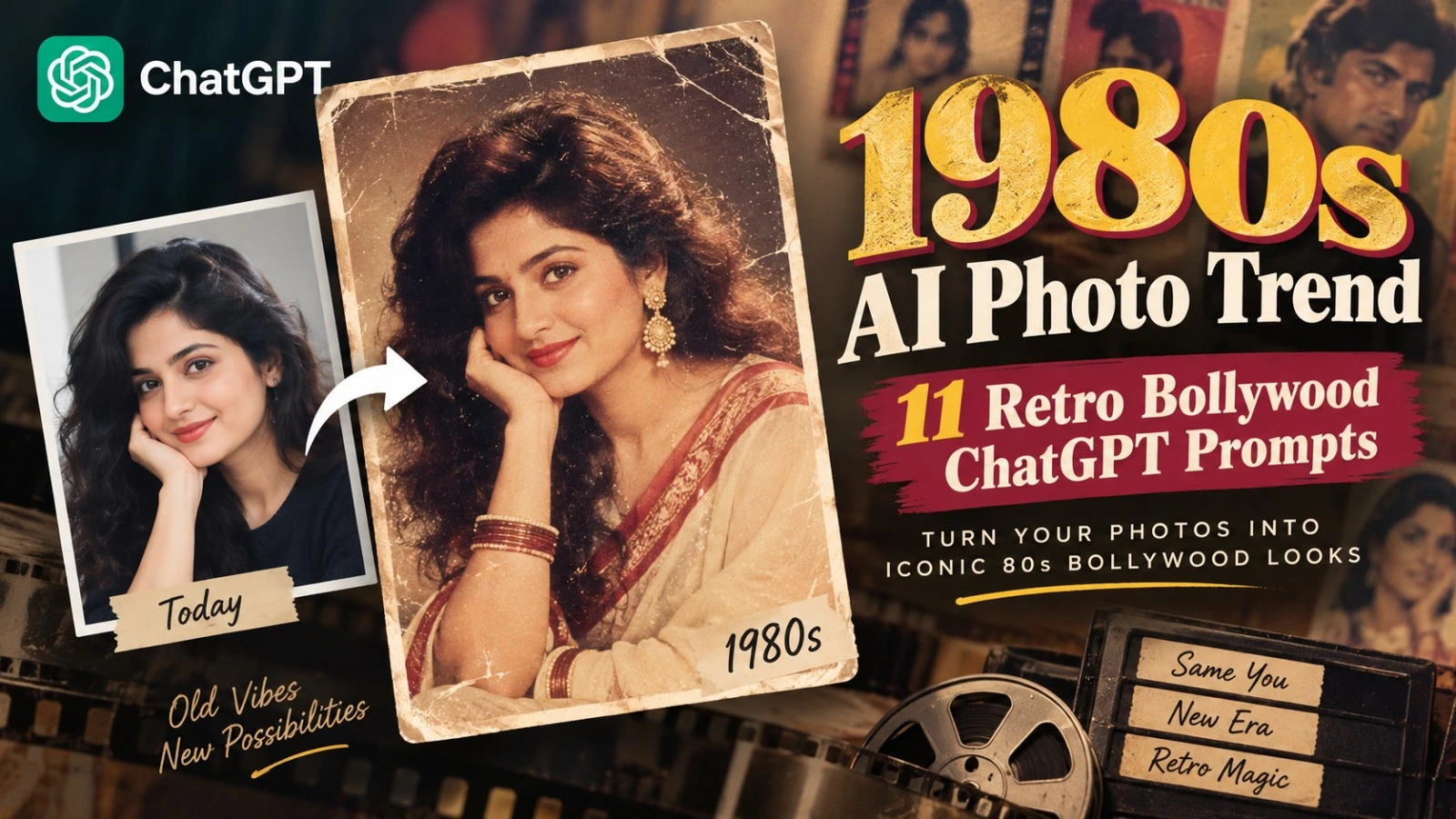
The 1980s AI photo trend is transforming modern photographs into retro Bollywood-style pictures with ChatGPT. Users on Instagram and other social platforms can recreate period hairstyles, clothes, lighting, colours and film textures without relying on professional photo-editing abilities.
The Times of India announced 11 methods of trying the trend on September 9, including traditional portraits of Bollywood heroines and heroes, imaginary film posters, wedding-album pictures and fake 35mm movie frames. Its simplicity lies in the fact that the users can post a clear photograph and explain the kind of hairstyle, clothing, lighting, background and general 1980s appearance they desire.
The Indian Express has also reported on the 1980s AI-photo trend and its spread across social media.
What Is the 1980s AI Photo Trend?
At its simplest, the 80s photo trend involves giving a modern photograph to an image-generation system and asking it to reinterpret the image using visual cues associated with the 1980s.
Such indications might be full or puffed hairstyles, period attire (sarees and other), flared pants, studio makeup, warm colouring, soft focus and film grain. The image which results can be like a Bollywood publicity portrait, a family snapshot, a wedding-album snapshot, a movie magazine cover or a movie poster.
The key difference is that the final picture is a contemporary AI artwork, rather than a photo of the 1980s. Visual characteristics such as 35mm film, film grain or old-print texture describe the intended appearance of the image; they do not establish how or when the image was actually created.
According to the Times of India article, the trend has been gaining popularity on Instagram and additional skills in professional photo-editing are not necessary. The user can start with a clear photograph and provide ChatGPT with prompts describing the hair, clothing, lighting, background and overall period look they want.
How ChatGPT Is Being Used
The current ChatGPT Images will allow one to generate images as well as editing existing ones. Documentation of OpenAI states that it is possible to upload a pre-existing image and explain the changes desired by the user, and generated images can be further edited with further instructions or via selected areas.
To transform a basic workflow into a retro Bollywood transformation, the following is all that is required:
- Open ChatGPT with image-generation or image-editing capabilities.
- Upload a clear photograph.
- Describe the 1980s Bollywood look you want.
- Specify the clothing, hairstyle, lighting, setting and photographic texture.
- Where appropriate, ask ChatGPT to preserve the person’s recognisable facial features and identity.
- Review the result for unwanted changes.
- Refine the instructions if specific elements are incorrect.
- Carefully inspect the final image before sharing it.
The actual interface and features may evolve over time, thus users need to adhere to the existing ChatGPT Images workflow that will be available to their account. Image creation and editing is now documented on web and mobile by OpenAI.
11 Retro Bollywood AI Photo Styles
The 11 concepts that the Times of India have come up with demonstrate the extent to which the same photograph can be construed based on various visual guidelines. The following are the descriptions of those concepts in original words instead of replicating the prompts of the publication.
- Classic Bollywood Heroine Portrait
This re-creates the refined studio portrait that goes with a typical 1980s Bollywood heroine.
An appropriate invitation may request a big, full period hairstyle, a pure silk saree, earrings in gold and design studio makeup. Warm retro lighting, subdued film grain and slightly desaturated colours can help to reinforce the period look.
One such tip is to not substitute the person with a new face but to preserve the recognisable features of the subject.
Copy-and-paste prompt: “Transform this photo into an early-1980s Bollywood heroine studio portrait. Keep my facial features, face shape, skin tone and identity recognisable. Add a voluminous period hairstyle, a silk saree, gold jewellery and soft studio makeup. Use warm vintage lighting, subtle 35mm film grain and slightly faded colours. Avoid modern clothing, accessories and objects.
- Retro Bollywood Hero Look
The male counterpart employs a number of common period indicators: a well-groomed hair, a shirt worn loosely or tucked in high-waisted pants, a thick moustache and an old wristwatch.
The portrait can be made to look like a vintage cinema publicity photograph by warm studio lighting, soft shadows, muted colours and the imitation of 35mm grain.
This is not about imitating a specific actor but rather the revival of the larger visual vocabulary of a time Bollywood hero portrait.
- 1980s Disco Heroine Look
For a more dramatic version, the prompt can adapt the photograph to an 1980s Bollywood disco setting.
The appearance can be achieved by use of sequins, feathered or period-appropriate hair, strong makeup and coloured lighting on the stage. The cinematic effect is further enhanced by reflections, haze, and a colourful background, in a nightclub style.
The colour treatment can combine the vividness associated with disco imagery with the slightly softened, aged appearance of an older film photograph.
Copy-and-paste prompt: Make this picture look like a disco in 1980s Bollywood. Keep my familiar face and name. Add a colourful sequinned outfit, hairstyle and make-up of the time, colourful stage lights, reflections, soft haze and a bright disco backdrop. Add a touch of softened, aged film colours to the picture and make it look like a vintage film.
- Vintage Indian Film Magazine Cover
This variation turns the photograph into a fictional Indian film-magazine cover inspired by the 1980s. Period clothing, hair and makeup can be combined with dramatic lighting, a colourful studio background, aged print texture and fictional headlines.
One should not place the name or branding of a real magazine unless he/she has a valid reason and permission. An imaginary magazine cover is a design that has the exercise firmly rooted in the world of AI-generated art.
Copy-and-paste prompt: “Turn this photo into a fictional 1980s Indian Bollywood film-magazine cover. Preserve my recognisable facial features and identity. Use period clothing, hairstyle and makeup, a colourful studio background, dramatic lighting and an aged-print texture. Add a fictional magazine layout and fictional headlines. Do not use real magazine names, logos or real celebrity identities.”
- 1980s Indian Wedding Album Photograph
The wedding-album version recreates the look of an older Indian wedding photograph using traditional clothing, jewellery, garlands, a simple studio backdrop, direct flash, soft focus, faded colours and film grain.
Copy-and-paste prompt: “Transform this photo into a traditional Indian wedding-album photograph from the 1980s. Preserve the recognisable faces and identities of everyone in the image. Add period-appropriate wedding clothing, jewellery, garlands and a simple studio backdrop. Use direct camera-flash lighting, soft focus, slightly faded colours and realistic film grain. Avoid modern objects and styling.”
- Sepia Family Album Portrait
The style replicates the personal appearance of an older Indian family photograph with the help of period clothing, minimal interior setting, warm natural light, slight grain, softness and old print texture.
Copy-and-paste prompt: Turn this photo into an old Indian family-album portrait, 1980s. Keep the faces and identities of the individuals in the photo. Use period clothes, a modest interior, warm natural light, slight film grain, slight softness and texture of old printed photos. Delete obvious modern elements, hair, clothing styles.
- Grainy 1980s Film-Camera Portrait
This difference is geared towards the aesthetic features of 1980s 35mm film photography, such as film grain, muted colours, low contrast, low highlights and natural light.
Copy-and-paste prompt: “Re-create this photograph as a realistic 1980s Indian 35mm film-camera portrait. Keep my natural facial features and identity. Use realistic-looking film grain, slightly degraded colours, low contrast, subtle highlights and natural light. Compose it like an old Indian family or studio portrait.”
Simulating 35mm characteristics does not mean the resulting image was actually photographed with a 35mm camera.
- Saree and Bouffant Heroine Appearance
This style focuses on the fashion associated with early-1980s Bollywood heroines, particularly bouffant hairstyles, colourful printed sarees, simple gold jewellery and period makeup.
Copy-and-paste prompt: “Transform this photo into an early-1980s Bollywood heroine portrait. Preserve my facial features and identity. Add a large bouffant hairstyle, a colourful printed saree, simple gold jewellery and period-appropriate makeup. Use a warm studio background, soft cinematic lighting, faded colours and subtle 35mm film grain. Avoid contemporary styling and accessories.”
- Kurta and Flared-Trousers Hero Look
This version gives a retro male look of a period style kurthood, flared pants, parted hair and an old watch.
Copy-and-paste prompt: Turn this photo into a vintage early-1980s Bollywood hero portrait. Keep my face and identity recognisable. Add a vintage kurthood, flared jeans, parted hair and an old watch. Use a basic studio setup, warm lighting, muted or a little de-saturation film colours and natural 35mm grain. Do not copy a particular actual actor.
- Hero-Heroine Duet Poster
The duet-poster concept combines two people in the style of a fictional 1980s Bollywood movie poster, using period clothing, hairstyles, dramatic poses, colourful illustrated backgrounds and hand-painted poster aesthetics.
Copy-and-paste prompt: “Combine these two photographs into a fictional 1980s Bollywood movie poster. Preserve both people’s recognisable facial features and identities. Give them period clothing, hairstyles and dramatic cinematic poses. Add a colourful illustrated background, hand-painted Indian cinema poster aesthetics, vintage typography, a fictional movie title and fictional character names. Do not reference a real 1980s movie or real celebrity.”
- Retro Film-Reel Portrait
The culminating idea is what makes the photograph look like a frame in a 1980s Indian movie, the amber light, the soft vignetting, the style of the period, the softness, the grain and the slight scratches.
Copy-and-paste prompt: Create a movie frame out of a fake 1980s Indian Bollywood movie. Retain my facial features and identity. Use period clothes and hairstyle, warm amber light, gentle vignetting, slight softness, visible 35mm film grain and slight film scratches. The result should still be presented as a modern AI recreation.
How to Create 1980s AI Photos With ChatGPT
Among the key lessons of the Times of India report is the fact that specificity is important. An instruction such as ‘make this photo look 80s’ leaves many visual choices unstated. A more specific prompt provides the image-generation system with a better idea of what characteristics to aim at.
- Dress: Indicate whether the subject should be in a saree, kurta, flared trousers, sequinned outfit or any other period-specific outfit.
- Hairstyle: Include details like a bouffant, side-parted hair or a fuller period hairstyle as opposed to just stating that the hair is old-fashioned.
- Lighting: Determine the desired lighting, like warm studio, flash of the camera, soft film light or coloured disco-stage light.
- Background: Determine whether the photograph is to be of a studio portrait, wedding album, film-magazine cover, disco scene or movie poster.
- Photography features: Add simulated 35mm grain, faded colours, soft focus, scratches on the film or texture of an analogue print.
This structured approach is not a guarantee of historical accuracy. Generative AI may have different interpretations of instructions compared to that of the user, and the output can have visual anomalies. However, more specific guidelines can provide the system with more information regarding the desired composition and aesthetic.
The image can also be refined by the users even after the first generation. The existing documentation of OpenAI states that it is possible to edit existing images with additional instructions, including targeted edits with the help of the selection tool.
Things to Check Before Sharing AI Photos
A persuasive retro image ought to be scrutinized prior to going online.
The Times of India, in particular, cautions that portraits created by AI may include flaws in such areas as fingers, jewellery, text being visible in the background.
The users should then analyse:
- Hands and fingers
- Jewellery and accessories
- Facial details
- Patterns and edges of clothing.
- Background objects
- Text in print or writing.
- Unexpected modern objects
- Disagreements among various individuals in one image.
A special emphasis should be given to text when designing an imaginary magazine cover or movie poster. A headline produced using AI may seem realistic when viewed but have spelling mistakes, misshapen characters or nonsensical lettering.
Avoid Sensitive Information
Users need to be careful of the photographs they post too.
The best thing to do is to avoid pictures with identity documents, financial data, passwords, confidential documents or sensitive business data. A photograph does not have to include a document to disclose personal information; backgrounds, screens, addresses and other background information can also be important.
OpenAI’s current Data Controls documentation says personal ChatGPT users can turn off ‘Improve the model for everyone’ under Settings → Data Controls. When the setting is turned off, conversations remain in chat history but are not used to train ChatGPT.
It is reasonable to have a look at the existing privacy and data-control settings prior to uploading photographs that include personal or confidential information.
Consider Consent Before Transforming Someone Else’s Photograph
Any alteration of an image of another recognisable individual, especially when it is to be published publicly, used in business or shown in a deceptive manner, can result in issues of privacy and consent.
It is important to consider whether an individual has consented to the use of his or her photo before editing or sharing it. This is very critical when the image has gone beyond being a personal experiment to the public, commercial or even a falsity.
Legal rules may be different in rules of jurisdiction, and consent is an expedient protection, not a legal consultancy.
Why the Trend Is Spreading on Social Media
It is especially an Instagram and visuals format since the change is simple to observe. The reinterpretation of a modern photograph is possible by utilizing nostalgic fashion, Bollywood imagery and analogue-type photography, allowing a user to experiment with the same source image in different ways.
The trend is a mix of various attractions:
Nostalgia: It re-creates visual attributes related to the Indian film, fashion and family photographing of the era.
Self identity: The users are able to insert themselves or friends in a fancied 1980s Bollywood environment.
Bollywood culture: heroine portraits, hero publicity shots, disco scenes and hand-painted posters are readily recognisable visual types.
Participation: The identical photograph of the source can yield various outcomes with regard to the prompt.
Shareability: The differences between the original photo and the retro AI version are simple to perceive on a social-media feed.
The spread of the trend in social media has also been covered by the Indian Express, as the trend is part of the wider appeal of AI-generated nostalgic imagery.
The Technology Behind the Trend
At a slightly lower level, the algorithm entails utilizing a pre-existing image and combining it with natural-language instructions. The picture uploaded gives details regarding the topic, whereas the prompt is the description of the desired changes. The input of the images in the image-generation system then creates a new image.
Generative image editing can modify or add visual information, such as clothing, light and backgrounds, and attempts to preserve some of the preferred qualities of the original image, in comparison with a more traditional colour or contrast filter.
The current Images documentation of OpenAI confirms that ChatGPT can edit images uploaded and that the user can refine the output by providing additional instructions.
There are still limitations in the technology. The created images may contain deformed hands, jewellery, details of clothes or background texts and hence it is never a bad idea to review the final output prior to sharing.
An AI Recreation Is Not a Historical Photograph
The most important distinction in the 1980s AI photo trend is between looking old and actually being old.
The pictures created by an AI may resemble washed-out colours, motion picture grain, scratches, blurry focus, old clothes and archaic light. All these characteristics are not a testimony to the fact that this picture was really painted in the 1980s.
The Times of India suggest displaying the finished image as an AI reconstruction, but not as an original photograph of that decade. When it is shared online, it is best to label the content as AI-generated, AI recreation or AI-generated in a 1980s style in order to conserve that context.
Final Takeaway
The trend of AI photos created in the 1980s demonstrates a way visual generation of nostalgia can be recreated as an interactive technology with the help of generative image tools.
The 11 styles enumerated by the times of India cover the portraits of the Bollywood heroines and heroes to the wedding albums, magazine covers, disco scenes and fictitious movies posters. An image-generation system can be customized by users to reinterpret what they want by specifying not only the desired wardrobe, hairstyle, lighting, setting and photographic qualities but also the desired wardrobe.
Good results are necessitated by some prompts, thought of the images created and correct use of photographs. In the case of other people, consent issues and AI-generated recreations should be specified in order not to be misunderstood and confounded with real historical photographs.