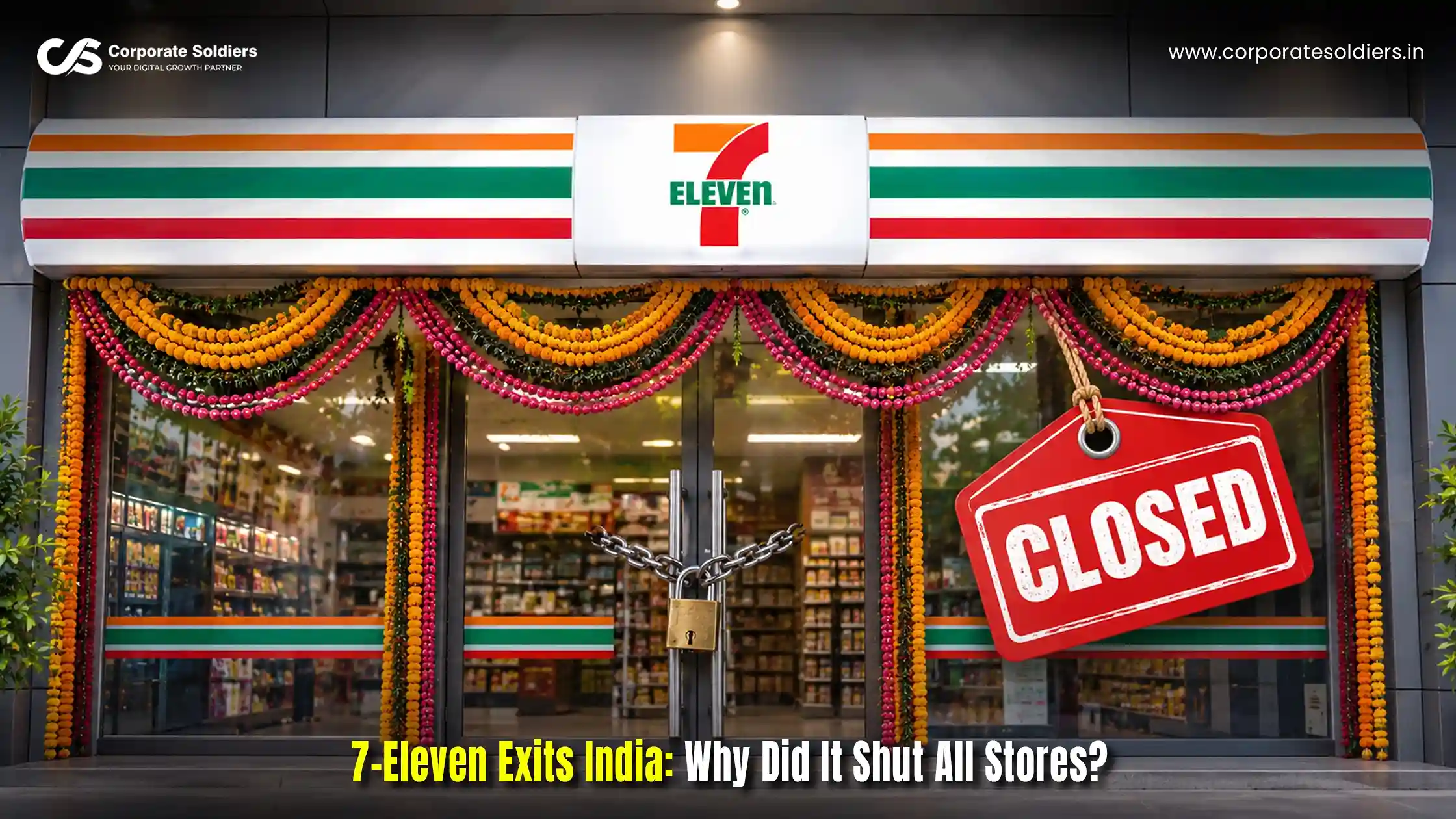
7-Eleven exits India after nearly five years in the market, with its remaining stores shutting down amid intense competition in the country’s convenience retail sector. The Japanese convenience-store giant entered India with Reliance Retail in 2021, but its network never reached the scale needed to establish a profitable nationwide presence.
The convenience-store chain of Japan in India was closed on September 30, 2026, covering 31 outlets. Seven & i Holdings, its Japanese parent company, confirmed the closures. The development marks the end of the chain’s current India operations, but not necessarily the end of its ambitions in the country.
Why Did 7-Eleven Exit India?
Despite the power of its global brand, 7-Eleven struggled to carve out a sustainable market share in India. While parent company Seven & i Holdings has not issued an official reason for closing its stores, reports from Japanese outlets Nikkei and Yomiuri highlight fierce competition from local Indian retailers.
The convenience giant found itself caught between market extremes. One reason could be the traditional Kirana stores functioning in India since old times. Another reason could be ultra-fast quick-commerce delivery apps, which have redefined consumer expectations by delivering essentials in minutes. For a physical convenience store chain, balancing local pricing with instant convenience proved too steep a hurdle.
How Many 7-Eleven Stores Were There in India?
7-Eleven’s Indian network reached approximately 60 stores at its peak, according to a Seven & i Holdings spokesperson cited by AFP. The chain initially expanded through Reliance Retail after signing a licensing agreement in 2021. However, the network later contracted.
By September 30, only 31 stores remained, all of which were subsequently closed. The final outlets were located in Mumbai and Pune. This means the chain’s Indian experiment ended with roughly half of its peak store network still operating.
What Happened to 7-Eleven’s India Business Financially?
The financial numbers help understand the difficulty of scaling this business. The 7-India Convenience Retail venture reported approximately ₹92 crore in revenue and a net loss of nearly ₹90 crore for the financial year ended March 2026, as reported by The Economic Times.
These figures highlight the challenge of building a profitable organised convenience-store network in India. Physical stores carry all expenses, which include rent, employees, inventory, refrigeration, logistics, and other operating costs. To make the model work, retailers generally need customer traffic and sales productivity across a dense store network.
7-Eleven’s relatively small Indian footprint made that scale harder to achieve.
Did Quick Commerce Hurt 7-Eleven in India?
Quick commerce is an important part of the changing Indian retail landscape, although it would be too simplistic to describe it as the sole reason for 7-Eleven’s exit.
India already has an extensive network of kirana stores, while platforms offering rapid delivery have expanded the range of products consumers can receive without visiting a physical store.
As reported by The Economic Times, convenience stores face pressure from both sides: neighbourhood retailers with lower overheads and quick-commerce companies competing for the same immediate-purchase occasions.
That creates a difficult proposition for organised convenience retail. A consumer looking for snacks, beverages or everyday essentials can choose a nearby kirana store or increasingly order those products online. A physical convenience chain must therefore offer enough differentiation to justify its location, pricing and operating costs.
Is 7-Eleven Leaving India Permanently?
Not necessarily. Seven & i Holdings has indicated that it continues to aspire to serve customers in India and will explore different options to develop its presence in the country over the long term.
So, the September 2026 shutdown should be described as the end of 7-Eleven’s current India store network and Reliance Retail arrangement, rather than proof that the brand has permanently abandoned the Indian market. A future return could involve a different partner, business model, or store strategy.
What Does the 7-Eleven India Exit Mean for Retail?
The 7-Eleven India exit is more than the closure of a global convenience-store brand. It highlights just how challenging India’s retail market can be, even for internationally recognised companies with established business models.
The combination of kirana stores, organised retailers and fast-growing quick-commerce platforms has created an intensely competitive environment. Consumers have more choices than ever, making convenience, pricing, location and speed critical factors in winning and retaining customers.
For global retailers, the lesson is clear: success in India requires more than a strong international brand. Companies must adapt their store formats, pricing, supply chains and expansion strategies to local consumer habits.
While the current 7-Eleven India operations have come to an end, Seven & i Holdings has not completely closed the door on the market. A future return could involve a new partner, a different retail format or a more carefully targeted expansion strategy.
For now, however, the exit stands as a reminder that India’s convenience retail market rewards local understanding, operational scale and adaptability. Whether the global retailer gets another opportunity to rewrite its India story remains to be seen.