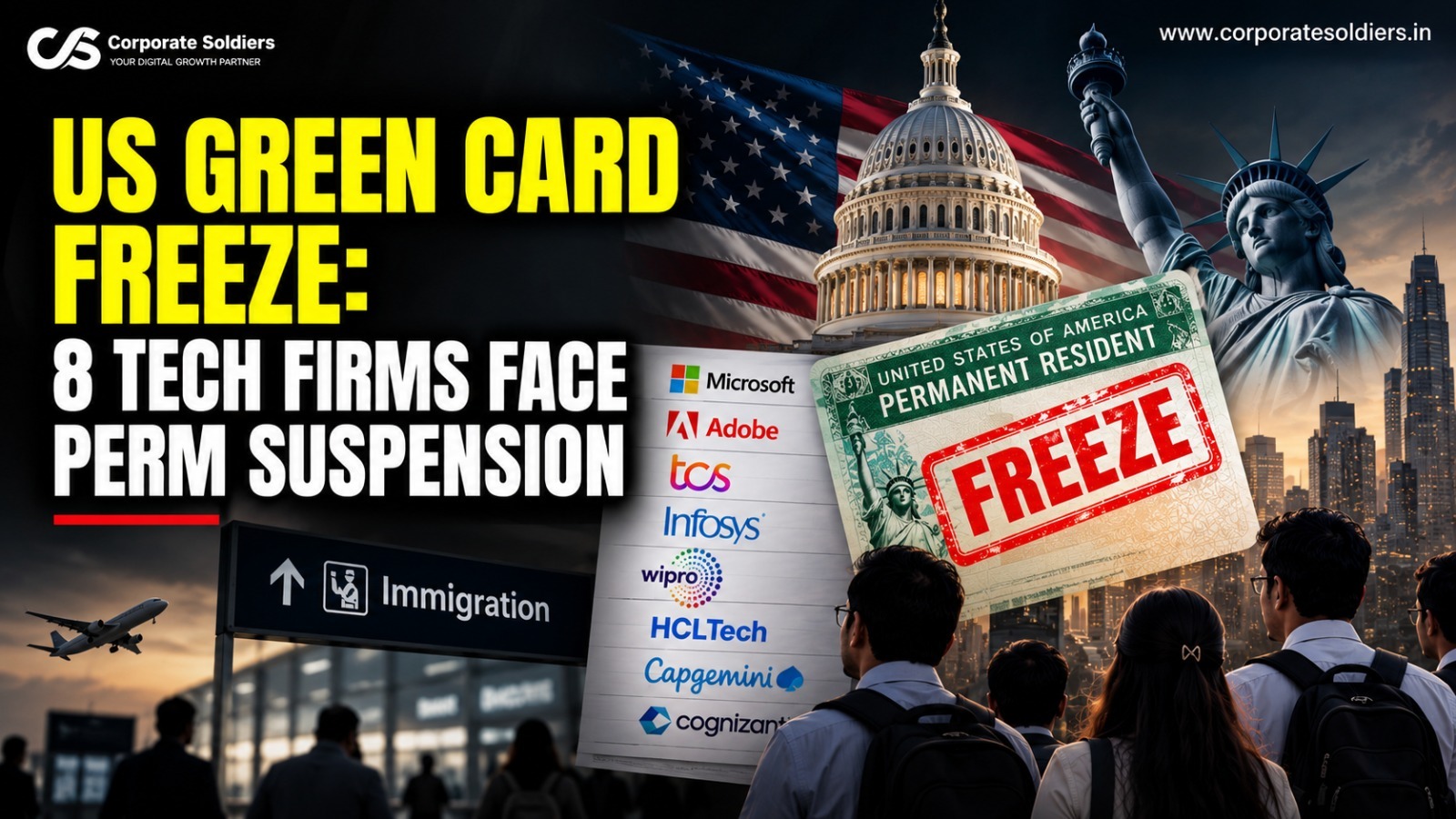
The US green card freeze affecting eight major tech companies has raised concerns for Indian IT professionals seeking permanent residency. Announced on October 8, 2026, the suspension targets new and pending PERM labour certification applications involving companies including TCS, Infosys, Wipro, and HCL Technologies.
TCS expects zero major disruptions to its hiring strategy or customer projects following the US PERM hold.
Why Has the US Suspended Eight Tech Companies?
The Trump administration says the suspension is intended to address alleged misuse of employment-based immigration programmes and protect American workers from unfair competition.
US Vice President JD Vance and Labor Secretary Keith Sonderling announced the measure on October 8. The action covers Microsoft and Adobe, along with six major IT services companies, including Indian IT giants TCS, Infosys, Wipro and HCL Technologies. The administration has accused some employers of using immigration programmes in ways that disadvantage American workers. These remain government allegations and should not be treated as proven wrongdoing by every company named.
Microsoft disputed the characterisation of its hiring practices. Microsoft said that approximately 80% of its H-1B applications in the most recent fiscal year were intended to extend or change the status of existing employees rather than recruit new workers.
This figure reflects Microsoft’s statement and should not be generalised to all eight companies.
Which Eight Companies Are Affected by the US Green Card Freeze?
The US Department of Labor has paused Permanent Labor Certification (PERM) applications for several major technology and consulting firms.
The affected employers include:
- Microsoft
- Adobe
- Cognizant
- Infosys
- Tata Consultancy Services (TCS)
- Wipro
- HCL Technologies
- Capgemini
The measure specifically concerns PERM applications involving these employers. It should not be interpreted as a blanket ban on all foreign workers employed by these companies.
What Is PERM, and How Does the Suspension Affect Indian Workers?
Permanent Labor Certification (PERM) is a mandatory U.S. Department of Labor (DOL) requirement for employers sponsoring foreign talent for employment-based green cards.
To obtain PERM certification, employers must demonstrate that there are no sufficient, able, willing and qualified US workers available for the position and that hiring a foreign worker will not adversely affect the wages and working conditions of similarly employed US workers.
This U.S. green card processing freeze directly affects foreign professionals, particularly Indian tech talent, whose permanent residency applications rely on these employers.
Workers with pending PERM applications face delays and uncertainty while the suspension remains in effect. And employees awaiting initial sponsorship will encounter significant barriers to beginning the green card process while the suspension remains active.
Importantly, the Labor Department‘s directive does not automatically revoke existing H-1B visas or cancel green cards already issued. The scope of the decision is strictly tied to the PERM certification pipeline, with individual consequences depending on a worker’s current immigration status and application phase.
Why Does TCS Expect No Major Impact?
1 Minimal Operational Impact
TCS expects no material disruption to its workforce strategy or client projects, noting its PERM filings totaled in the single digits over the past two years.
2 Expanded US Hiring
The company reaffirmed its commitment to recruit 15,000 local employees in the US over the next five years.
3 Focus on Local Recruitment
By prioritizing local hiring and campus drives in the US, TCS limits its reliance on PERM sponsorship.
4 Uncertainty for Foreign Staff
Despite low overall corporate risk, employees awaiting PERM approvals or planning green card applications still face potential delays.
Will the US Green Card Suspension Affect the Indian IT Industry?
1 Limited Financial Impact
Indian IT firms accounted for less than 2% of PERM filings between October 2024 and September 2025, according to ICICI Securities research cited in reports.
2 Employee Uncertainty
Foreign professionals awaiting PERM decisions may face delays and uncertainty over permanent residency.
3 Retention Challenges
Prolonged restrictions could make it harder for IT companies to retain skilled employees seeking long-term US residency.
4 Local Hiring Continues
Indian IT firms increasingly hire locally in the US, but this does not eliminate the need for employer-sponsored green cards.
5 Long-Term Workforce Impact
If the suspension continues, companies may need to reassess recruitment, employee retention, and workforce planning strategies.
What Indian IT Professionals Should Do Next?
1 Verify Your Case Status
Check directly with your employer’s immigration team to see if your PERM application is unfiled, pending, or certified.
2 Review Visa & Work Authorization
Track your current visa (e.g., H-1B) and work authorization expiration dates independently from your green card status.
3 Consult Immigration Legal Experts
Seek guidance from your employer’s immigration counsel or a qualified U.S. immigration lawyer to explore alternative options.
4 Exercise Caution Before Job Switching
Do not assume an existing green card application transfers automatically to a new employer—transfer rules depend strictly on your application’s current stage.
5 Track Official Updates
Follow the U.S. Department of Labor announcements closely and confirm details with your employer before making major career or relocation moves.
What Happens Next?
The broader implications of the PERM suspension are set to impact individual foreign workers far more than IT companies’ short-term bottom lines. According to ICICI Securities reporting via Reuters, Indian tech firms represented under 2% of total PERM filings between October 2024 and September 2025, signaling minimal risk to immediate corporate revenue.
However, the pause introduces serious long-term hurdles for employee retention and investor sentiment. While tech giants have steadily expanded local U.S. hiring, that strategy cannot replace employer-sponsored green cards for eligible international staff.
As long as these restrictions persist, affected workers face growing uncertainty around their long-term residency plans, forcing IT firms to re-evaluate their recruitment and talent retention strategies.