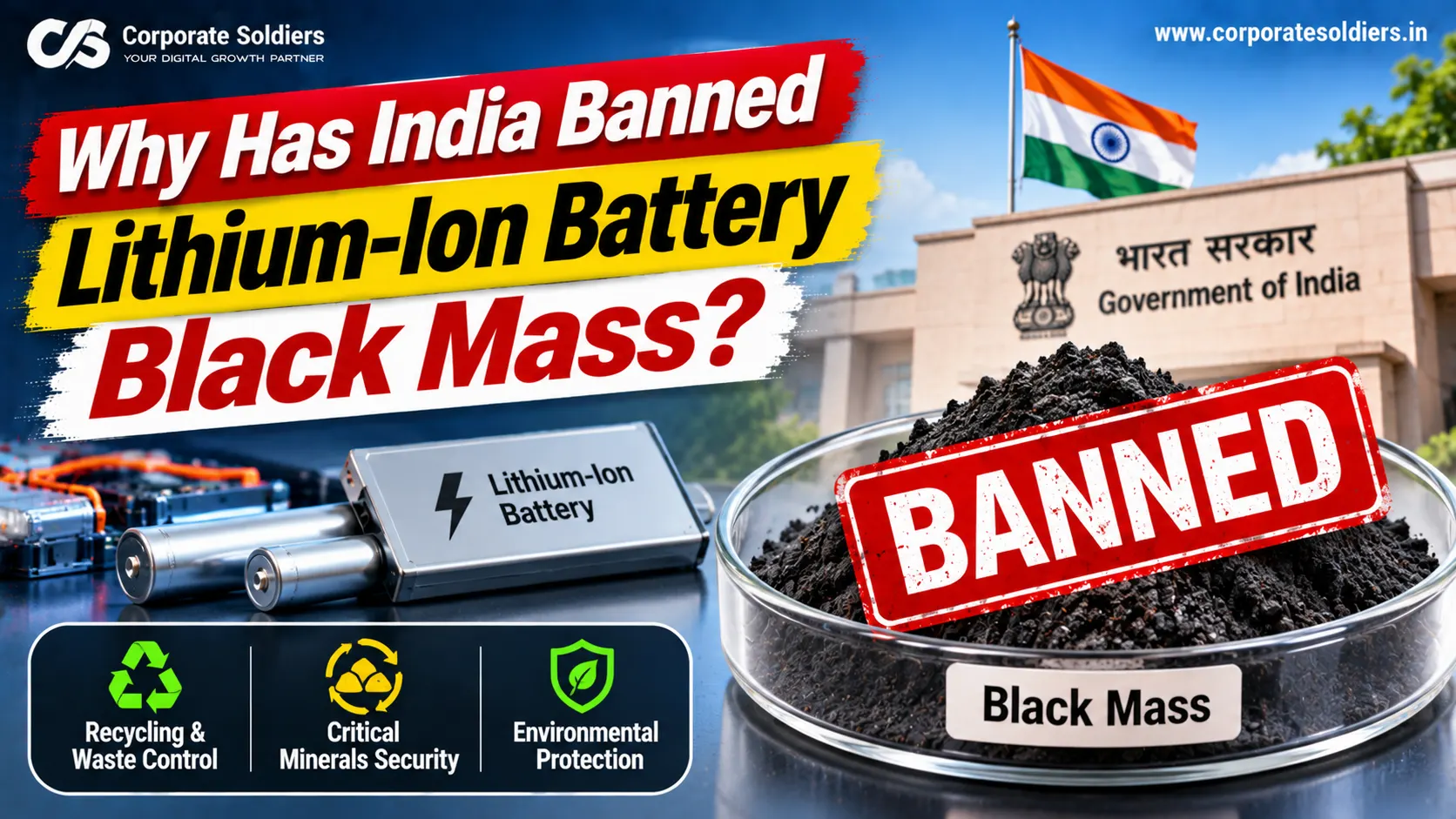
India has banned the export of lithium-ion battery black mass, a valuable source of critical minerals such as lithium, cobalt, nickel, and manganese. Announced by the government on November 11, 2026, the move aims to retain these resources within the country, strengthen domestic battery recycling, and reduce dependence on imported minerals.
India’s decision could reshape how battery waste is handled, recycled, and converted into valuable resources. But what exactly is black mass, and why does the government want domestic recyclers to process it instead of exporting it?
What Is Lithium-Ion Battery Black Mass?
Black mass is a powder-like material produced by shredding end-of-life lithium-ion batteries and battery manufacturing waste.
Despite being classified as battery waste, it contains valuable recoverable minerals, including:
- Lithium: Used in rechargeable battery production.
- Cobalt: Used in certain lithium-ion battery chemistries.
- Nickel: Helps improve battery energy density.
- Manganese: Used in several battery cathode formulations.
Instead of treating discarded batteries as waste, recyclers can extract valuable minerals from black mass and reuse them in the production of new batteries.
Why Has India Banned Black Mass Exports?
The Directorate General of Foreign Trade (DGFT), under the Ministry of Commerce and Industry, issued Notification No. 49/2026-27 on November 10, 2026.
Under the notification, the export policy for lithium-ion battery black mass covered by ITC(HS) Code 85491400 has changed from ‘Free’ to ‘Prohibited’, with immediate effect and until further orders.
The notification also states that transitional arrangements under Paragraph 1.05 of the Foreign Trade Policy 2023 will apply.
The government’s primary objective is to ensure that domestically generated black mass is processed within India rather than sent overseas.
According to the government, some domestic recycling facilities are not operating at full capacity because of insufficient raw material. In some cases, Indian recyclers have also had to import black mass to meet their processing requirements.
The export restriction aims to address this gap by making more domestic feedstock available to Indian recycling and refining companies.
How Will the Export Ban Affect India’s EV Industry?
The decision could have wider implications for India’s electric mobility and battery manufacturing sectors.
1. More opportunities for battery recyclers
Domestic recycling companies are expected to gain better access to black mass, helping them improve plant utilisation and potentially expand their operations.
2. Better recovery of critical minerals
Recovering lithium, cobalt, nickel and manganese from used batteries could create an additional domestic source of materials needed for battery production.
3. Stronger battery supply chains
Greater domestic recovery of critical minerals could help battery manufacturers access locally processed raw materials, diversify their supply chains and reduce exposure to international supply disruptions.
4. Potential investment and employment growth
Improved access to raw materials may encourage companies to invest in recycling infrastructure, refining technologies and skilled employment.
It is important to understand that India’s lithium-ion battery black mass export ban applies to the specified category under ITC(HS) Code 85491400. It is not a blanket prohibition on exporting all lithium-ion batteries or every type of battery waste.
Will the Move Reduce India’s Dependence on Imported Minerals?
India depends substantially on imports for several critical minerals used in advanced battery technologies. Building domestic recycling capacity offers another way to recover these resources without relying entirely on newly mined materials or overseas suppliers.
The export restriction also supports the government’s National Critical Mineral Mission (NCMM). In September 2025, the Union Cabinet approved a ₹1,500 crore incentive scheme to develop critical mineral recycling capacity using secondary sources, including battery waste and electronic waste.
By retaining black mass for domestic processing, the government aims to ensure that these recycling facilities have access to the raw materials they need.
This approach also supports a circular economy, where discarded products become sources of reusable materials rather than simply adding to waste.
What Happens Next for India’s Battery Recycling Sector?
The export prohibition marks an important step towards strengthening India’s domestic battery recycling ecosystem. However, its success will depend on efficient battery collection, processing capacity, and the ability to recover critical minerals at scale.
For India’s EV and clean energy industries, the bigger opportunity is to turn discarded batteries into a reliable source of valuable resources. Whether this policy significantly reduces import dependence will become clearer as domestic recycling capacity expands.