Who Is Arnav Paparkar?
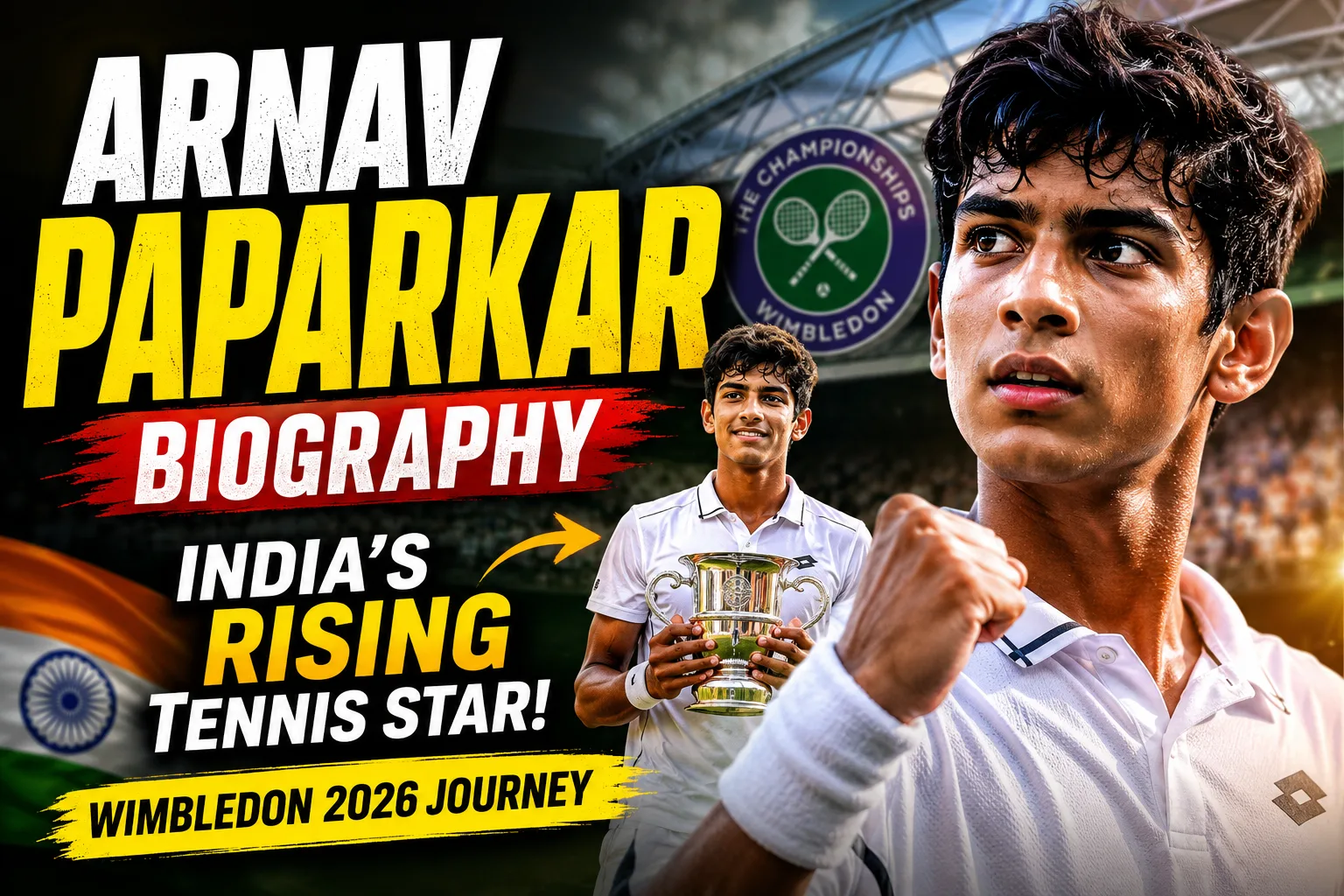
When discussing the future of Indian tennis, one name has quickly risen to prominence Arnav Paparkar. At just 18 years old, the Pune-born tennis player has become one of India’s brightest sporting prospects after making history with an outstanding run at the 2026 Wimbledon Boys’ Singles Championship.
His journey is notable because it was not built on instant fame or early international sponsorships. Instead, Paparkar progressed through domestic tournaments, Asian junior events, and the ITF circuit before establishing himself on the global stage. His breakthrough performances at Wimbledon showcased a combination of powerful serving, intelligent tactics, and impressive mental composure.
For Indian tennis fans searching for the next singles player capable of competing consistently at the highest level, Arnav Paparkar represents genuine hope. His steady development, disciplined work ethic, and willingness to learn have earned praise from coaches, analysts, and former players alike.
Early Life and Family Background
Every successful athlete has a story that begins long before international tournaments and television cameras. For Arnav Paparkar, that story started in Pune, Maharashtra, where he was raised in a family that valued education, discipline, and personal growth alongside sporting achievements[.
Unlike many elite athletes who grow up in sports-oriented households, Arnav was raised by parents who come from professional, non-sporting backgrounds[. His father, Vijay Paparkar, is an engineer, while his mother, Dr. Vijaya Paparkar, practices Ayurveda[. Rather than pushing him toward one specific career path, they encouraged him to explore different activities during childhood. Swimming, cricket, table tennis, and other sports became part of his early routine, allowing him to develop overall athletic ability before specializing in tennis.
This balanced upbringing played an important role in shaping his personality. Instead of facing excessive pressure to become a professional athlete, Arnav developed a genuine love for competition and continuous improvement. Many coaches believe this type of environment produces mentally stronger athletes because they learn to enjoy the process rather than focus solely on immediate results.
How Arnav Paparkar Discovered Tennis
Some careers begin with years of planning, while others start with a fortunate coincidence. Arnav’s introduction to tennis happened almost by accident.
At the age of six, he regularly attended swimming classes. Nearby was a tennis court where local coaching sessions were taking place. While spending time around the courts, one of the coaches noticed his natural athletic movement and suggested that he should try holding a tennis racket. That simple recommendation changed everything.
What began as a casual introduction soon developed into a passion. His parents supported the decision by enrolling him in structured coaching sessions, where his natural coordination and willingness to learn became immediately evident. This story highlights an important lesson for young athletes and parents alike: exposure to multiple sports during childhood often helps children discover talents they may never have identified otherwise.
Growing Through Discipline Rather Than Shortcuts
One characteristic that separates Arnav Paparkar from many young athletes is the pace of his development. Modern junior sports often create overnight sensations through social media and viral highlights, but Paparkar’s career followed a different path.
Instead of chasing immediate international recognition, he gradually built experience through:
- Local tournaments in Maharashtra
- National junior championships
- Asian Tennis Federation events
- ITF Junior Circuit competitions
- ATP Challenger exposure
This step-by-step progression allowed him to gain valuable match experience against increasingly stronger opponents without rushing his development. Sports experts frequently point out that athletes who spend time mastering each competitive level transition more successfully into professional competition. Paparkar’s journey reflects exactly that philosophy.
Education and Early Tennis Training
Balancing academics with professional sport is never easy, particularly in India where education often takes priority. Throughout his childhood, Arnav managed both responsibilities while dedicating increasing hours to tennis training.
As his tournament schedule expanded, so did the demands of international competition. Like many high-performance athletes, Arnav had to adapt his structured education around intensive practice sessions, fitness work, and overseas tournaments.
A typical development program for an elite junior tennis player includes:
- Technical practice and match simulation
- Tactical analysis and video review
- Strength and conditioning
- Recovery sessions and nutrition planning
- Sports psychology
Paparkar embraced this professional approach at an early stage, helping him compete confidently against some of the world’s best junior players.
Coaches, Academies, and Support System
Hemant Bendre Tennis Academy, Pune
Most of his foundational development has taken place at the Hemant Bendre Tennis Academy in Pune. Under the guidance of experienced coaches Hemant Bendre and Prosenjit Paul, Paparkar refined the technical fundamentals that would later become his biggest strengths.
The academy emphasizes:
- Consistent footwork
- Match discipline
- Serve mechanics
- Tactical awareness
- Physical conditioning
International Training in Spain
Recognizing that future ATP players need regular exposure to European competition, Paparkar also trains at the Soto Tennis Academy in Spain under coach Nigel Beavers. Spain has produced numerous world-class tennis players, making it one of the best environments for developing professional competitors.
Training overseas offers several key advantages:
- Stronger sparring partners
- Faster tactical learning
- Different court conditions (such as European red clay)
- Exposure to diverse international playing styles
- Greater competitive intensity
Combining domestic coaching with European training has accelerated Paparkar’s development.
The Support System Behind His Success
Professional tennis is among the world’s most resource-intensive sports. Travel expenses, coaching fees, fitness specialists, tournament entries, accommodation, and equipment can cost thousands of dollars each season.
Fortunately, Arnav has received backing from several organizations throughout his journey, including:
- Maharashtra State Lawn Tennis Association (MSLTA)
- Mahatennis Foundation
- Maharashtra Government’s Mission Lakshyvedh initiative
- Aryan Pumps (corporate sponsor)
- His family and local mentors
This combination of family commitment and institutional support has allowed him to compete regularly on the international junior circuit without financial limitations hindering his progression.
Early Career Achievements
Long before his historic run in 2026, Arnav Paparkar had already established himself as one of India’s leading junior tennis players. His breakthrough years demonstrated consistent progress rather than isolated success.
2023: National Recognition
The year 2023 proved to be an important milestone in his career. Among his biggest achievements were:
- Australian Open Under-14 Asia-Pacific Elite Trophy: Champion (Melbourne)
- National Under-16 Championship: Winner (Kolhapur) after entering the tournament as a wildcard
Winning prestigious junior tournaments helped him gain valuable international ranking points while building confidence against elite competition.
2024: Entry Into Professional Tennis
Rather than waiting until adulthood, Paparkar began experiencing professional tennis at an early age. On his 16th birthday, he received a wildcard entry into an ATP Challenger tournament, giving him his first exposure to senior-level competition.
Although junior and professional tennis differ significantly in speed and physicality, the experience proved invaluable for his long-term development. Competing against older, stronger players helped him understand the adjustments needed to succeed at the next level.
2025: International Breakthrough
By 2025, Paparkar had evolved from a promising domestic player into a genuine international contender. His growing confidence resulted in victories at several prestigious junior events, including:
- ITF J60 Manama (Bahrain)
- ITF J200 Kuala Lumpur (Malaysia)
These tournament victories significantly boosted his international ranking while reinforcing his reputation as one of Asia’s fastest-rising junior players. Just as importantly, they demonstrated his ability to perform consistently away from home under different playing conditions.
Wimbledon 2026: The Tournament That Changed Everything
For many young tennis players, simply qualifying for a Junior Grand Slam is a significant achievement. For Arnav Paparkar, Wimbledon 2026 became the tournament that transformed him from a promising junior into one of the most talked-about young players in world tennis.
Entering the Championships ranked World Junior No. 19, Paparkar was considered a dangerous outsider rather than a title favorite. Few expected him to produce one of the tournament’s biggest stories. Instead, he delivered a remarkable run, reaching the Wimbledon Boys’ Singles Quarterfinals without dropping a single set. His consistency, composure, and attacking tennis attracted attention from coaches, former professionals, and international media.
With this achievement, he became the first Indian in 36 years to reach the Wimbledon Boys’ Singles quarterfinals since Leander Paes’ historic title-winning campaign in 1990. This milestone has reignited optimism about the future of Indian men’s singles tennis.
Wimbledon 2026 Results
First Round
- Opponent: Joshua Craze (Great Britain)
- Result: 6–2, 6–2
Paparkar began his Wimbledon campaign with confidence. His powerful first serve immediately became a weapon, allowing him to dictate rallies from the opening game.
Match Highlights:
- Comfortable straight-set victory
- Dominated service games
- Aggressive baseline play
- High first-serve percentage
- Minimal unforced errors
Second Round: A Career-Defining Upset
- Opponent: Keaton Hance (USA)
- Tournament Seed: No. 3 (Junior World No. 3)
- Result: 6–2, 6–3
Every breakthrough tournament has one defining victory. For Paparkar, that match came against American star Keaton Hance, one of the strongest title contenders and the Australian Open junior finalist.
Rather than playing cautiously, Paparkar attacked from the beginning His performance demonstrated remarkable maturity for an 18-year-old.
Key Statistics:
- 6 aces
- Saved all 6 break points
- Won the majority of first-serve points
- Controlled rallies with aggressive forehands
More impressive than the statistics was his tactical preparation. Before the match, Paparkar carefully analyzed Hance’s previous-round performance with his coaching team. He noticed that the American struggled when forced wide during rallies. Instead of relying purely on power, Paparkar repeatedly targeted that weakness, proving that elite tennis is as much about strategy as athletic ability.
Round of 16: A Statement Performance
- Opponent: Ryo Tabata (Japan)
- Result: 6–2, 6–1
Against Japan’s Ryo Tabata, Paparkar produced arguably the best performance of his junior career.
Match Statistics:
| Statistic | Performance |
| First-Serve Points Won | 92% (23 of 25) |
| Winners | 20 |
| Aces | 8 |
| Unforced Errors | 5 |
| Match Duration | 52 Minutes |
These numbers highlight extraordinary efficiency. Paparkar barely gave his opponent an opportunity to settle into the match, converting 4 of his 10 break points and refusing to concede a single break point on his own serve.
Turning Past Defeat Into Motivation
What made this victory over Tabata even more impressive was the history between the two players. Before Wimbledon, Tabata had defeated Paparkar twice. One defeat was particularly painful: Paparkar had led 5–2 in the deciding set and held five match points, only to lose the match.
Many young athletes carry such disappointments into future meetings, but Paparkar used the experience as motivation. Rather than seeking revenge emotionally, he focused on keeping his composure. This ability to learn from setbacks rather than fear them is one of the strongest indicators of future success in professional sport.
The Playing Style That Makes Paparkar Different
Modern tennis is faster and more physically demanding than ever before. Success requires more than simply hitting the ball hard. Paparkar’s game combines power, tactical awareness, and intelligent shot selection.
Powerful First Serve
His serve has become one of his biggest weapons. Standing just over six feet tall, he is able to generate steep angles and high pace. During Wimbledon 2026, he registered:
- Fastest serve: 208 km/h (129 mph)
- Average first-serve speed: 196 km/h
These numbers compare favorably with many professional ATP players. A strong first serve allows Paparkar to win easy points while putting immediate pressure on his opponents’ return games.
Aggressive Baseline Tennis
Paparkar prefers to dictate points rather than defend. His playing style includes:
- Heavy, deep forehands
- Flat backhands
- Early ball striking (taking the ball on the rise)
- Offensive returns
- Short, aggressive rallies
This approach is particularly effective on faster surfaces such as grass and hard courts.
Tactical Intelligence
One characteristic that coaches frequently praise is his willingness to study opponents. Rather than relying solely on instinct, Paparkar and his coaching staff analyze:
- Service patterns
- Rally preferences under pressure
- Court positioning and footwork
- Movement weaknesses
This analytical mindset gives him a distinct advantage against players with similar technical abilities.
The Service Change That Elevated His Game
One of the biggest turning points in Paparkar’s career came shortly before Wimbledon. Coach Hemant Bendre modified his serving technique. Instead of using an abbreviated, rushed motion, under Bendre’s guidance, Paparkar transitioned to a service motion characterized by:
- A smoother, more relaxed rhythm
- Fuller shoulder rotation
- Improved physical balance
- Better contact timing
Initially, the adjustment required patience. However, the long-term benefits quickly became obvious. The new motion not only reduced injury risk but also improved consistency without sacrificing pace. This technical refinement played a major role in his Wimbledon success.
Career Timeline
- 2023:
- Australian Open Under-14 Asia-Pacific Elite Trophy Champion
- National Under-16 Champion
- 2024:
- Made his ATP Challenger debut via a wildcard entry on his 16th birthday
- Began competing against professional players to ease his transition to the senior tour
- 2025:
- ITF J60 Manama Champion
- ITF J200 Kuala Lumpur Champion
- Continued steady rise in the ITF Junior Rankings
- 2026:
- Held the AITA Boys’ Under-18 No. 1 ranking for 21 consecutive weeks
- Reached the round of 16 (third round) at the Roland-Garros Junior Championships
- Historic Wimbledon Boys’ Singles Quarterfinalist
- Established himself as one of the world’s leading junior players
Why Arnav Paparkar Matters for Indian Tennis
Indian tennis has produced exceptional doubles champions and a handful of successful singles players, but sustained success in men’s singles at the global level has been limited. Paparkar’s rise is significant because it reflects a highly structured, modern approach to player development.
His journey combines:
- Long-term developmental planning over immediate fame
- Early international exposure and overseas training camps
- Professional coaching and physical conditioning
- Deep tactical preparation and mental resilience
Rather than relying on raw talent alone, he has developed a complete game capable of competing internationally. If this progression continues, Paparkar could become one of India’s strongest ATP Tour prospects in the coming years.
What Can Young Athletes Learn From Arnav Paparkar?
Paparkar’s story offers valuable lessons that extend far beyond the tennis court:
- Success Takes Time: He progressed steadily through local, national, Asian, and international competitions instead of chasing shortcuts.
- Learn From Defeats: His response to previous losses against Ryo Tabata demonstrates the importance of resilience, mental composure, and continuous improvement.
- Preparation Wins Matches: Studying opponents’ weaknesses and adapting tactics helped him defeat higher-ranked players.
- Strong Fundamentals Matter: Years spent mastering basic techniques and physical mechanics provided the platform for success on the world stage.
Frequently Asked Questions (FAQs)
Who is Arnav Paparkar?
Arnav Paparkar is an Indian junior tennis player from Pune who gained international recognition after reaching the Wimbledon Boys’ Singles Quarterfinals in July 2026.
How old is Arnav Paparkar?
As of 2026, Arnav Paparkar is 18 years old.
Where is Arnav Paparkar from?
He was born and raised in Pune, Maharashtra, India.
Who are Arnav Paparkar’s coaches?
He trains under Hemant Bendre and Prosenjit Paul at the Hemant Bendre Tennis Academy in Pune, while also receiving coaching from Nigel Beavers at the Soto Tennis Academy in Spain.
What is Arnav Paparkar’s playing style?
He is an aggressive baseliner known for a powerful first serve, heavy forehand, and tactical intelligence.
Why is Arnav Paparkar famous?
He became the first Indian in 36 years to reach the Wimbledon Boys’ Singles Quarterfinals, making him one of India’s most promising young singles tennis prospects.