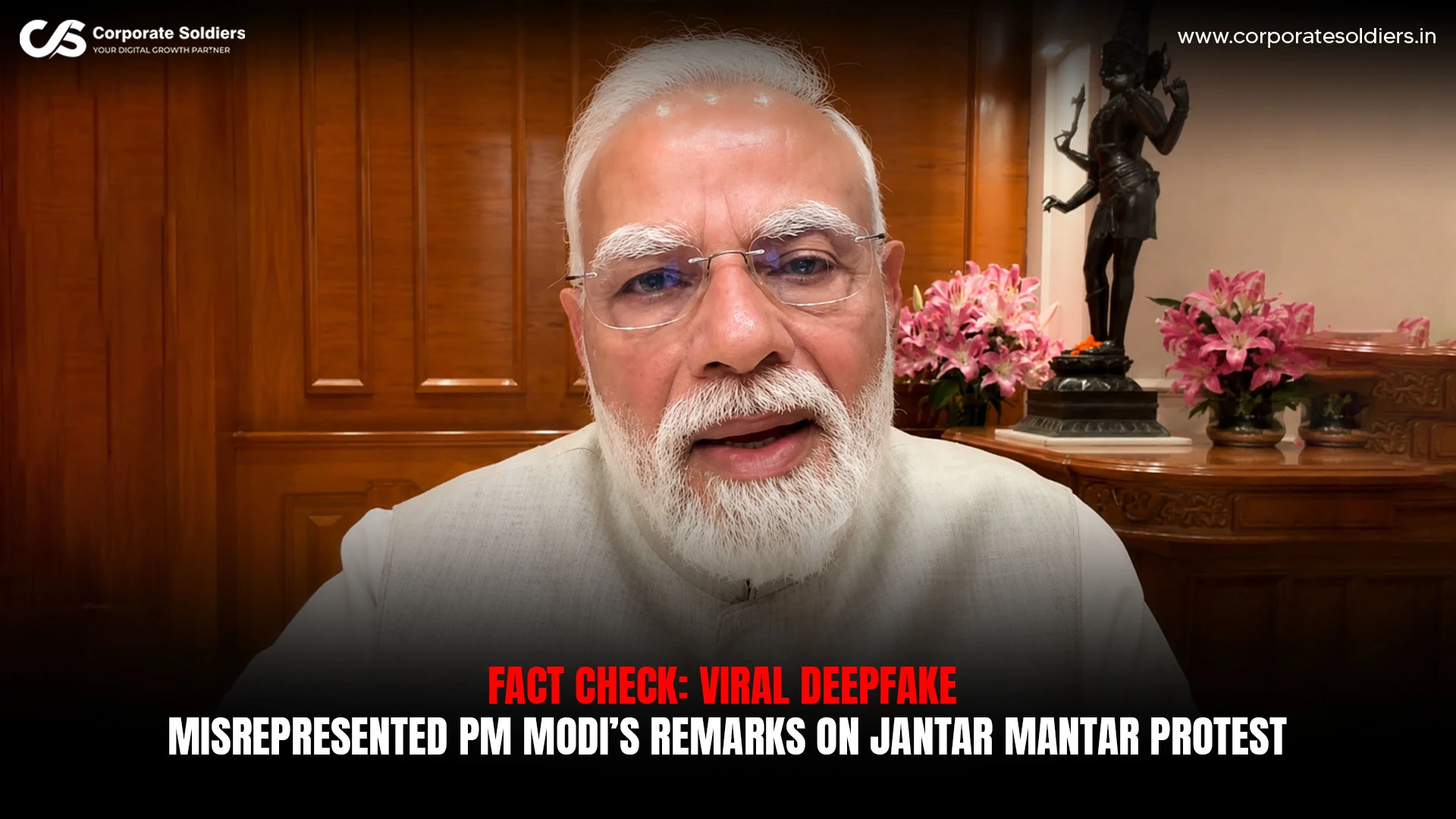
One such video which gained widespread attention in social media in July 2025 seems to have Prime Minister Narendra Modi warning protesters in Delhi who have gathered at Jantar Mantar and threatening to take action against them. The video was released along with the information that the Prime Minister personally responded to the ongoing protests and stated that he would surely grab the perpetrators of the protests with strong measures.
There are however some fact check questions that uncovered the video was being manipulated. The independent checks and verifications by government fact-checkers concluded that the statements recorded by the Prime Minister were fake and the viral clip had been edited with the help of artificial intelligence-based editing tools. The utterances in the viral video have been officially confirmed to not have been made by PM Modi at any time.
This case reflects an increasing menace of AI-generated misinformation and deepfakes in the online world.
What the Viral Video Claimed
The viral video depicted Prime Minister Narendra Modi purportedly threatening protesters who were involved in protests at Jantar Mantar in New Delhi. The posts on social media that accompanied the video, hinted that the Prime Minister had issued a direct warning to those who were involved in the protest movement and that action was to be taken against them.
The video was viral as it was purported to contain genuine video footage of the Prime Minister making the comments. To most viewers, the video looked believable on the surface with the combination of real imagery and apparently realistic sound.
Fact-checkers, however, concluded the assertions that were accompanying the video as not true. The rumors spread on the internet were not included in any real speech or official statement of the Prime Minister.
Fact Check: What Was Verified
The Fact Check Unit of the Press Information Bureau (PIB Fact Check) discovered that the viral video was manipulated with the help of AI-generated content. Prime Minister Narrendra Modi did not make the statements in the clip as clarified by the official.
PIB Fact Check presented the content as a fake video that was made to mislead the audience and prompted users not to share it. The agency also connected the audiences with the original, raw footage that the manipulated one was made out of.
Similar reports by other news organisations also reported that the viral video was based on real visual footage but substituting or editing the original audio to form a fake story. The doctored video gave a false impression that PM Modi was threatening demonstrators when there was no such declaration in the original video.
The results of the fact-check were in line with a larger trend of AI-generated videos of senior public figures during a time of increased public interest regarding protests and political events.
How the Deepfake Was Identified
To conclude that the video was doctored, fact-checkers employed a number of verification techniques.
- Comparison To the Original Video
The viral clip was equated with the actual video, which is spread through the official channels, by investigators. In the comparison, it was found that the threatening statements were not in the original tape as they were in the version being circulated. The distorted sound was put into otherwise realistic visuals.
- AI-Generated Audio Indicators
The characteristics of the video that was edited were typical of artificial speech synthesis. Some of the indicators that fact-checkers are looking at when they consider something to be manipulated are unnatural pauses, speech patterns that are uneven or audio that is always not fully in sync with the lips of a speaker. After analyzing the viral clip and the original video, investigators gave evidence of the use of AI to create or manipulate audio.
- Official Verification
The most powerful case was provided by PIB Fact Check, which denied that the statements spread online by the Prime Minister were made by him and indicated the video as a deepfake by an AI.
- Contextual Inconsistencies
The context to which the supposed remarks were made was also scrutinized by fact-checkers. No official speech, press conference, government release or official verified social media post were used to back the claims being propagated along with the video. The absence of additional sources of valid evidence only raises more doubts about its validity.
What Was the Authentic Context?
As official fact-check results show, the original video utilized in the edited clip was of a separate authentic video of the Prime Minister. The viral variant had edited the audio to give the misleading impression that the Prime Minister was commenting on and threatening protesters gathered at Delhi’s Jantar Mantar.
The viral posts had statements that were not in the real video that he had made. Fact-checkers emphasised that the audience was being presented with real images and fake audio, a strategy which is becoming more common in current deepfake efforts.
Official Clarifications
The Fact Check Unit of the Press Information Bureau released a statement that the viral video was fake news. It said that Prime Minister Narendra Modi never said what was heard in the clip and advised users to trust the verifiable sources before sharing such a source.
The fact-check findings were corroborated by further reporting by various news outlets and that the video was not authentic.
Why Deepfakes Are Becoming a Serious Concern?
The Jantar Mantar misinformation case is an indication of a world wide challenge.
The technical barriers to the production of believable fake audio and video content have been greatly reduced by advances in generative AI. The current deepfake algorithms can even copy the voice, the facial expression and speech patterns and be more realistic, which makes manipulated media harder to notice by an average user. It has been identified that deepfakes can take advantage of the trust in visual evidence and make it hard to check the information online.
Analysts have cautioned that such material may be especially dangerous when it goes viral at a time when the political atmosphere is delicate as falsified messages that are assigned to government officials can reach masses before the truth is uncovered. Deepfakes have the power to affect the discourse of the population, ruin reputations, spark social conflicts and make people lose trust towards legitimate sources of information.
Digital verification and media literacy is thus more essential than ever before because AI-generated media have become more sophisticated.
How Readers Can Identify Manipulated Videos
Although certain deepfakes may be extremely realistic, there are a few feasible measures that users can take to assess suspicious information:
- Check the news coverage of the video by established news organisations.
- Confirm by checking the official websites of the government and verified accounts in social media.
- Find the original source of the video and compare them with the viral one.
- Note any abnormal lip movements, facial movements or irregular audios.
- Always beware when a video is published on anonymous accounts on social media.
- Find fact-checks of organisations like PIB Fact Check, Alt News, BOOM Live, Reuters Fact Check, AFP Fact Check and other reputed verification sources.
- Do not forward information that has not been self-authenticated.
There is no one indicator that indicates that a video is fake but there are several tell-tale signs that should raise extra concerns.
Broader Impact on Digital Information
The dissemination of false videos proves why media literacy is one of the most important skills of the population. Citizens are becoming more and more worried about verifying the information before accepting or sharing it in an environment where AI tools can create realistic content within minutes.
The independent fact-checking organisations, journalists, researchers and technology platforms are significant elements in identifying the misinformation. Nevertheless, the individual users can also be considered as the initial line of defense against the viral lies.
The responsible sharing practices can greatly diminish the distribution of misleading information and contribute to maintaining the credibility of the legitimate information sources.
Final Thoughts
The viral video purportedly depicting Prime Minister Narendra Modi threatening the protesters at Jantar Mantar was not genuine. Professional fact-checkers concluded that the video was identified by PIB Fact Check as AI-generated and manipulated, and the statements attributed to the Prime Minister were fabricated.
The case demonstrates the potential of deepfake technology to produce persuasive, yet inaccurate accounts of what is happening around people and politicians. With the emergence of AI-generated misinformation, which is getting more advanced, it is becoming more and more important to be able to verify information via trusted sources and independent fact-checks.
To consumers of the digital media, the best action to take is easy; stop, check and disseminate responsibly.