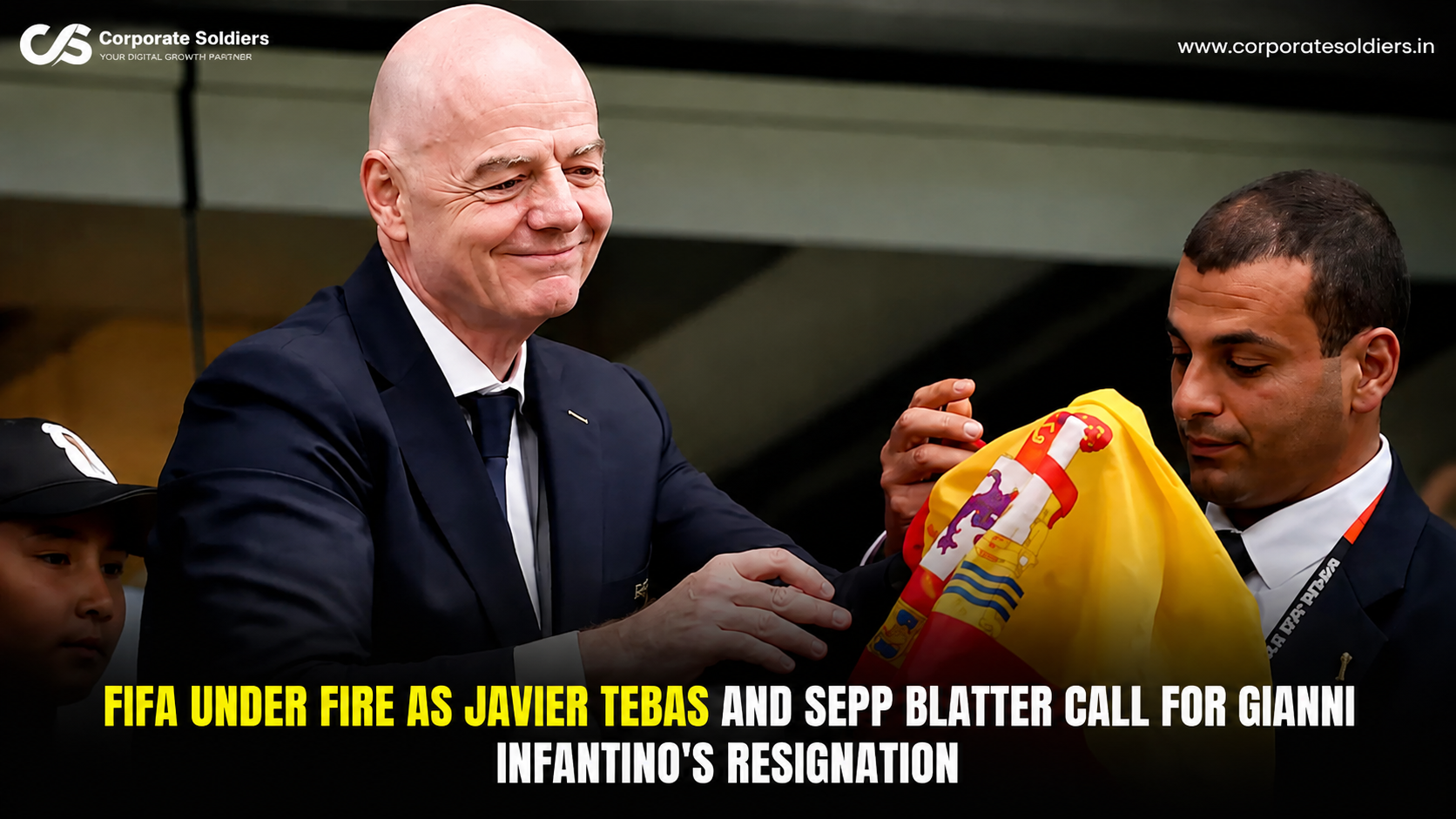
A growing controversy over the future of world football has once again placed FIFA President Gianni Infantino under scrutiny as it has become the target of a fresh wave of critics, and one of the first to take aim at the leadership of the governing body has been LaLiga President Javier Tebas and former FIFA President Sepp Blatter.
Recent criticism of FIFA’s expanding competition calendar, the continued growth of major tournaments, and broader concerns over governance, commercial interests, and the balance of power between international football bodies and domestic leagues has intensified the controversy.
Tebas has openly called for Gianni Infantino’s resignation, claiming FIFA is harming the football industry, whilst Blatter has also come out to attack the game saying that decisions to put politics and commercial interests first in the game are hurting the game.
The discussion is of great consequence well beyond FIFA headquarters. It rubs shoulders with issues of clubs, leagues, players, national associations and fans in the entire football ecosystem in the world.
What Triggered the Controversy?
The most recent criticism has been in the wake of the FIFA world cup and as the debate persists on the long term competition strategy of FIFA.
In the Italian press interviews, Tebas was no kind at all of FIFA under Infantino particularly in the manner FIFA had been committed to expansion of major international tournaments and its consideration of future expansion of tournaments like those related to the 2030 FIFA world cup.
The criticism is set against a backdrop of years of strife between FIFA and various domestic leagues in matters of overload of fixtures, excessive workload on players, scheduling and the increasing number of international tournaments. The FIFA Club World Cup increase, the world cup 32 to 48 team increase (starting in 2026) and the discussion of the further enlargement of the event have only contributed to those problems.
The other controversy has been on the manner in which FIFA has dealt with some disciplinary issues and governance problems during the last few tournaments that have cast doubt on the transparency and independence of the institutions.
Javier Tebas’ Criticism of FIFA
Destroying the Football Industry
Javier Tebas has become one of the most passionate opponents of the current strategic course of FIFA.
In post-World Cup interviews, the president of LaLiga claimed that FIFA is harming the overall football ecosystem by continually expanding international events, and disproportionately investing in short-term global events over domestic football systems that run all year round.
Tebas said that football should not be all about the World Cup and cautioned that domestic competitions are the linchpin on which professional football is based. His argument was that national leagues cater to thousands of clubs, players, employees and businesses around the globe that are associated with football.
Concerns About Tournament Expansion
Among the key arguments that Tebas has presented is that there are suggestions of expanding the men’s world cup even more.
The 2026 tournament has already been increased to 48 participating countries (previously it was 32). Football officials of South America have conducted talks during which they have proposed an increase in the 2030 tournament to 64 teams. Tebas has publicly rejected the idea, saying that this would be foolish, and would provide an addition to the already congested football calendar.
Domestic Leagues Under Pressure
Tebas believes that FIFA is using domestic leagues to pay the cost of their expansion strategy.
His stance indicates the long-standing fears of league administrators that growing international obligations make recovery time shorter, schedules harder, and broadcasting options harder, and puts more work demands on elite players.
He has also been critical of FIFA with regards to how they have conducted their tournaments operations such as long commercial breaks, competition structures which he believes do not favor sporting factors, but rather revenue generation.
Call for Infantino’s Resignation
Tebas did not stop his criticism of policy and even said that he thinks Infantino should step down.
Although FIFA has a well-established backing of Infantino by its member associations, Tebas maintained that there is lack of opposition in the governing body and that most football stakeholders are privately concerned but are not willing to come out publicly to oppose FIFA.
Sepp Blatter’s Remarks
The former FIFA President, Sepp Blatter has joined the fray too, giving further credence to the criticism of the current direction of the organization.
Blatter has been saying that football would need to lose its credibility when the sporting ideals are covered by the political interests and commercial interests. He was also concerned that the modern day governance model of the sport was shifting towards ideals that ought to provide the basis of international football administration, following recent controversies.
What is especially noteworthy about the comments made by Blatter is that they are made by the former FIFA president who served as FIFA President from 1998 until leaving office in 2015 amid the FIFA corruption crisis.
Despite the controversial nature of his own FIFA presidency, the fact that, despite that, Blatter intervened, shows how worried some of the higher ranking football figures are about the current direction FIFA is taking.
He has publicly echoed concerns about FIFA’s current direction and expressed support for criticism of the organization’s leadership under Infantino.
Why Are Calls Growing for Gianni Infantino’s Resignation?
Governance Concerns
Critics believe that the FIFA decision-making process is becoming more and more centralized and less responsive to domestic leagues and other stakeholders.
Various football administrators have been asking whether key strategic decisions are being undertaken in consultation with the rest of the football community.
Calendar Congestion
The most regular criticism is related to scheduling.
Domestic leagues, player unions and football executives have time and again expressed their concerns that the growing international competitions have left the players with hardly any time to rest and have accrued physical pressures to the elite players.
Commercialisation of Football
Opponents such as Tebas claim that commercial growth has emerged to be a powerful force in decision making.
The worry is that the growth of the tournaments, new matches and the increased global events make FIFA a lot of commercial money and leave the operational and sporting costs to the clubs, leagues and players.
Relationship With Domestic Leagues
The conflict is also indicative of a bigger power game between FIFA and domestic competitions.
Competitions like LaLiga have always been saying that national tournaments are the economic and sporting basis of football and FIFA insists that international tournaments are the key to the development of football.
FIFA’s Expanding Calendar
FIFA Club World Cup Expansion
The FIFA Club World Cup has been one of the biggest changes in the leadership of Infantino.
FIFA has made the expanded tournament a global event that has the potential to generate new business and involvement by more people around the globe. Some criticize it, though, as an additional burden to the already busy schedules.
FIFA World Cup Expansion
With the 2026 world cup, the World Cup of men would have increased its team size up to 48 teams.
FIFA has been championing the shift as a way of enhancing world representation and availing more countries to the best football tourney. Opponents argue that an additional growth would undermine the competitive levels, and would result in higher burdens on schedules.
Additional International Competitions
FIFA has not stopped experimenting with new forms of tournament and the wider international football possibilities, which have further led some leagues and clubs to voice their concerns about the congestion of fixtures.
Impact on Stakeholders
The implications of expansion of the calendar are under discussion throughout the football world:
- There are more workloads and little rest among the players.
- There are clubs which have to cope with more international commitments.
- Home leagues are faced with scheduling problems.
- There are increased congested programming schedules by broadcasters.
- Domestic realities weigh on international ambitions which the national associations balance.
These are the issues which are in the focus of the current debate.
FIFA’s Position
FIFA has also been on the defensive of its expansion strategy.
The governing body claims that the bigger tournaments provide the world with more inclusion, more chances to the upcoming football nations, more development money, and enhance the global presence of football.
Under the leadership of Infantino FIFA has on multiple occasions tabled competition expansion as an expansion of a wider initiative to expand the game internationally and redistribute resources among member associations.
Infantino is widely expected to seek another term as FIFA President in 2027, reflecting the continued support he enjoys from many FIFA member associations. The following presidential elections will take place in 2027.
At the time of the publication, FIFA has not declared any shift in its policy as per the request of Tebas, who is asking for resignation.
Wider Impact on Global Football
Player Welfare
One of the most significant governance aspects in football today has been player workload.
Health professionals, coaches, representatives of the players, and league officials have intensively pointed out issues of injuries, fatigue, and inadequate recovery periods.
Financial Implications
Although FIFA has increased tournaments which present huge commercial incomes, critics believe that the financial gains do not necessarily match the operation expenses incurred by the clubs and national tournaments.
Domestic League Competitiveness
The main source of football activity all year round is domestic competitions.
The league administrators are worried that over international expansion will hurt the sporting and commercial worth of national championships in the long-run.
Governance and Accountability
The conflict indicates more general issues regarding the way in which football will be run in the next few decades and how power will be distributed between FIFA, confederations, leagues, clubs, and even the organizations of players.
Why This Debate Matters
The controversy extends beyond a disagreement between football administrators.
Fundamentally, this discussion is about how world football should be governed in the future and the tradeoff between commercial expansion and sporting sustainability.
Those in favor of the FIFA strategy point to the expansion as a way to encourage inclusion and development of the world. Critics rebuttal this by saying that uncontrolled expansion will jeopardize the welfare of players, national competitions and the competitive balance of football.
Choosing to either succeed or fail in this debate may determine the way international football will be organized in the coming years.
Current Status
According to the last confirmed report:
- Javier Tebas has openly requested Gianni Infantino to resign.
- Criticism of FIFA has extended to its management and leadership style by Sepp Blatter.
- FIFA remains in favour of expansion of competition.
- Infantino is still going to run again as a presidential candidate in 2027.
- There is no existing FIFA procedure, which in turn would compel a shift in leadership due to the criticism.
Quick Facts
| Parameter | Details |
| FIFA President | Gianni Infantino (In office since 2016) |
| Key Critics | Javier Tebas (LaLiga President), Sepp Blatter (Former FIFA President) |
| Main Issue | FIFA’s international tournament expansion and political interference controversies |
| Tournaments Involved | FIFA World Cup (48/64 teams), 32-team FIFA Club World Cup |
| Key Allegations | “Destroying the football industry”, compromising tournament credibility, bending rules under political pressure |
| FIFA Response | Defends expansion as vital for globalizing football and funding developing nations |
| Current Status | Infantino remains FIFA President and is widely expected to seek another term in 2027. |
| Latest Development | Tebas and Blatter publicly demand Infantino step down following post-World Cup controversies |
Conclusion
The conflict between FIFA and some of the most prominent administrators of football has turned out to be one of the biggest governance controversies in the sport. The resignation of Gianni Infantino demanded by Javier Tebas and the criticism of the current direction of FIFA by Sepp Blatter is a symptom of increased alarm within the football establishment about the direction that the tournaments are taking, the number of fixtures, governance, and the relationship between sporting integrity and commercial expansion.
FIFA still justifies its approach as one that is needed to develop football in the world, and critics say that the governing body risks destroying the cornerstones of the sport by putting more and more pressure on the national leagues and athletes.