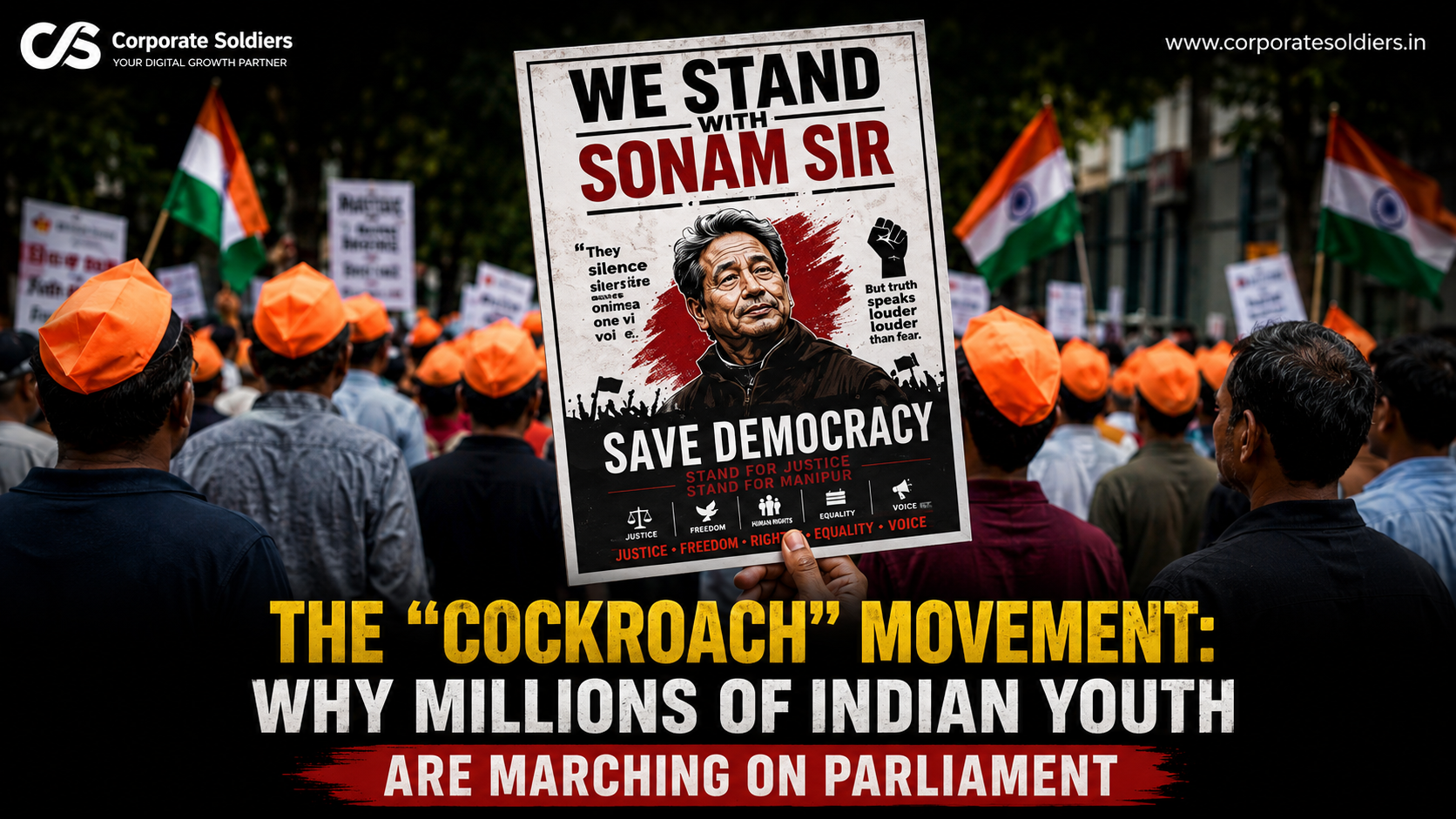
With the gates of Parliament opening on Monday, the political nerve center of the Indian capital was not only receiving the usual legislative sessions, but was witnessing a major youth-led protest unfolding just a few kilometres away. Surrounded by the ranks of policemen, the historic protest site at Jantar Mantar was filled with students and young professionals. Students, recent graduates, and young professionals had gathered with plans to march towards Parliament.
The so-called Cockroach Movement of youth mobilization has quickly become one of the most noticeable popular movements against the central administration. What started as an ironic, internet-born satirical organisation has transcended the digital divide, moving out of the virtual world and into the physical world, on the streets. The movement has attracted national attention and placed education governance at the center of public debate, fueled by examination leak controversies and longstanding concerns about youth unemployment.
What Is the Cockroach Movement?
This movement gets its unconventional name after the Cockroach Janata Party (CJP), a youth-based political outfit that started on May 16, 2026. Abhijeet Dipke, a 30 year old political communications strategist and Boston University graduate who once worked on digital campaigns in New Delhi, is the founder of the organization.
The movement’s name emerged through online political satire. According to reports surrounding its emergence, activists adopted the term “cockroach” as a symbol of resilience and persistence. The label later became the basis of the Cockroach Janata Party’s identity and social media campaigns.
Instead of rejecting the label, Dipke initiated a satirical online counter-campaign. In reappropriating the term, the CJP set up a fake political party that called itself the Voice of the Lazy and Unemployed and open to anyone who felt that they were structurally disenfranchised by mainstream politics. The organisation witnessed rapid growth across social media platforms, gaining millions of followers and attracting national attention. Nevertheless, the movement soon evolved beyond satire as concerns over examination irregularities and education governance gained national attention, prompting real-world accountability campaigns.
The Trigger: Examination Paper Leak
Although the movement’s name emerged from online political satire, it gained momentum amid concerns surrounding the NEET-UG 2026 examination controversy.
In May 2026, allegations of an examination paper leak raised questions about the National Testing Agency’s examination processes. The irregularities raised concerns about the integrity of an examination taken by more than 22 lakh students all over India. The following proclamation of partial re-examinations, changing explanations, and delayed remedies through the law brought so many miseries to students and to their families.
To the protesting youth, the medical entrance paper leak was not just a breakdown, but a sort of existential crisis. Indian examinations are hyper-competitive, so that a one-point difference can ruin years of hard, costly work. The scandal broke the trust of the population in the testing system, making the anger of students a national movement of demands towards the accountability of their institutions.
Hunger Strike and Sonam Wangchuk’s Role
The protest took the agitation to a high level with the participation of prominent environmentalist and reformist in education Sonam Wangchuk at Jantar Mantar. In support of the students who were protesting to have radical changes in examination, Wangchuk began an indefinite hunger strike on June 28.
By mid-July, Wangchuk was in a much worse state of health with medical reports documenting a loss of almost 9.5 kilograms and clinical signs of dehydration. The situation escalated on July 18, when Delhi Police carried out an overnight operation to forcefully take the 59-year-old activist to Safdarjung Hospital.
Different Attitudes to the Hospitalization:
- Delhi Police Statement: The administration asserted that the transfer was done under strict adherence to Delhi High Court order to provide Wangchuk with necessary medical care on the basis of expert medical advice, about his worsening vitals.
- CJP and Activist Claims: Protesters, among them CJP founder Abhijeet Dipke, who was himself targeted in a blue ink attack by an unknown person on the same day, accused the police of deployment of heavy-handed tactics and jammers to break up peaceful night-vigil observers.
After the ousting of Wangchuk, a hunger strike of their own was initiated by Dipke and a group of student outfits, which had the following requirements: the agitation would continue until the government provided clear parliamentary accountability of the failures in education.
The Bigger Issue: India’s Youth Unemployment Crisis
To comprehend why a medical leak exam would have mobilized millions of young people who are not even medical aspirants, analysts look right at macro-employment trends. Competitive exams are commonly perceived as the main way out of economic precarity, yet the figures show that there is a narrowing bottleneck.
The institutional labor tracking assessments have shown that, although the headline economic growth of India is strong, the problem of youth unemployment is still a structural problem. The Periodic Labour Force Survey (PLFS) and independent surveys show that rates of youth unemployment in the urban areas are always significantly higher than the national rates. In the case of graduates holding tertiary qualifications, the hunt to secure stable and formal jobs is often more arduous and this has resulted in underemployment whereby highly skilled candidates seek to join the ranks of lowly administrative workers.
As such, once people put the honesty of their public examinations into question, they have shut the limited channels of upward mobility available to well educated young people and governance stability has become a political battleground.
Voice from the Protest
Protesters interviewed by various media organisations said examination irregularities had undermined their confidence in a system that often determines educational and career opportunities. Many argued that greater transparency and accountability were necessary to restore public trust in competitive examinations.
Protesters have primarily raised the following demands:
- Transparency of Structure: The complete public audit of testing organizations and the introduction of digital authentication with tamper-resistant systems.
- Accountability: Protesters have called for accountability from senior education officials, including demands for the resignation of Union Education Minister Dharmendra Pradhan.
- Support Measures: Financial assistance and mental health support for families affected by examination-related stress and disruptions.
Political Implications
The government is faced with a politically sensitive challenge due to the protests.
Senior education officials have been held responsible by the organisers, the opposition parties and other activists have tried to use the scandal to question the governance and administration.
The authorities on the other hand have highlighted the importance of ensuring that there is order in the society especially during the Monsoon Session of Parliament. Delhi Police wrote that they had not given a sanction to a march to parliament and it would not allow unofficial gatherings in restricted areas.
The controversy has also stirred debate over the issue of the compromise between social protest, democracy and security in the areas surrounding major governmental buildings.
Parliament can eventually form a significant platform to respond to the concerns by protestors, especially when the call to look into reforms in examinations proceeds to win more supporters.
Why This Movement Matters
The Cockroach Movement is more than just the controversy that surrounds examination leaks at the time.
First, it raises the concern of the increasing interest in governance of education and the validity of the high stakes examinations in a nation where competitive exams are important in social mobility.
Second, it shows the strength of digital mobilisation. Social media allowed the organisers to quickly create networks, communicate their demands and translate online participation into real one.
Third, the movement represents a more general trend in terms of the youth involvement in democracy. Young citizens are now activating through campaigns in the streets, online platforms, and non-violent methods of protest to influence policy discussions.
Lastly, the demonstrations highlight the need to keep people trustful of organizations dealing with education, hiring, and distribution of opportunities.
In the absence of that confidence, even the solitary administrative malfunctions can develop into bigger governance problems.
What Happens Next?
The future of the movement may take a number of possible directions.
In the ongoing parliamentary session, parliamentarians have the opportunity to ask questions about the management of examinations and accountability.
Additional reforms that could be considered by government agencies to enhance examination security, oversight, and transparency include improving the security of examinations, enhancing their monitoring, and their openness. Such changes in the structure of administration and monitoring of examinations are already some of the proposals that movement leaders have already advanced.
Courts can also have a future impact, especially when a legal dispute occurs based on examination scandals or anti-protest laws.
In the meantime, the long-term path of the movement will probably be determined by its capacity to retain the popular audience, create the demands that seem feasible, and interact with the institutional dynamics.
It is still unclear whether it will turn into a long-lasting reform movement or continue to address particular issues of examination, which will be revealed in the months to come.
Final Thoughts
The Cockroach Movement has brought renewed attention to concerns surrounding India’s education system.
What has started as an outcry of purported examination anomalies has grown into a broader discussion of educational governance, openness, institutional responsibility, and the opportunity of the youth.
To most students, the movement is a measure of unfairness and lack of trust in systems that define their future of education and careers. To the policymakers, this is a challenge of responding to both short term grievances and structural problems in the long term.
Irrespective of political inclination, the discussion has revealed the need to rebuild the confidence in the competitive examinations and the importance of having the institutions that deal with educational opportunities being run in a transparent and credible manner.
The success of reforms, and the adaptability of institutions in India, might become a key factor influencing the perception of opportunity, government, and political involvement by the next generation as India continues to open access to education and employment.
What are your thoughts on the Cockroach movement and the current education crisis in India? Share your perspective in the comments below.