The official launch of the QS World University Rankings 2027 has been one of the most impressive achievements of international higher education done by India. This year, 52 Indian institutions have featured in the index as part of its trend towards enhancing its global competition. The Indian Institute of Technology (IIT) Delhi, the oldest in the country, and as of 2014, the 118 th-ranked globally, is the top-ranked in India and is the traditional position of the country at the center of the QS ecosystem.
The most recent Quacquarelli Symonds data shows that there is significant improvement in main performance indicators, namely research impact and employer reputation. This development portrays the infrastructural transformation which has been done in the technical and popular academic systems of the nation. However, a more detailed analysis of the measurement indicators demonstrates that there are still some areas in the structure, which do not allow moving forward. The image of the academic institutions in the eyes of the foreign colleagues remains relatively low and the features of internationalisation of the campuses such as the number of foreign students, attraction of international professors etc. are not changing significantly.
This is a detailed examination of forces that have led to the historic performance of India, the institutional tendencies that have developed and the systematic challenges that have not been effectively addressed and how the new environment impacts the life of both the domestic and international students.
India’s Best-Ever Performance in QS Rankings 2027
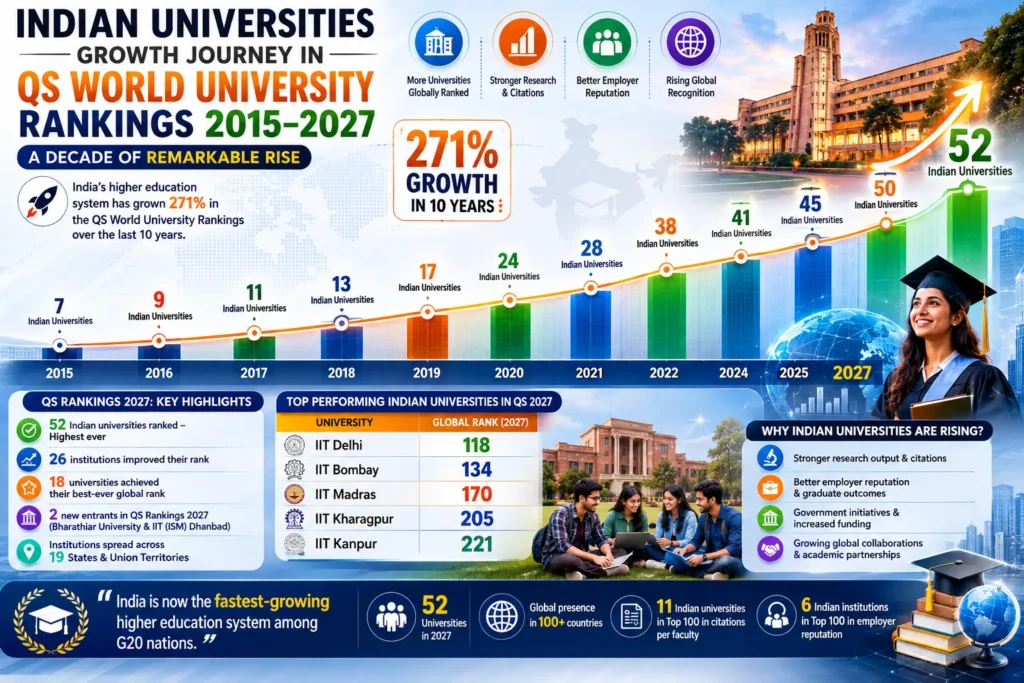
India is solidified as the fastest-growing higher education system in the G20 countries by relative development in the 2027 world university rankings. The Indian institutional presence in the QS world charts has increased by 271 percent in the last ten years; it had 14 ranked universities in the last assessment cycle. Out of the 50 ranked Indian entities in the past, 26 institutions had managed to improve their rank and 18 institutions received the highest global rank ever.
Two other institutions- Bharathiar University, and the Indian Institute of Technology( Indian School of Mines ) Dhanbad also entered the 2027 rankings. Their presence is not only a sign of the increasing geographical and institutional diversity of the Indian higher education environment, but also a marker of the increasing internationalization of recognition of higher education not only in India, but also beyond the traditional elite academic institutions of the country.
This is a significant step towards systemic development of higher education in India. The results introduce the fact that the quality of Indian higher education is slowly developing in a mass, as we are no longer dealing with a few and specialized institutions of the traditional elites, but with a network that disperses over the geography of 19 states and union territories.
Top Performing Indian Universities in QS World University Rankings 2027
The upper echelon of Indian higher education continues to be anchored by public technical institutions. The following table highlights the top-performing Indian universities within the global tier:
| University | Global Rank (2027) |
| IIT Delhi | 118 |
| IIT Bombay | 134 |
| IIT Madras | 170 |
| IIT Kharagpur | 205 |
| IIT Kanpur | 221 |
IIT Delhi’s Continued Rise
IIT Delhi has improved its ranking to 118th in the world and has managed to maintain its top rank in the country in this ranking cycle which was done by 123rd to 118th. This particular rank is the highest it has ever got in history by an Indian institution. The positive trend the university has followed has been largely due to a set of specific internal measures.
The employer reputation index of IIT Delhi improved by 11 positions to rank 39th in the world, an indication of good international corporate confidence in the technical expertise of the institute graduates. In addition, the school gained 60-place jump in the employment outcomes measure, and a 26-place grade in citations per faculty. These aspects highlight a healthy focus on career achievement after graduation and strong research in the academic sector, which reinforced its competitive stance in global education surveys.
Why Indian Universities Are Moving Up the Rankings
The greater multi-institutional progress in the world university rankings identifies structural alterations in three different regions.
Strong Research Output
Indian higher education institutions have shown quantifiable increases in the volume of scientific literature and impact on research in general. Eleven Indian universities have made it into the world top 100 in terms of citations per faculty. This progress is a sign of gradual growth in institutional research funding, more sophisticated laboratory systems, and a boost in high-impact international research partnerships. The total number of peer-reviewed articles with Indian origin has been growing steadily, transforming the academic ecosystem into the generation of output to high-citation, foundational science.
Better Employer Reputation
The match between university curriculum and business needs has directly boosted the perception of employers. There are six Indian institutions in the top 100 employers reputation in the world. The employability among graduates is further emphasized when the University of Mumbai moved 70 spots to be ranked 25th in the world in terms of employment outcomes whereas the University of Delhi was ranked 35 th. It means that Indian graduates are considered to be highly competent job-ready professionals by major domestic and international companies and able to cope with modern industrial challenges.
National Education Reforms
These positive rank adjustments have been hastened by the continuous institutional regularisation under the National Education Policy (NEP). NEP programs have laid significant stress on developing strong innovation systems, promoting interdisciplinary education models, and establishing formal standards of international cross-border university networks. Indian universities have broken down historical silos among separate branches of engineering, science, and the humanities to allow them to develop flexible educational models that are more aligned to western-style assessment.
The Catch Behind India’s Ranking Success
Although it is evident that there has been an improvement in research references and graduate employability indicators, a fair evaluation can demonstrate that there are structural weaknesses that can not allow Indian institutions to break into the world top 100.
Academic Reputation Remains Weak
Whereas research citation measures indicate the mathematical significance of published articles, qualitative global academic perception parameter is a reputable bottleneck. Among the ranked Indian institutions, only 8 percent experienced an upward trend in academic reputation this year and 28 percent had a downward trend. This measure is based on international peer surveys of institutional performance. Beyond engineering in the mainstream global market, Indian universities are rated lower by international scholars than similar institutions in Europe, East Asia and North America because of the lack of visibility and past insularity.
International Student Numbers Are Stagnant
Internationalisation measures remain one of the weakest areas of higher education in India. About 9 of the 100 Indian universities surveyed registered no change or negative international student ratios, and only one indigenous university was able to be in the top 500 in terms of international faculty representation.
The established United States, United Kingdom, Australian, and Singaporean hubs present stiff competition to Indian campuses. The lack of a multi-cultural international student body and faculty base constrained multi-cultural campus relationships and negatively affected the international research network scores used by global ranking organizations.
Private Universities Are Emerging as Serious Global Competitors
One important structural change identified in the QS World University Rankings 2027 is the infiltration of the private, research-intensive institutions into a sector that was previously dominated by strongly subsidized state institutions.
Shoolini University of Biotechnology and management sciences has reached to the top 500 globally as it is ranked at the position of 452. This success makes it the highest-ranked privately funded university in India in its fourth successive ranking cycle and the tenth-ranked in the country, along with traditional public institutions such as the IITs and the Indian Institute of Science (IISc).
Shoolini University Global Rank Trajectory (QS WUR):
2023: 801–1000 Band
2024: 771–780 Band
2025: 587
2026: 503
2027: 452 (Global Top 500 Entry)
The main cause of this increase is that the citations per faculty indicator has increased by 62 places, shifting to 76 th in the world. The private universities are also keeping pace with the international standards of competitiveness through the use of agile governance structures, investing private capital into some particular high-yield research laboratories, using performance-based incentives on faculty publications and establishing global industry collaborations. This evolution represents a shift to research-based operations, rather than just teaching-based models, and diversifies the larger system of higher education in India.
How QS Rankings Are Calculated
| Metric | Importance |
| Academic Reputation | Global academic perception |
| Employer Reputation | Graduate employability |
| Faculty-Student Ratio | Teaching quality |
| Citations per Faculty | Research impact |
| International Faculty | Global diversity |
| International Students | International appeal |
| Employment Outcomes | Career success |
| Sustainability | Environmental and social impact |
QS takes a combination of these indicators based on weighted methodologies to come up with general rankings. The reputation and employability in particular are quite high factors since they make a good percentage of the total score. The indicators of research impact and internationalisation also contribute significantly in the global ranking of universities.
Why These Rankings Mean for Students
These shifts in the dynamics of the global university rankings have a pragmatic perspective of the student decision-making structures.
For Indian Students
Institutional degrees at the local level are recognized internationally in favor of the local students. Graduating in a college that has ranked as one of the top 200 in the world makes it simpler to enter into the elite global post-graduate systems and it directly increases the employability of the university with the multi-national companies. In addition, the high figure in the number of research citations implies that undergraduate and post graduate students have access to highly dynamic, well funded laboratories ecosystems in their home country and there is no need to travel to other countries at the earliest opportunity in search of good research projects.
For International Students
To applicants who are considering the possibility of studying in India, recent rankings are an economic alternative to the conventional western destinations. The fact that India has globally known public and private universities that are providing low-cost education at one-tenth of the tuition fees that a student needs to pay in the US or UK, only enhances the case of India as an emerging destination of technical and scientific education.
Factors Students Should Consider Beyond Rankings
Though high global rank implies institutional strength, students have to examine variables that could be missed by standard indices:
- Granular Course Quality: The Macro-rank of a university may be good, yet the quality of particular departments may be different.
- Faculty Accessibility: Research faculty with high impact might emphasize publication over classroom instruction.
- Localized Placement Networks: It is important to review industry-based geographic recruitment pipelines when it comes to employment.
- Campus Infrastructure and Experience: The assessment of the real support services to students, the quality of housing, and the ongoing projects of the industry incorporation.
The Road Ahead for Indian Higher Education
In order to maintain this positive growth trend and place several institutions in the world top 100, the higher education policy in India should consider some key systemic aspects.
Areas Needing Improvement
The nation must have an organized system to recruit foreign talent. This necessitates the softening of visa regulations on international scholars, provision of special scholarships to international students and the establishment of global recruitment channels of faculty members. Moreover, the university labs to industrial commercialisation routes need to be streamlined so that high value citations are converted directly to intellectual property, patents and spin-offs in the market.
Strategic Opportunities
The widening area of the National Education Policy offers a great opportunity to carry out these upgrades. Engaging in more research through grants to the public, fostering greater industry partnering in funding research, and aiding the research capacity of the emerging private universities can contribute to developing a more globally integrated educational model.
Conclusion
The ranking of the Indian universities in the QS World University Rankings 2027 is a great milestone towards the Indian higher education industry. The striking statistics of this cycle – the 52 ranked institutions anchor, the rise of IIT Delhi to the 118 th position, and the emergence of the private research institutions in the global top 500 list are indications of quantifiable improvement in the output of research and in the employment ability.
But, to secure a position in the top 100 list of the world universities, one will need to deal with structural issues that have existed over the years. To promote international academic reputation, increase representation of international faculty and students, and advance campus diversity, Indian institutions need to do more than rely on research citations to establish themselves as a global institution. By resolving these foundational areas, India can shift its status from being a primary exporter of foundational talent to becoming a highly integrated globally desirable destination of higher education.