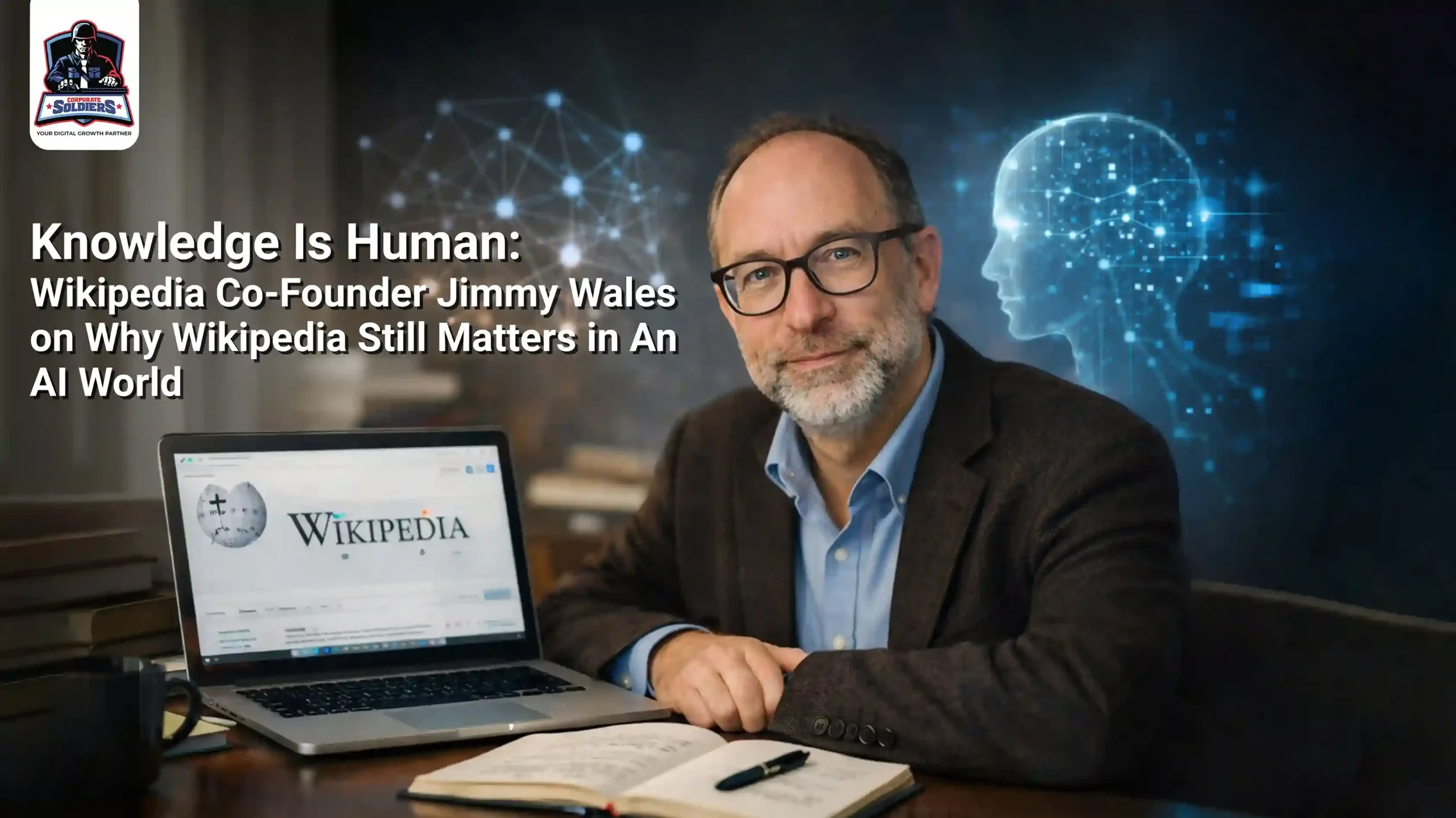
As generative models flood the internet with synthetic content, Wikipedia’s co-founder argues that human-led curation remains the ultimate safeguard for factual integrity.
Human Imperative to a Synthetic World
The very nature of knowledge is experiencing a tectonic change in a world where it is possible to create essays, code, and art, within seconds, using generative artificial intelligence. But to Jimmy Wales, the co-founder of Wikipedia, the emergence of Large Language Models (LLMs) has not made the largest encyclopedia in the world irrelevant; instead, it has endangered its humanist mission more than ever. Speaking at an AI-focused event in India, Wales solidified a fundamental philosophy: Knowledge is human. With AI systems moving into the digital world with more and more realistic yet at times unreliable information, Wales argues that the only possible underpinning of a dependable global information ecosystem is the human verification that is extremely labor intensive and volunteer based.
The Foundations of the Internet: the World Wiki
Wikipedia began as a radical experiment in open collaboration in January 2001. It has grown over twenty-five years since it was a controversial project that anyone can edit into one of the most-visited websites globally and a central reference point on the internet. The platform today has over 60 million articles across more than 300 languages with a network of hundreds of thousands of active volunteer editors globally.
Wikipedia is the building block of the AI revolution even outside of its actual purpose as a destination of curious readers. Many large language models are trained on publicly available datasets that include Wikipedia content. Because Wikipedia offers structured, cited and human-reviewed text, it has become a significant reference source within the broader AI training ecosystem. Researchers have warned that over-reliance on synthetic data could degrade model quality over time — a phenomenon sometimes referred to as “model collapse,” where AI systems begin training on their own generated outputs, leading to reduced factual reliability.
Knowledge Is Human: The Limitations of AI
The comments by Wales indicate that the superficial skills of AI systems are not to be confused with credibility. Generative models have the capability to generate convincing responses that are coherent but do not know information as a human being would. They are predictive of patterns on the basis of training data, and can produce inaccuracies also called hallucinations with high confidence.
In comparison, the power of Wikipedia is human judgment. Editors argue about the origin of the sourcing, question unsourced assertions and delete unreliable content. This is an imperfect process of iteration that involves collective reasoning as opposed to algorithmic probability.
Wales has always warned not to overestimate the epistemic authority of AI. Generative systems have strengths in creativity and synthesis, yet it is up to humans to decide which things are accurate, notable or well represented. His point of difference is urgent, as there is an ever-growing speed in automated content creation.
Community Oversight: The Deadline Defense
The defense mechanism of Wikipedia against the hallucinations that are common to AI is its stratified community control. Wales explained the methods used in the community in a hybrid way to ensure quality. Although the platform is powered by simple bots to complete repetitive tasks, like the checking of ISBN numbers or undoing of obvious blanking vandalism, the hard work of editorial decision-making is squarely human.
Volunteer editors provide the last line of defense against advanced fake news. They have lists of depleted sources, which prohibit websites that propagate propaganda or fake news, and they do deep-investigations into so-called sockpuppet accounts that are trying to bias the opinion of the population. In the AI world, where the synthetic bots create their fake news pieces at scale, the only thing standing between the digital commons and being overwhelmed by disinformation is the human editor with his or her sense of intent and context.
Fighting AI-driven Fake News
Misinformation has been aggravated with the development of generative AI. Artificial intelligence can produce credible writing, deepfakes and fake articles on a mass scale, making it difficult to determine the difference between truth and fiction. This threat overlaps with the current issues of digital media ecosystems, where viral fake news may affect the ultimate conversation and democracy.
The editorial structure of Wikipedia, where one has to provide references to published materials that can be trusted, is a countermeasure. The content conflicts are solved by discussion and agreement as opposed to algorithmic amplification. Although Wikipedia cannot be devoid of mistakes, the correction mechanisms are visible and iterative.
Wales has identified this type of governance as one of the differentiators. Unlike AI systems which can produce answers without being traced to their origin, Wikipedia articles have the citation of verifiable resources. With the information overload, one of the metrics of value is trust and traceability.
The Future of Wikipedia in India
India represents a significant readership and contributor base for Wikipedia. The language diversity of the country also is compatible with the multilingual mission of the platform which also incorporates long editions in Hindi, Bengali, Tamil, Telugu and Marathi among a host of other languages used in India. The Wikimedia Foundation has been keen on increasing the local language content, especially with the increased internet penetration in non-English speaking areas.
Wales has also emphasized the need to build the community of editors in the new digital economies. The fact of a big, young, technologically engaged population in India offers an opportunity, as well as a task: to make sure that the knowledge creation is not based on the Western or English-language narratives, but is a reflection of the different perspectives.
Better machine translation applications, also with AI-based applications, may help in closing language barriers. Nevertheless, the human editors are required to provide context, verify and modify the content appropriately. In this regard, AI and the volunteer community of Wikipedia can function complementarily: technology with increased coverage, and humans with integrity.
The Future of Collaboration: AI as an Assistant, Not an Author
When looking into the future, Wales does not envision the antagonistic relationship between Wikipedia and AI, but a cautious cooperation. He sees a time when AI will be an advanced tool of human editors to check out possible contradictions in stories, citation suggestions or coverage holes. Nevertheless, the ultimate editorial privilege should never leave an individual.
Another way of gaining more inclusive knowledge is through the emergence of open-source AI models. The developers can train models using the Wikipedia diverse language data and restrict the biases present in models that have been trained using the English-centric datasets. However, it is up to the human community to make sure that the data that is being inputted into these models is representative and unbiased.
Conclusion: The Enduring Value of the Human Touch
Since the digital world is at the intersection of the AI revolution, the defense of Wikipedia by Jimmy Wales reminds us that facts are not simply pieces of data, but the product of human agreement and moral standards. Though AI is able to process information in the scale that humans cannot, it does not have the moral compass and the adherence to the truth that the Wikipedia community embodies.
Wikipedia remains relevant because it does not automate the most critical function of knowledge – determining what is true. The label of the human origin of knowledge can be the most valuable attribute of it in a future where it is probably overwhelmed with the AI-generated content. As Wales argued, the search for a common reality is a distinctly human task, something that can never be replaced by an algorithm, as sophisticated as it is.