The philosophy of space operations has entered a paradigm shift in an era where the orbital space is becoming more and more crowded and keeping assets is important in preserving research infrastructure on the planet. Over decades, the lifecycle of a spacecraft was a somewhat rigid and costly plan: launch, operation, run out of fuel or wear and tear, and, finally, abandonment or de-orbit. Nevertheless, there is an official break of this cycle by a historic cooperation between NASA and the commercial aerospace sector.
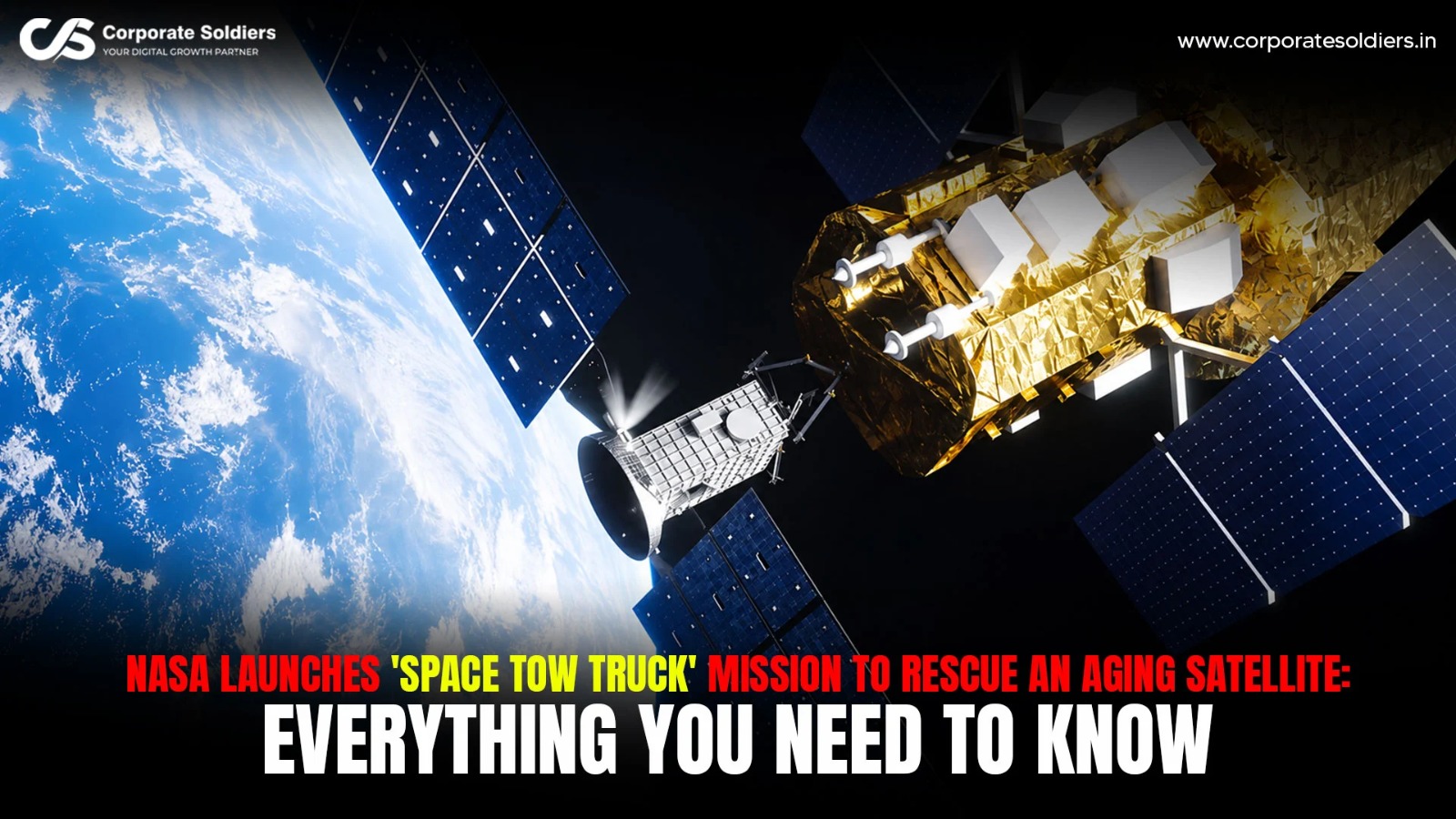
The launch of a special purpose robotic orbital servicing vehicle capable of intercepting, attaching itself and re-boosting a vital scientific mission has ushered in the space tow truck. This groundbreaking mission is not just to rescue a multi-million-dollar telescope on a looming death at the hands of the atmosphere but also to act as an essential testbed to technologies that will essentially transform space sustainability, satellite life-span and orbital logistics.
What Is NASA’s Space Tow Truck Mission?
The project serves as a pathfinding demonstration for robotic satellite servicing and revolves around a new vehicle that is specifically designed to orbit the earth and it is designed by a start-up company based in Arizona, Katalyst Space Technologies. This robotic spacecraft, named LINK, is designed as an orbital servicing vehicle and maneuvering tug to support aging or unpowered satellites in low Earth orbit (LEO).
Mission Objectives and Parametres
The main LINK mission aims at achieving two goals:
- Physical Interception and Stabilization: Carry out an autonomous rendezvous and proximity operation (RPO) with an uncooperative, aging satellite that does not have native docking fixtures.
- Orbital Re-boost: Use high-efficiency propulsion units to literally drag the target satellite off of its degrading orbit and into a safe, sustainable operating orbit about 600 kilometers above the Earth.
Launch Profile and Technical Partnerships
The spacecraft was launched into orbit using a Northrop Grumman Pegasus rocket- a special air-launched spacecraft carried off into orbit by a modified Stargazer L-1011 aircraft, an ideal spacecraft to provide orbital insertion flexibility.
The formulation and implementation of the mission is a very agile public- private cooperation. NASA offers institutional expertise and tracking infrastructure, and the target asset, but Katalyst Space Technologies designed, built and operates the LINK servicing vehicle. Remarkably, the whole project was implemented between the concept and the launch pad in less than a dozen months- a time frame that the conventional aerospace procurement models would normally take five to seven years to complete.
What Satellite Is Being Rescued?
This first spacecraft orbital rescue mission is none other than the Neil Gehrels Swift Observatory (sometimes simply called the Swift satellite).
Legacy of the Swift Observatory
The Neil Gehrels Swift Observatory was launched by NASA in November 2004 to study gamma-ray bursts (GRBs), some of the most energetic explosions in the universe. During more than two decades of operation, Swift has revolutionized high-energy astronomy by detecting thousands of gamma-ray bursts, studying black holes and distant galaxies, and providing rapid observations of some of the universe’s most energetic transient events.
The Critical Vulnerability
Although its instruments are still very useful and able to add data to the scientific community, Swift faces a significant operational challenge because it lacks onboard propulsion to maintain its orbit.
At the time of Swift deployment, it was put into LEO where it is fed by a minute yet steady dose of atmospheric drag which incessantly bled the kinetic energy of the spacecraft. Over time, atmospheric drag has gradually lowered the satellite’s orbit. Swift would have eventually crashed into the thicker airborne strata, and after reentry would be disastrous as the historic telescope would have burnt away entirely. Greenlighting of the LINK mission was aimed at preventing this loss and providing the aging satellite with a second lease on life.
How Does the ‘Space Tow Truck’ Work?
To successfully execute a dynamic capture of an aging satellite with a speed of more than 27,000 kilometers per hour, a coordinated effort by a number of automated systems is needed. The LINK mission operational architecture is broken down into detailing, step-by-step phases.
[Phase 1: Transit & RPO] ——> [Phase 2: Proximity Probing] ——> [Phase 3: Triple-Arm Capture] ——> [Phase 4: Coordinated Re-boost] (1-Month Drift to Asset) (Sensor & Camera Mapping) (Mechanical Gripper Lock) (60-Day Orbital Re-boost)
The Interruption and Proximity Sequence
After orbit insertion of LINK by the Pegasus rocket, the satellite starts a one-month careful journey to the Swift satellite. With a combination of tracking systems and autonomous navigation, LINK will gradually reduce the distance to the Swift Observatory before beginning close-proximity operations.
The servicing vehicle also switches to its relative navigation system as it approaches Swift. Using onboard cameras and sensors, LINK assesses the satellite’s position and orientation to support a safe and precise approach. This is an important step because Swift was not originally designed for in-orbit servicing or docking.
Mechanical Capture and Orbit Adjustment
After completing its approach, LINK deploys three robotic arms equipped with hand-like grippers to gently secure the Swift Observatory. Once a stable connection is established, the servicing spacecraft can safely maneuver the combined system before beginning the planned orbital re-boost.
LINK will then use its onboard propulsion system to gradually raise the observatory into a higher orbit over an estimated 60-day period, moving Swift to an orbit about 600 kilometres above Earth.
Why Satellite Servicing Matters
The relevance of the LINK mission goes much further than the conservation of one of the astrophysics telescopes. It is an indicator of a paradigm change in the attitude of national governments and business organizations towards assets in space, directly affecting the economics, defense, and orbital sustainability in the long term.
Extending Satellite Lifespan
In the past, billions of dollars have been wasted as the satellites that were in good condition were scrapped out simply because of fuel shortage or a small orbital degradation. The basic nature of life extension missions is that it alters the financial amortization of space hardware such that operators can wring a few more years of revenue or scientific data out of the investments they already have.
Reducing Space Debris
The dumping of dead satellites renders them a space debris that is dangerous. These uncontrollable objects over the time not only drift, rust, and risk catastrophic collisions resulting in clouds of shrapnel, but also increase the risk of Kessler Syndrome (a situation in which LEO has become too dangerous to use). Moving and de-orbiting of aging assets physically maintains pathways that are critical.
Lowering Mission Costs
The construction and the deployment of a substitute satellite is a tremendously expensive affair. Using one, reusable, or modular servicing vehicle to service many assets can help space agencies and commercial constellations significantly reduce the total infrastructure costs.
Supporting National Infrastructure and Orbital Sustainability
Most of the world’s communication, navigation and weather networks are based on old fashioned satellites of the heavy-class. In order to protect this critical infrastructure on earth, orbital servicing prevents such a breakdown. On a wider scale, by introducing an active, circle-based space economy that aims at repair and reuse, the orbital environment on Earth will be able to be sustainable in the future.
The Technology Behind the Mission
The technology of the LINK spacecraft engineering is a culmination of current aerospace technology, a combination of deep automation and ruggedized mechanical systems, to endure extreme thermal and radiation conditions.
| Technology System | Core Functionality | Integrated Components |
| Autonomous GNC | Real-time path planning and collision avoidance during close approach. | Onboard cameras, sensors and autonomous navigation software. |
| Robotic Capture Suite | Secure satellite capture and stabilization. | Three robotic arms with hand-like grippers. |
| Propulsion System | Raises the attached satellite into a higher orbit over an extended period. | Onboard propulsion system (specific propulsion technology has not been publicly disclosed). |
The biggest technological achievement of this mission is the shift between human-in-the-loop control to the highly autonomous machine execution. The speed-of-light communication lag between ground stations and LEO means that the last meters of docking will then have to be calculated completely on board by the central computer of LINK which will then react in real time to any erratic micro-movements of the Swift satellite.
Challenges of Servicing Satellites in Space
On the one hand, the idea of an orbital tow truck is a beautiful one, but on the other, implementing it in the conditions of the environment that does not tolerate zero margins of error poses enormous engineering challenges.
- Extreme Hyper-Velocities: Both vehicles are traveling in space at the speed of about 7.5 kilometers per second. Even a difference of a few centimeters per second in the last docking may cause a mild mechanical grip to become an explosion of high velocity crash.
- The Issue of the Non-cooperative Asset: Swift and other legacy satellites do not have communication handshakes with which to transmit positional telemetry to the incoming craft. LINK is obliged to regard the observatory as a perfectly passive, lifeless object.
- Mass Property Alterations: When LINK attaches itself to Swift, the center of mass and the moments of inertia of the whole system change by a huge amount. These changes have to be dynamically calculated by the flight computer of LINK to ensure that the combined stack does not go into uncontrolled spin due to the firing of propulsion thrusters.
How This Mission Could Shape the Future of Space Exploration
If the LINK mission successfully demonstrates its planned capabilities, it could accelerate the development of commercial satellite servicing technologies. Future orbital servicing missions may include spacecraft designed for satellite inspection, repair, repositioning and life-extension, helping operators maintain critical space infrastructure more efficiently.
Technologies demonstrated during the LINK mission could also support future orbital servicing and logistics missions beyond low Earth orbit. Autonomous rendezvous, docking and satellite-handling capabilities are expected to play an important role in future space infrastructure, including NASA’s Artemis program and the Lunar Gateway.
Global Competition in Satellite Servicing
The space race to control the in-space servicing, assembly, and manufacturing (ISAM) market is escalating around the world as a fundamental aspect of geopolitical space dominance, both to the defense and the civilian worlds.
[Global ISAM Market Landscape] ├── United States: NASA / Katalyst Space Technologies (LINK, Proximity Tug Development) ├── Commercial Leaders: Northrop Grumman (MEV), Astroscale (ADRAS-D Debris Capture) └── European Union: ESA (ClearSpace-1 Active Debris Removal Initiatives)
Although NASA and Katalyst are leading the way in civilian-focused rapid-response solutions, other organizations such as the U.S. Space Force are investing heavily in tactical versions of these solutions to monitor and defend national security satellites. The European Space Agency (ESA) is financing specific debris-removal campaigns, such as ClearSpace-1, internationally, and commercial capture mechanisms and orbital gas stations are actively being tested by commercial enterprises, including Astroscale and Orbit Fab. The LINK mission puts an impressive standard of low-cost, quick execution in this multi-billion-dollar worldwide market.
Industry and Expert reactions
The fast development cycle and successful launch of the LINK mission has created considerable wave-effects across the aerospace sector with accolades that it is not based on the slow and traditional development models.
Katalyst CEO Ghonhee Lee emphasized the wider space defense and operational readiness implications in an official statement about the significance of the security and strategic weight of the flight:
This is of great concern to the US Space Command, since in the end this is one of the fundamental aspects of space superiority, and a typical mission like this would have been five years to assemble, and we were able to do it in less than a year.
The partnership also demonstrates the growing feasibility of responsive orbital servicing capabilities by significantly reducing the development timeline compared with traditional aerospace programs.
What Happens Next?
Following launch, LINK will undergo initial spacecraft checkouts before beginning its approximately one-month journey toward the Neil Gehrels Swift Observatory. Once it reaches the satellite, the mission plans to conduct proximity operations, attempt a robotic capture using its three-arm system and, if successful, begin the planned 60-day orbital re-boost to raise Swift into a higher orbit. The mission will also evaluate LINK’s autonomous rendezvous and satellite-servicing technologies, helping inform future orbital servicing missions.