Introduction
The conventional approaches to blogging placed a lot of emphasis on posting single articles on single isolated keywords. Although this method was effective in the past, it is becoming more and more inefficient in competitive search settings. Search engines no longer treat pages in isolation; they evaluate entire content ecosystems.
Topical authority, contextual relevance and semantic relationships among pieces of content are the key factors considered by modern search algorithms. This has necessitated semantic SEO and structured content systems that are required to ensure long term visibility.
It is here that pillar pages and topic clusters make the difference in terms of SEO performance. A business does not post unrelated blogs but creates content hubs, which are interrelated and reveal a high level of expertise on certain topics.
An effective topic cluster model helps search engines recognize your website as an authority within its niche. Properly applied, it can greatly enhance rankings, boost organic traffic, and enhance overall domain authority.
By using a well-organized content hub approach, businesses can take over niche search visibility by interlinking pillar content and cluster supporting pages strategically.
What Are Pillar Pages?
A pillar page is a detailed guide that acts as the central hub for a broad topic. It discusses a topic in-depth at a high level but links to more detailed supporting articles.
Purpose of Pillar Content
Pillar pages are designed to:
- Get authority on a fundamental subject.
- Combine similar information within one umbrella.
- Enhance internal linking.
- Take users through a systematic learning process.
How Pillar Pages Function
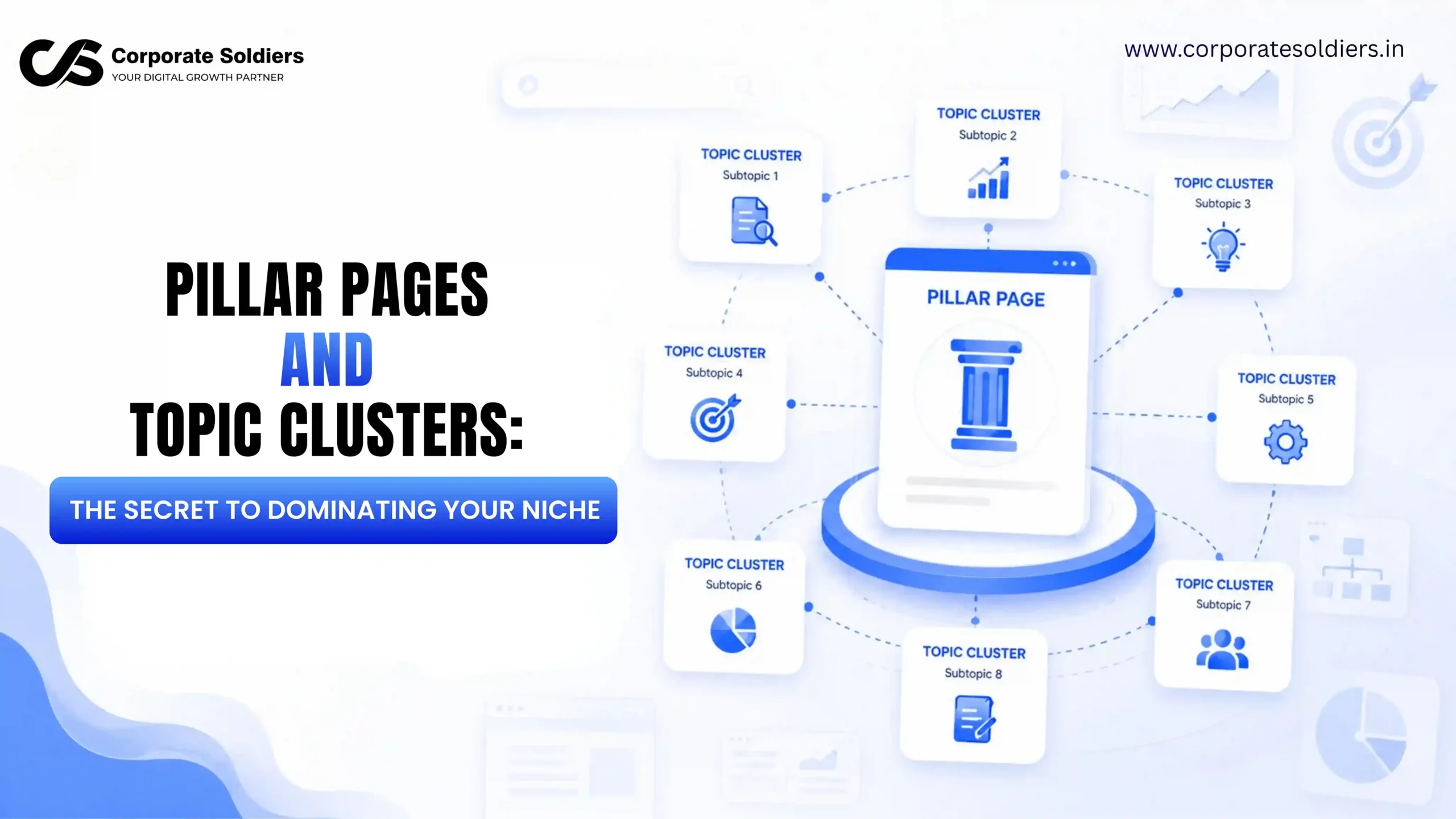
A pillar page is the anchor to a content clustering system and it connects to several related articles (cluster pages) which expand on subtopics. This creates a connected content network that search engines can easily interpret.
Examples of Pillar Pages
- Complete SEO Guide
- Ultimate Content Marketing Guide
- Digital Advertising Hub
Common Formats
- Ultimate guides
- Resource hubs
- Beginner-to-advanced educational pages
Pillar pages, unlike regular blog posts, focus more on breadth and less on depth to have complete coverage of the topic.
What Are Topic Clusters?
A topic cluster is a collection of related content items which revolve around a single pillar page. The cluster pages are centered on a particular subtopic and they are all linked to the pillar page.
Connection between Pillar Pages and Clusters
- Pillar page = hub of authority.
- Cluster pages = espousing deep-dive articles.
This architecture constitutes a closely-knit SEO ecosystem.
Example of a Topic Cluster Structure
For example, an SEO Strategy Guide can serve as the pillar page. Cluster page support could involve such topics as keyword research, on-page SEO, technical SEO, building links, local SEO, SEO analytics, and SEO audits.
All of the supporting articles will discuss a smaller subtopic but they will all refer to the overall pillar page. Meanwhile, all the content related to the pillar page is linked to the cluster content, which is easily connected to form an ecosystem of related content.
This organization enhances semantic connections between pages, internal linking, and assists the search engines to gain a better idea of the breadth and depth of your knowledge on a subject.
Why Topic Clusters Matter
Websites that are rewarded by search engines typically show:
- Clear topic organization
- Good internal linking strategy.
- Complete coverage of subject matter.
Examples of Topic Clusters
- SEO cluster structure: on-page SEO, Keyword research, link building.
- SaaS marketing cluster: onboarding, retention, pricing strategies.
- E-commerce search optimization group: product search optimization, category search optimization, schema search optimization.
How the Topic Cluster Model Improves SEO
The topic cluster model improves SEO performance in several ways.
Improved Crawlability
Bots that operate search engines can move across interrelated pages with ease and enhance indexing efficiency.
Strong Internal Linking Structure
An internal linking strategy that is well-planned spreads authority among the pages of the cluster and supports the pillar page.
Enhanced Topical Authority
The publication of related material is an indicator of competence in a particular niche, and it enhances topical authority.
Reduced Keyword Cannibalization
Rather than having several pages with the same keyword, content is strategically divided.
Increased Engagement Metrics
Users can browse between related pages, which enhances:
- Session duration
- Pages per session
- Return visits
The Relationship Between Topic Clusters and Topical Authority
Topical authority refers to a website’s demonstrated expertise and depth of knowledge on a specific topic. Contemporary search engines are increasingly considering how a site addresses a complete subject matter as opposed to posting single articles that focus on a single keyword.
Topic clusters help build topical authority by connecting related content under a central pillar page. When search engines see comprehensive coverage of a topic and strong semantic relationships between pages, they gain greater confidence in the website’s expertise.
For example, a website that publishes content on SEO strategy, keyword research, technical SEO, on-page SEO, link building and SEO reporting will be perceived as an authority as compared to a site that has published just one article about SEO.
This all-encompassing content ecosystem enhances rankings on both competitive head term and long-tail search terms. With more cluster pages being added with time, the overall authority and search visibility of the whole content hub can only increase.
Pillar Pages vs. Traditional Blogging Strategy
To fully realize the power of content clustering, it is helpful to contrast it directly with historical content creation methodologies.
| Strategic Dimension | Traditional Blogging Strategy | Topic Cluster Model |
| Keyword Targeting | Targets isolated keywords with varying intents on a post-by-post basis. | Targets broad head terms with the pillar, and long-tail variants with clusters. |
| Internal Linking | Ad-hoc, unstructured, or occasionally non-existent linking between posts. | Rigorous, reciprocal, and programmatic parent-child linking hierarchy. |
| Content Structure | Linear, chronological feed where older content gets buried and loses value. | Hub-and-spoke architecture that maintains content equity over time. |
| Search Visibility | Fragmented; individual posts rank for niche terms but fail to capture competitive keywords. | Holistic; whole clusters lift each other up, allowing the site to rank for high-volume head terms. |
| Authority Building | Relies heavily on acquiring external backlinks for every individual URL. | Distributes backlink equity across the entire cluster via optimized internal links. |
| User Experience | Chaotic; users must use search bars or manual filtering to find related topics. | Seamless; logical semantic pathways guide users from beginner to advanced concepts. |
| Scalability | Diminishing returns; publishing more content increases the risk of cannibalization. | Scalable; new subtopics seamlessly integrate into existing hubs as markets evolve. |
Publication of random unorganized content thwarts domain authority. It makes search engines speculate on which page has the ultimate authority on a topic and often the visibility of all the involved pages is suppressed.
The Anatomy of a High-Performing Pillar Page
A good pillar page consists of:
- Clear navigation structure
- Comprehensive topic coverage
- SEO-optimized headings (H1–H3)
- designed cluster page links.
- Strong visual hierarchy
- Search optimization markup.
- Clear calls-to-action (CTAs)
- Mobile optimization
- Fast loading performance
Breadth is to be addressed in a pillar page whereas depth is to be addressed in cluster pages.
Creating a Topic Cluster Strategy: Step-by-Step
Step 1 – Identify Your Core Topic
Choose a general and high value subject in line with:
- Business relevance
- Search demand
- Audience interest
- Monetization potential
Examples: “SEO Strategy or Content Marketing.
Step 2- Keyword Research
Focus on:
- Search intent (informational, transactional, navigational)
- Semantic keyword variations
- Long-tail opportunities
- Content gaps
Tools:
- Ahrefs
- SEMrush
- Google Search Console
- Google Trends
Step 3 – Create the Pillar Page
Create a detailed guide which:
- Discusses the subject in general.
- Includes structured headings
- Responds to important user queries.
- Links to cluster pages.
Step 4 – Develop Supporting Cluster Content
Write in-depth articles on subtopic topics like:
- Tutorials
- FAQs
- Case studies
- Comparisons
- Problem-solving guides
The cluster pages should be narrowed down to one form of a keyword.
Step 5- Effect Strategic Internal Linking
A good internal linking plan comprises:
- Labelling pillar pages with cluster pages.
- Cluster pages that are cross-linked.
- Descriptive anchor text.
- Maintaining logical hierarchy
Step 6 – Update and Expand the Cluster
Sustain performance in content by:
- Updating outdated information
- The addition of new cluster pages.
- Monitoring rankings
- Removing underperforming content
Auditing Existing Content for Topic Cluster Opportunities
Dozens or even hundreds of blog posts are already published by many businesses over the years. Prior to developing new content, one should look at existing assets to get topic clustering opportunities.
Content audit assists in determining pages that can be restructured to form a more structured content ecosystem. Businesses often have the ability to enhance their SEO performance by using the content that they have already produced, as opposed to creating it all on their own.
The content audit may assist in finding:
- Existing pillar-page candidates
- Articles that are related and can be cluster pages.
- Content gaps that require new content
- Keyword cannibalization issues
- Internal linking opportunities
Instead of having to create a lot more content to increase the content production, businesses can enhance topical authority, internal linking, and search visibility by rearranging existing content into structured topic clusters.
Real-World Topic Cluster Examples
Many leading SEO and digital marketing companies use topic clusters as a core content strategy to build topical authority and improve organic search visibility.
HubSpot organizes content around major topic hubs such as marketing, sales, CRM, customer service, and business growth. Each hub contains extensive supporting content that links back to broader pillar resources.
Semrush builds comprehensive content ecosystems around SEO, PPC advertising, content marketing, competitive research, and digital marketing strategy. Its content structure allows users to navigate related topics through interconnected guides and resources.
Ahrefs uses topic clusters extensively across keyword research, link building, technical SEO, content strategy, and SEO analytics. Their pillar-style guides are supported by detailed articles that address specific subtopics and user questions.
These examples demonstrate how structured content hubs can help websites build authority, improve user experience, and strengthen organic search performance over time.
Real Examples of Successful Topic Cluster Models
SaaS Example
- Pillar: Guide SaaS Growth
- Clusters: reduction of churn, onboarding, pricing strategy.
- Result: increased number of people registered to trials and organic traffic.
E-commerce Example
- Guide: SEO in e-commerce.
- Clusters: product page optimization, category optimization, reviews strategy.
- Findings: enhanced product visibility.
Healthcare Example
Pillar: Guide to Dental Care.
Clusters: oral hygiene, treatments, procedures
Outcome: increased local search-insourcing
Finance Example
- Pillar: Personal Finance Hub
- Budgeting, investing and tax planning: clusters.
- Conclusion: increase in trust and conversions.
Common Mistakes to Avoid
Avoid these pitfalls:
- Weak internal linking
- The material of thin or low-value aggregates.
- Targeting unrelated topics
- Keyword cannibalization
- Over-optimization of keywords
- Poor site architecture
- Ignoring search intent
Such errors undermine topical authority and decrease the level of SEO.
Pillar Pages and Topic Clusters for Local SEO
Clusters can be used by local businesses to leverage them in:
- City-based content hubs
- Service-area pages
- Hyperlocal keyword targeting
Examples:
- SEO Services in Mumbai.
- Dental Clinics in Delhi
- Bangalore Real estate.
This plan builds the presence of local search results.
Best Tools for Building Topic Clusters
- Ahrefs – Competitor analysis, Keyword analysis.
- SEMrush -topic discovery and tracking of SEO.
- Surfer SEO -Optimization of content.
- Frase / Surfer SEO – AI-powered content briefs and optimization guidance.
- Screaming Frog – Site structure analysis.
- Google Search console- performance monitoring.
- Notion / Trello -Organization and planning of content.
Measuring the Success of Your Content Cluster Strategy
Track key metrics:
- Organic traffic growth
- Keyword ranking improvements
- Internal click-through rates
- Average session duration
- Pages per session
- Backlink acquisition
- Conversion rates
- Search visibility index
These pointers depict the increasing niche power.
Why Topic Clusters Are Critical for Modern SEO
Search is transforming to:
- AI-driven understanding
- Entity-based indexing
- Semantic search interpretation
- Intent-based ranking systems
Structured content clusters help search engines better understand expertise, relevance, and depth. Sites which are based on isolated content find it difficult to compete with structured bodies of knowledge.
Frequently Asked Question (FAQ)
What does a pillar page mean?
A pillar page is a high level, broad based, guide on a web site in detail. It acts as the anchor point of a given subject and goes out to further more relevant pages that are known as cluster pages.
What are topic clusters in SEO?
A topic cluster is a form of content organization in which one central pillar page is linked with a collection of related subpages that are closely related in content, through purposeful internal linking. The structure assists search engines to identify the profound topical authority of your site on that topic.
Do topic clusters improve rankings?
Yes. Topic clusters improve rankings by strengthening topical authority, improving internal linking, and helping search engines understand content relationships more clearly.
Are topic clusters beneficial to rankings?
Yes. Categorizing your content into distinct groups will enhance your internal linking structure, reduce the problem of cannibalization of keywords within your site and also facilitate easy search of your content to search engines. This aids in proving that there is great topical authority, which increases search visibility among all the pages.
What should be the frequency of updating pillar pages?
The auditing and renewal of pillar pages should be done at least once a year or once in six months. Since they are the main knowledge centers of your viewers, it is important to ensure that they are updated on the latest industry statistics, new internal connections and other pertinent search information.
What is the difference between topic clusters and categories?
Website categories Categories are organizational buckets of high level of broad navigation (e.g., “Blog,” “Services,” “Case Studies). Topic clusters, conversely, are very narrow content units, strategic structures that are based on semantic relationships in order to develop authority on a certain topic.
Conclusion
Topical authority is no longer a choice that businesses wishing to increase their organic search presence can opt for. By keeping on supporting the depth of expertise and user experience, as search algorithms, websites based on unstructured ad-hoc publishing will remain at a disadvantage against its better-organized competitors.
A pillar page and topic cluster strategy shifts focus from short-term keyword targeting to long-term structured content planning. Mapping your content to user search intent, developing overall central hubs, and linking them, in conjunction with a programmatic internal linking strategy, you make a valuable, scalable informational asset.
The ultimate goal of search engines is to provide the best, most authoritative answer to a query by a user. With content hubs that are constructed in detail and are tightly interlinked, you demonstrate to search engines and your audience that you are the authority in your field. Follow this step-by-step plan in your main business themes, and your site will be able to gain the credibility it requires to take over your niche.
Businesses that consistently build and expand topic clusters over time create compounding SEO value, where every new piece of content strengthens the visibility and authority of the entire content ecosystem.