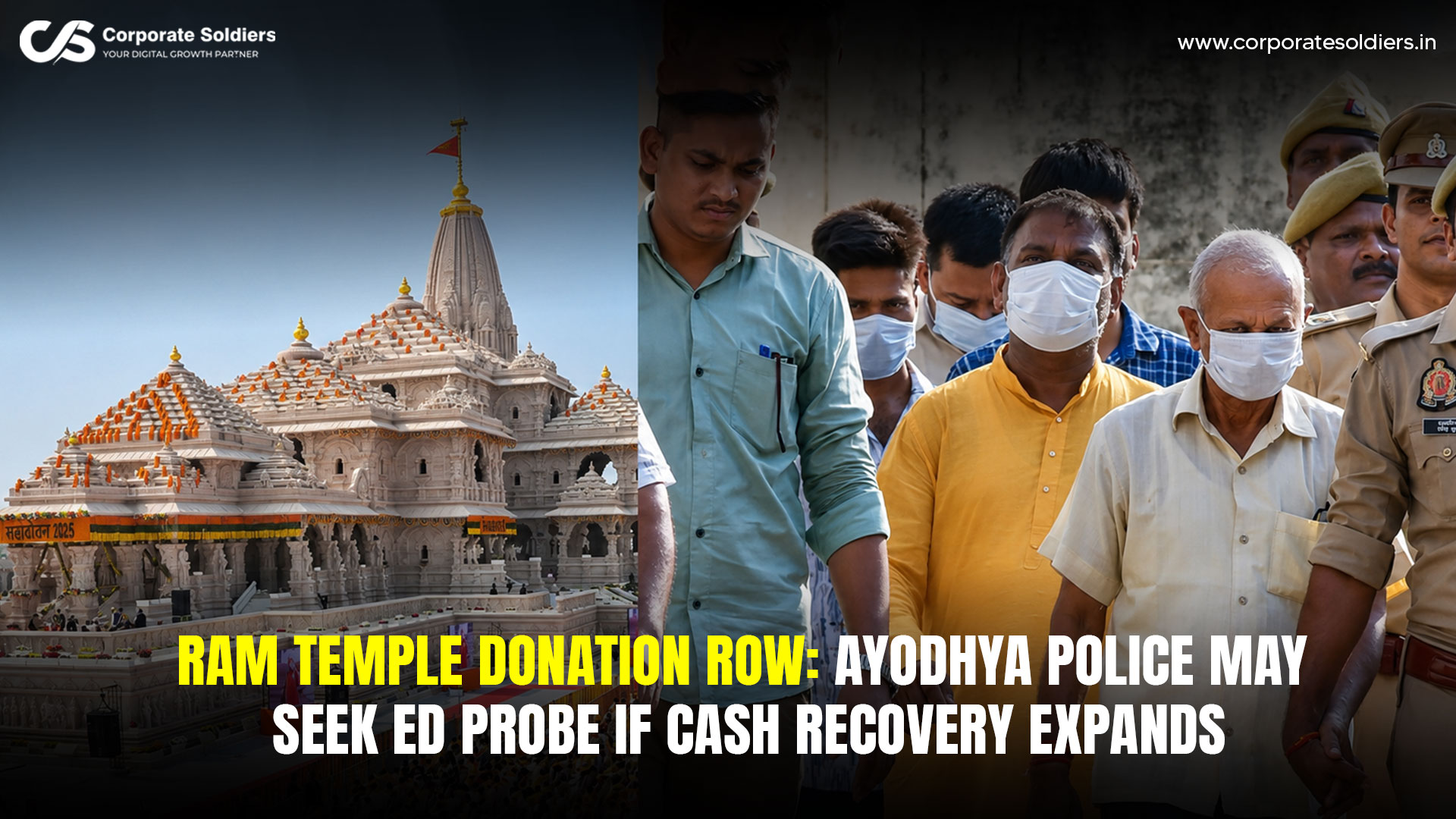
The investigation into the alleged embezzlement of donations made to the Ram Temple in Ayodhya has entered a new phase, with Uttar Pradesh Police examining whether the Enforcement Directorate (ED) may become involved if the financial trail expands.
Investigative sources say that Ayodhya Police is still retrieving cash and valuables that could have been related to the case as they investigate the financial transactions, bank accounts and assets of the accused. In case the recoveries are still rising or investigators find evidence that the proceeds of the alleged offence were laundered into financial channels, central agencies like the Enforcement Directorate can be involved, based on the evidence obtained in the process of the investigation.
The case is being watched across the country considering the donations that are being made to one of the most important religious institutions in India. The theft itself is not the only issue that has brought this investigation to the fore; it also serves as a reminder of how important financial accountability is, along with internal controls and transparency in the management of the funds.
What is the Ram Temple Donation Row?
The issue is how funds, voluntarily given by devotees at the Ram temple, at Ayodhya, were misappropriated by those entrusted with collecting and counting the money.
A Special Investigation Team (SIT) constituted by the Uttar Pradesh government carried out a preliminary inquiry into the alleged irregularities. Based on the SIT’s findings, Ayodhya Police registered an FIR against eight individuals who were allegedly involved in counting and managing temple donations.
Those suspected are those who were allegedly involved in the collection of cash and valuables at the temple. Eight people have been arrested in the case and the police said the search is continuing.
Over some time, investigators claim, money and assets were diverted to other purposes from the temple. In the subsequent search of residences and locations related to the accused, authorities have recovered a number of objects which they say are being scrutinised as evidence.
Significantly, these claims have not been substantiated in court and are currently being investigated.
Why Ayodhya Police Are Considering an ED Probe
Whether a case warrants an ED investigation will depend on the financial aspects of the case, reports said, citing police and investigative sources.
Police are currently examining:
- Whether the total amount allegedly misappropriated exceeds the cash recovered so far.
- Bank accounts linked to the accused and their associates.
- Movable and immovable assets allegedly acquired during the period under investigation.
- Whether the recovered cash represents only a portion of the suspected financial irregularities.
According to the officials who have knowledge of the investigation, if there is any evidence that the money collected in the alleged scheduled offence was hidden, staked out or used for other purposes, it could be picked up by an anti-money laundering mechanism in India.
But as it stands, there’s no official statement that confirms the Enforcement Directorate took over or has formally begun an investigation.
What Does the Enforcement Directorate Investigate?
The Enforcement Directorate (ED) is a key directorate tasked with investigating financial crimes in accordance with several laws such as the Prevention of Money Laundering Act, 2002 (PMLA).
Under the Prevention of Money Laundering Act (PMLA), the ED investigates whether the proceeds of a scheduled offence have been concealed, transferred, used, or projected as legitimate assets.
A predicate (scheduled) crime is usually registered by another law enforcement agency, like police or Central Bureau of Investigation (CBI), and this is the first step in an ED investigation. The agency subsequently reviews the information and determines independently if there has been any money laundering as per the definition under the PMLA.
An ED investigation will also be separate from the criminal investigation. The ED is concerned with movement and laundering of allegedly tainted money, whereas police determine if an offence (theft, criminal breach of trust or cheating) has occurred.
Current Status of the Investigation
Ayodhya Police have conducted multiple searches in Ayodhya and nearby locations as part of the ongoing investigation.
Police statements and publicly reported information indicate:
- Eight people have been arrested in connection with the case.
- As of the latest publicly reported police updates, cash recoveries have exceeded ₹79 lakh.
- Additionally, police have seized gold, silver, foreign currency, and a donation box with a QR code in their investigations of one of the accused.
- Investigators are also examining whether the recovered QR code-linked donation box was connected to the alleged diversion of donation funds. However, authorities have not officially disclosed the exact manner in which the QR code was allegedly used, and the matter remains under investigation.
- Bank accounts are being investigated, as are property records, financial documents and computer evidence.
- Interviews with temple officials and others involved in the management of donations have been conducted.
- The Uttar Pradesh government has extended the SIT the time needed to conduct its investigation.
In addition, the police expanded their investigation to include whether internal controls, security procedures or surveillance systems were breached in connection to the alleged embezzlement.
Meanwhile, the Shri Ram Janmabhoomi Teerth Kshetra Trust has stated that it is cooperating with the investigation. Reports also indicate that the Trust has reviewed its internal donation-handling and security procedures following the alleged irregularities.
Investigators continue to gather evidence, and no court has yet determined the guilt or innocence of the accused.
As the investigation progresses, its findings will determine the legal provisions that may ultimately apply.
Legal Implications
The case remains at the investigation stage.
Based on the evidence gathered, authorities may invoke provisions of the Indian Penal Code (IPC) or the Bharatiya Nyaya Sanhita (BNS), which replaced the IPC in July 2024. The applicable law will depend on when the alleged offences were committed, along with other relevant criminal statutes.
In case investigators identify evidence that the proceeds of a scheduled offence have been laundered, the Enforcement Directorate can investigate the money trail independently under the Prevention of Money Laundering Act (PMLA) including:
- Where the money came from that has been recovered;
- Transfers of funds via bank accounts;
- acquisition of assets;
- Possible attachment of suspected proceeds of crime pursuant to statutory procedures.
Such action would still be subject to judicial review and the process of law.
Like any criminal investigation, the presumption of innocence is afforded to the accused until proven guilty in court.
Why This Case Matters
The row of donations of the Ram Temple is not limited to the criminal investigation itself. It has also brought bigger questions concerning the management, accountability and transparency of the donations offered by millions of followers to the big religious institutions.
The Indian religious institutions are gigantic and believers deposit much of their cash, through online transactions, jewellery, precious metals and other assets to such institutions. Consequently, good collection, accounting, storage, auditing and security systems should be put in place to ensure the confidence of the people.
The case highlights the importance of:
- Improved internal financial control; and
- transparent donation accounting;
- Effective surveillance and security measures; and
- Co-ordination with financial specialists when appropriate.
Whatever the decision turns out to be, the case has brought the issue of best practices with respect to religious donations and the protection of public trust into focus.
What Happens Next?
The urgent priority is to finalise the continuing police investigation and SIT investigation.
Investigators are expected to continue:
- analysing financial records;
- Identifying further recoveries, if any; and
- Checking electronic and/or documentary evidence;
- questioning relevant witnesses;
- Proving ownership of assets related to the accused.
If investigators find there could be a broader financial network or money laundering, they may suggest other agencies like the Enforcement Directorate, depending on the law, be involved.
The decision of whether to pursue an ED investigation would be based on the evidence collected, not just the allegations.
Final Thoughts
The case of the Ram Temple donation has attracted attention in the whole country since it is one of the most important religious organizations in India and management of the donations given by millions of followers. In addition to the criminal investigation, the case has rekindled debates on transparency of finances, internal controls, and accountability in management of religious funds.
Although investigative sources indicate that an ED probe may be considered if the financial trail expands, no such investigation has been officially announced. Until the investigation is complete and the case progresses through the courts, the allegations should be regarded as part of an ongoing investigation rather than established facts.