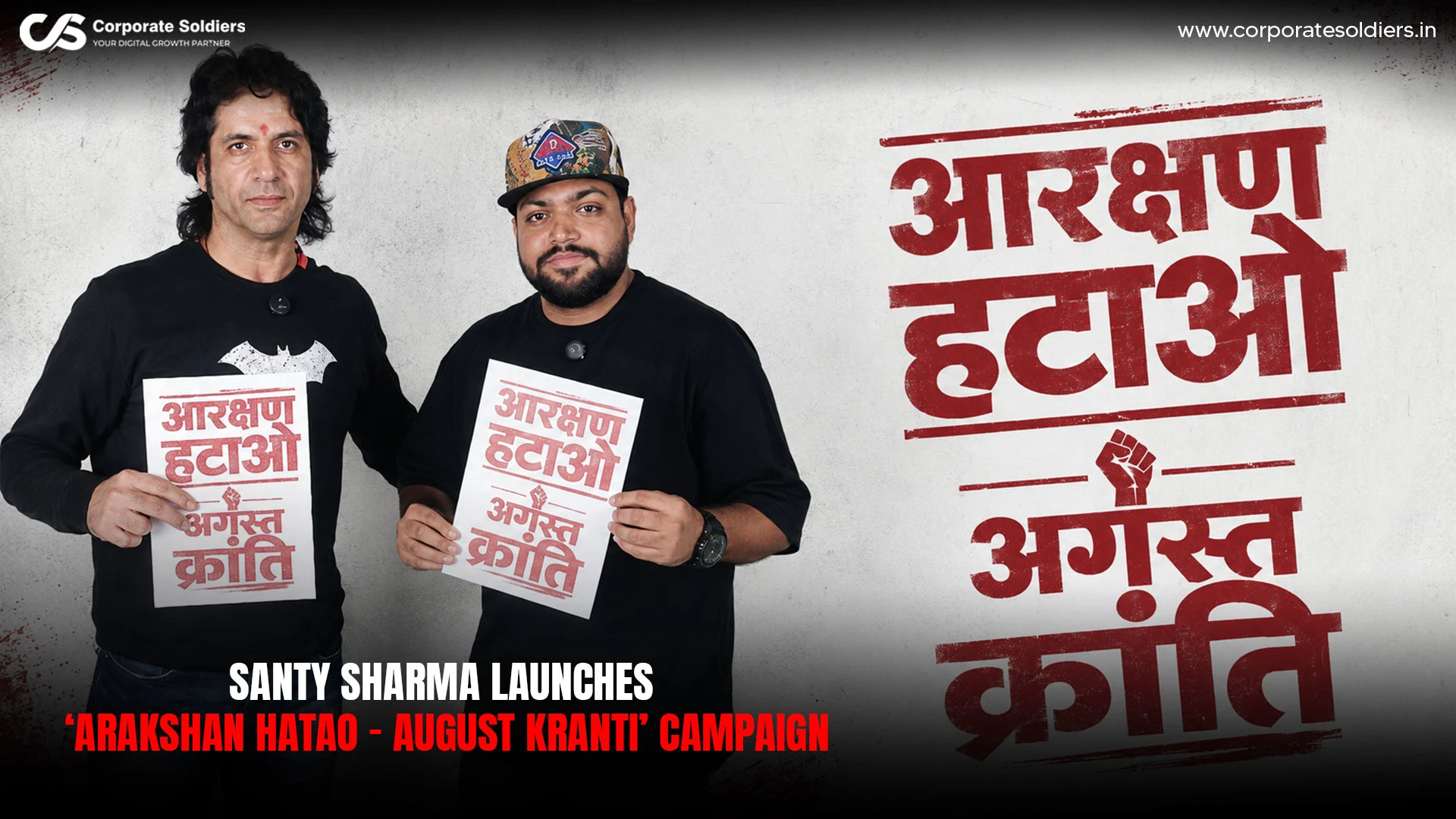
In a press conference in Mumbai, independent rapper and social media personality Santy Sharma has announced a social awareness program, called Arakshan Hatao – August Kranti. The announcement has also drawn interest in the circles of entertainment, social media and public affairs due to the fact that it touches upon the problem of the reservation policy long-debated in India. As Sharma explained in the event, the aim of the campaign is to create awareness and provoke social discourse in regards to reservations via digital communication and cultural content.
It was launched in Andheri West, Mumbai and actor Puneet Vasishtha was also in attendance. Sharma reported that the campaign would commence mostly in the social media and will involve subsequent public engagement programs.
As of publication the campaign is a citizen-led campaign announced by Sharma and not linked to any officially proclaimed political organisation, as he himself claims.
Who is Santy Sharma?
Santy Sharma is an independent rapper, singer and digital content creator who gained recognition through songs such as Suni Suni Sadko, Udaan, Koshish Meri, Fake Stars, Mujhe Pyaar Kar and Gangsta.
In recent months, Sharma has remained in the public spotlight due to his comments on social and political issues. During the press conference, he also criticised the Cockroach Janta Party (CJP) in connection with protests over the alleged NEET paper leak, claiming that student concerns had been politicised and that public property had been damaged during demonstrations.
What Is the ‘Arakshan Hatao – August Kranti’ Campaign?
As Sharma announced, Arakshan Hatao -August Kranti is an awareness campaign that is scheduled to be presented publicly which will concern the issue of reservations in India. According to Sharma, the movement aims to create discussion and awareness around reservation-related issues through social media outreach and public engagement. According to statements made during the launch event, Sharma and actor Puneet Vasishtha argued that opportunities and support systems should be based on merit and economic conditions rather than caste. They also called for equal standards in competitive examinations for all candidates.
The name Arakshan Hatao can be translated roughly as Remove Reservation and the name of the August Kranti is based on a campaign that started in August. The news of the opening indicates that the project will heavily depend on digital communication, such as the content shared on the social sites and online platforms of Sharma.
Notably, the objectives of the campaign outlined here are quotes of Sharma and supporters of the campaign. The initiative has not been supported by any government agency or constitutional power and what the campaign suggests is not accepted as the policy of the people.
How and When Was the Announcement Made?
The campaign was announced during a press conference held in Andheri West, Mumbai, on Saturday, August 1, 2026. Reports published on August 3 detailed the launch and the campaign’s proposed roadmap.
Puneet Vasishtha, an actor, was present at the event and said that he supported the initiative. The press conference report reveals that Sharma explained the plans of a social media-based awareness campaign and talked about the content to be introduced in the future that would be related to the campaign.
Sharma also shared a preview of lyrics from his upcoming hip-hop track ‘August Kranti’, which is linked to the campaign and is expected to form part of its outreach strategy.
Key Statements Made by Santy Sharma
In the launch and in previous public announcements on the August Kranti, Sharma said that the initiative would be aimed at offering what he termed facts and evidence on matters he is to bring into the limelight. He added that the campaign would not be associated with any political party either. Sharma also said that he had not received funding from any political party or political organisation.
Before the press conference, Sharma had announced via social media that August was going to be the start of August Kranti and that he would be discussing several issues of the people during the event. Sharma also stated that his primary YouTube channel, which contained several years of his work, had been permanently removed following what he described as mass reporting. He said he plans to launch a new channel in the future.
When speaking about the campaign, Sharma denied that the movement was affiliated to any political organisation and said that it was an awareness initiative, but not a programme supported by a party.
Why the Campaign Is Drawing Attention
The announcement has aroused interest due to a number of reasons.
To begin with, reservation policy is one of the most controversial areas of public policy in India. Any movement that promotes the alteration of the current structure will probably gain the attention of the people, media and online debate.
Second, Sharma already had a sizable following in social media even prior to the campaign launch. His recent public statements, criticism of CJP leaders, and claims regarding the removal of his YouTube channel have also contributed to increased public attention.
Third, the involvement of entertainment figures and the application of music-based outreach have increased the level of interest among political audiences into areas of youth and popular culture communities.
Reservation in India: Constitutional and Legal Context
The reservation system is based on the constitutional provisions in India that aim at fostering social justice and enhancing representation of historically disadvantaged groups.
The affirmative action in favor of socially and educationally backward classes, Scheduled Castes (SCs) and Scheduled Tribes (STs), is made possible by various provisions of the Constitution such as Articles 15 and 16. The policy of reservation has been changing over the decades due to legislation, constitutional amendments and judicial rulings.
The matter still creates controversy among the policymakers, law professionals, political parties, and civil society groups. People who believe in reservations tend to say they are needed to settle past and structural unfairnesses, whereas those against reform suggest reforms or other strategies. These conflicting opinions constitute a current social and constitutional debate in India.
Sharma launches his campaign in this wider context. Any plan to change the policy of reservation would however require action to be taken either via constitutional, legislative and judicial process depending on the proposed change.
Public and Online Reactions
The campaign announcement has sparked debate on social media and was covered by various news organisations. But even available reporting has not been much concerned with the announcement itself, but has been more concerned with reporting all-inclusive data on public sentiment.
As is the case with most politically sensitive matters, responses online seem divided. Both positive and negative opinions have been evident in the media. Since social media commentary may not be a perfect representation of the wider opinion, this type of reaction is to be taken with a grain of salt.
By the time of writing, no independently verified polling or large-scale popular opinion data on the campaign had been reported.
Any Official Response?
By the time of publication, no official reaction by the Union Government, state governments, constitutional authorities or even the major political parties had been much publicized in relation to the launching of the campaign Arakshan Hatao – August Kranti.
In case official statements or responses to the policy appear, they would probably become a significant element of the progress of the story.
What Happens Next?
According to statements made during the launch event, the campaign is expected to continue through social media outreach and related content initiatives. Sharma also expressed intention of utilizing online platforms, his online channels to reach out to audiences and deliver campaign messages.
According to reports from the launch event, campaign-related music content may form part of the initiative’s future outreach efforts.
There was no publicly announced detailed nationwide calendar of events, protest schedule or official organizational structure as of the time of writing.
Final Thoughts
The recent campaign by rapper Santy Sharma called the Arakshan Hatao -August Kranti has revived the general debate on the issue of reservation policy in India. Introduced in a press conference in Mumbai, the project has been introduced by Sharma as an act of public awareness, which will largely be run via social media and cultural outreach.
Although the campaign has already created a buzz online and in the media, its long-term success will be determined by the way it evolves within the next couple of weeks and whether it can gain the attention of more people or will the government take any action. As the story unfolds, readers and observers will continue to need to abide by verified information and official statements.