Few stories in Indian cricket generate as much speculation as the future of Rohit Sharma.
Over the past week, reports have emerged that the third ODI between England and India at Lord’s could potentially be the final international appearance of one of India’s most successful white-ball cricketers. The reports, initially published by The Indian Express and later picked up by several other national media outlets, have led to a raging debate on the future of Rohit Sharma in the ODI team, long term planning of the Indian team to host the 2027 world cup and the way in which Indian cricket is going to change hands over the coming generations.
Despite the speculation, nothing has officially changed. Rohit Sharma has not announced his retirement, and the BCCI has not confirmed whether the ODI at Lord’s will be his final international appearance.
What is unfolding is a narrative shaped by media reports, selection discussions and broader questions about the future of India’s ODI team.
The significance of these reports extends beyond a single player. They have touched on succession planning, evolution of leadership and the dilemma of the need to balance between the proven greatness and the future needs.
The Reports Behind the Story
A report published by The Indian Express suggested that selectors do not view Rohit Sharma as a central part of their long-term plans leading up to the 2027 ODI World Cup.
Later reports by PTI, which have been quoted by other media outlets such as India Today, suggested that the selectors would be eager to give a longer ODI run to the younger openers, especially Yashasvi Jaiswal, as India starts strategizing on future international tournaments.
It is necessary to underline that these stories are still reported in the media depending on some anonymous sources who are aware of the events. The BCCI as well as Rohit Sharma have not publicly verified what the nature of such conversations was.
What is clear, however, is that planning for India’s post-2027 future has become a major talking point in cricket circles.
The 2027 World Cup Equation
The 2027 ICC Men World Cup in cricket is the highlight of the debate.
Rohit Sharma will be almost 40 years old when that tournament comes to South Africa, Zimbabwe and Namibia. Modern day cricket is characterized by fitness requirements, work load and scheduling requirements that are constantly growing and, as a result, selectors are usually forced to make long term decisions many years ahead.
India, it is reported, is thinking of a new generation of ODI openers and is looking to give longer chances to those players who may be the backbone of the team in 2027. Yashasvi Jaiswal is one such name, which has been mentioned on several occasions as a top long term candidate.
Jaiswal has been able to ascend across formats which has enhanced his future as an all-format opener. Other than him, India also has several younger batting alternatives that will give it a chance to take over top-order slots in the next 18 months.
The debate around Rohit’s future has become part of a wider Indian cricket transition, as selectors balance immediate competitiveness with long-term World Cup planning.
To selectors, succession planning does not have much to do with an immediate replacement of one player. It is the process of developing sufficient international exposure for the next generation, prior to the coming of a major tournament.
That appears to be the strategic backdrop against which these discussions are taking place.
Rohit’s Reported Reaction
It has been reported that Rohit Sharma hoped to continue playing ODI cricket until the 2027 World Cup.
The report in Indian Express indicated that Rohit was disillusioned by the reported attitude of the selectors, and had requested a meeting with senior board officials on his future.
No official word of Rohit has however been published to confirm his intentions as well as the specifics of such discussions.
Consequently, any evaluations of his response should be within the confines of what is reported as opposed to what is actually known.
The England Series Context
The time in which the reports have been issued has inevitably put into the limelight the recent performances of Rohit in the ODIs.
As the India vs England ODI series continues, Rohit has come under scrutiny for his recent performances at the top of the order. His innings in the second ODI reignited discussions about form, consistency and India’s long-term plans ahead of future ICC tournaments.
However, it may be unreasonable to evaluate a player based on a few matches.
Even the best ODI batters have gone through a time of low performance. The concern among selectors is that the recent returns are a momentary downturn or indicators that the team will have to start preparing to play without one of its most significant players.
Support From The Team Management
As speculation surrounding the retirement grew, the team management of India came out in support of Rohit Sharma.
Batting coach Sitanshu Kotak rejected the idea that the long-time opener was permanently on the downward slope and claimed that the top players tend to go up and down. Reuters reported Kotak arguing that Rohit was still a good player in the team and could still deliver performances that would win the team.
The general thesis is nothing new in the history of sport.
Form is temporary. The cricketing term class, as ever, is here to stay.
The long international career of players is often the cause of ups and downs. All Sachin Tendulkar, Ricky Ponting, Kumar Sangakkara and Jacques Kallis had moments in their careers when doubt had arisen about their future before making any meaningful contribution in their later years.
Supporters of Rohit’s continuation point to that historical trend.
The Legacy Conversation
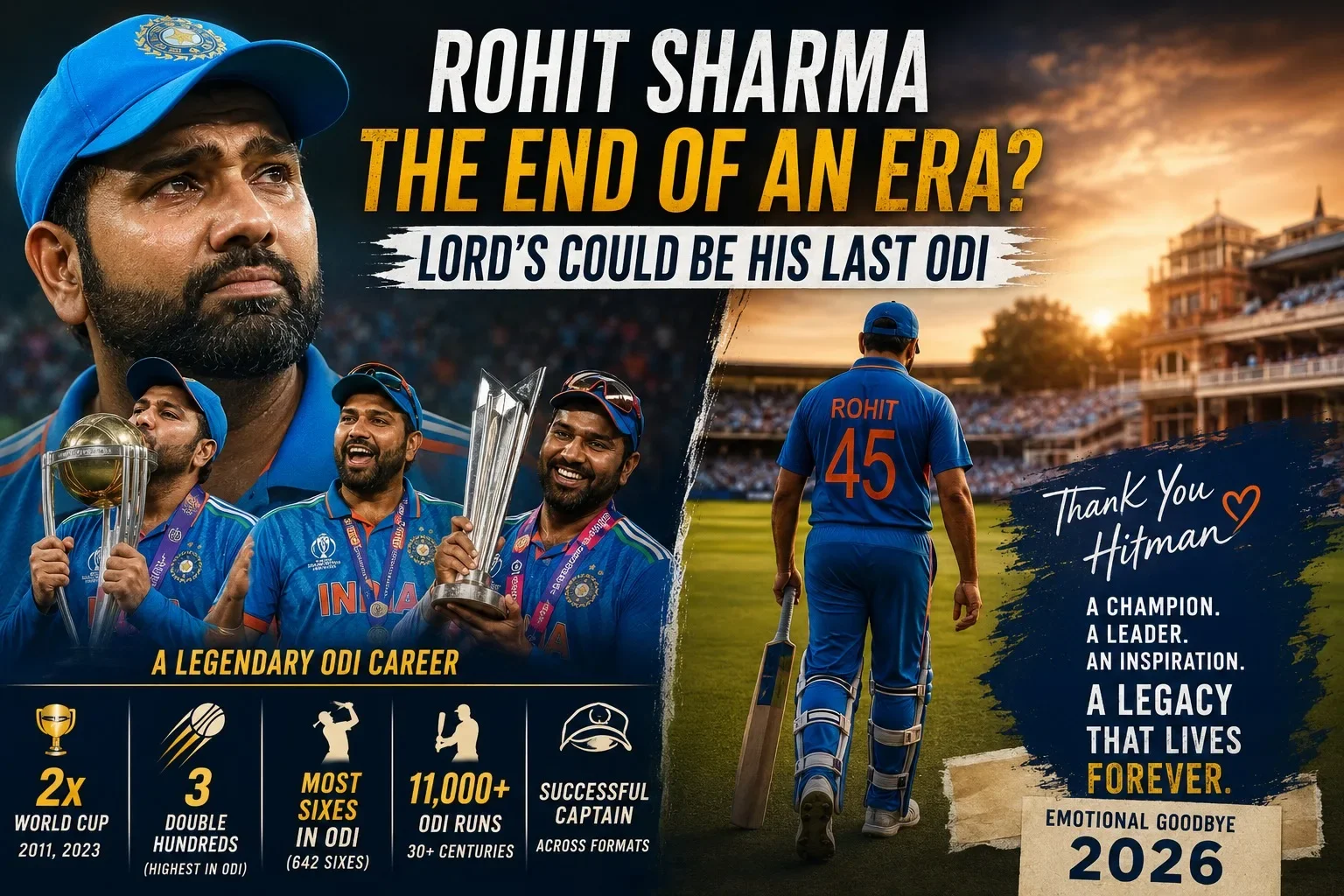
No matter what may transpire, the ODI legacy of Rohit Sharma is already one of the greatest in the history of cricket.
Rohit is the highest scoring player who has made ODI double centuries. He is the only batter who has been able to record three of them.
The highest individual score of 264 that he scored against Sri Lanka in 2014 at Eden Gardens is the highest individual score of all time in One-Day International cricket.
In his ODI career of more than 11,000 runs, over 30 centuries and as one of the iconic white-ball batters of his generation, Rohit has established himself as one of the most iconic white-ball batters in the history of the game.
As captain, he led India through a successful period in white-ball cricket, with the team consistently remaining among the strongest limited-overs sides in the world.
His tournaments at ICC had a significant impact especially. His five-hundred-centuries in the 2019 world cup is still remembered as one of the most outstanding personal batting campaigns in the history of the tournament.
His influence cannot absolutely be explained by the statistics.
Rohit fundamentally changed the way India approached batting in ODI cricket.
Where earlier times would tend to focus on conserving in the initial overs, Rohit was adopting measured aggression at an ever-increasing pace. He was ready to go after the new ball and this provided momentum which enabled the middle order in India to play on strong positions.
That was a change of tactics that came to characterize modern Indian white-ball cricket.
Beyond Statistics
The story of Rohit is remarkable since it has not been evident all the time.
He started in international cricket as a talented middle-order batsman whose great talent always seemed to predominate over his reliability.
It was after he was promoted to opener in ODI cricket that it changed.
This choice transformed his career and the batting make up of India.
Being an opener, Rohit found a position that optimized his talents: time at the crease, restrictions on fielding, and the opportunity to turn an innings into a marathon performance.
There was also a change in his leadership style.
In contrast to captains who are very demonstrative, Rohit established a reputation of making decisions calmly, flexibility in tactics and good communication with his teammates. One of the younger players often mentioned how easy things were with regards to roles under his captaincy and the confidence he gave them in the dressing room.
His mentorship extended across formats, particularly during India’s transition to a younger batting group.
Such an impact is hard to measure but in most cases, it can be one of the most lasting parts of the legacy of any senior player.
The Question of Farewells
The tradition of Indian cricket is to pay tribute to their icons.
The benefit of this was a national affair when Sachin Tendulkar retired in 2013 in the Wankhede Stadium in Mumbai. His last speech is still one of the most memorable events in Indian sporting history.
The departure of MS Dhoni followed a new route. In 2020, he declared his international retirement by using social media after having retired from active international cricket.
Among those instances is a bigger fact: the best players in Indian cricket are typically given the opportunity to be publicly recognized for their efforts.
This is one of the reasons why the speculation of the day has been so well received.
When a cricketer like Rohit Sharma decides to quit international cricket without an officially announced farewell it would be odd in contrast to the traditions that have accompanied the legends of the Indians.
Why Lord’s Matters
There are hardly any cricket venues in the world that carry the symbolic weight of Lord’s.
The London ground has a special place in the history of cricket, and is known the world over as the Home of Cricket.
Players of many generations have judged their careers by Lord’s performances. Every visit to the venue is significant because of the renowned pavilion, the honours boards and the historical value of the venue.
In the case of Indian cricket, Lord’s has been the venue of several historic events having witnessed both Kapil Dev win the World Cup in 1983 and the great Test wins, as well as the great individual performances.
The symbolism would be undoubtedly clear should the venue come to be linked to the last ODI of Rohit Sharma.
But as yet that is only a possibility and not a certainty.
The Current Reality
This is a significant difference.
As of now:
- Rohit Sharma has not officially declared his retirement from ODI cricket.
- The BCCI has not confirmed that the Lord’s ODI will be his last match.
- No official announcement has been made regarding any retirement before the 2027 World Cup.
- Rohit Sharma remains an active India player unless an official announcement states otherwise.
The current discussion is being driven by credible media reports and sources familiar with developments, but none of it has yet been officially confirmed.
This difference is necessary to comprehend the story well.
Final Thoughts
Rohit Sharma has already secured his place among the greatest ODI batters the game has produced. His records, leadership and influence on India’s white-ball approach have ensured that his legacy is firmly established, regardless of when he chooses to step away.
Whether Lord’s ultimately becomes the venue of his ODI farewell remains uncertain. For now, it is only a possibility discussed in reports rather than an official reality. But if that day does arrive, it will mark the closing chapter of one of the most remarkable ODI careers of the modern era.