There are moments in a nation’s journey that quietly redefine its future. They don’t just introduce a new product or a new technology. They change the way an entire country thinks about innovation.
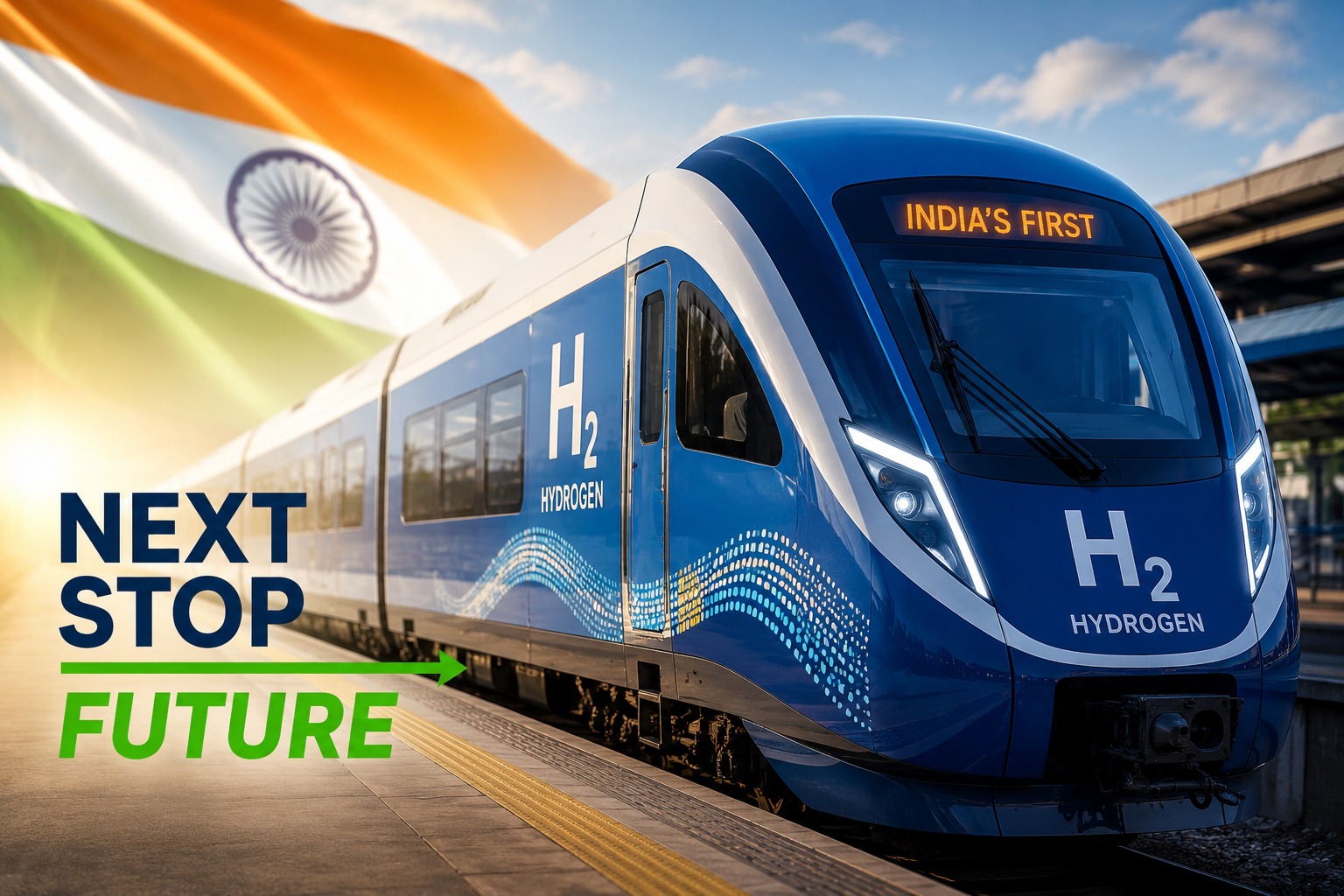
The launch of India’s first hydrogen-powered train is one such moment.
For decades, Indian Railways has been recognized as the backbone of the country’s economy, connecting over 7,000 stations and carrying millions of passengers every single day. It has evolved from steam locomotives to diesel engines and later to one of the world’s largest electrified railway networks. Now, India has taken another significant leap by introducing hydrogen fuel cell technology, placing itself among a select group of nations shaping the future of sustainable rail transport.
The First Hydrogen Train Route
The newly launched hydrogen train will operate on the Jind to Sonipat route in Haryana, covering approximately 89 kilometers. While the route itself may appear modest, its significance goes far beyond the distance it travels. It represents a live demonstration of India’s ability to develop next generation railway technology within the country instead of depending entirely on foreign innovation.
How Hydrogen Fuel Cell Technology Works
Unlike conventional diesel trains, a hydrogen train generates electricity onboard through hydrogen fuel cells. Hydrogen combines with oxygen inside the fuel cell to produce electricity, and the only byproduct released into the atmosphere is water vapor. There is no smoke, no harmful carbon emissions during operation, and significantly lower noise levels. It is one of the cleanest forms of rail transportation currently available anywhere in the world.
An Environmental and Economic Milestone
This is not just an environmental milestone. It is an economic one as well.
As countries across the globe commit to reducing greenhouse gas emissions and achieving net zero targets, transportation has become one of the biggest sectors under scrutiny. Railways already produce fewer emissions than road transport, but hydrogen technology takes sustainability a step further. It opens new possibilities for railway lines where full electrification is either technically challenging or financially impractical.
Built in India
What makes this achievement even more remarkable is that it has been built in India.
The train has been designed, engineered, integrated, and tested by Indian Railways along with Indian manufacturing facilities and engineering teams. Instead of importing an entire solution, India has focused on developing domestic capabilities, strengthening the country’s vision of becoming a global manufacturing and technology hub. This project reflects years of engineering expertise, indigenous innovation, and collaboration across multiple railway organizations.
Building the Supporting Infrastructure
However, building the train was only one part of the challenge.
Hydrogen powered transportation requires an entirely new ecosystem. Dedicated hydrogen production, safe storage facilities, specialized refueling infrastructure, advanced monitoring systems, and strict safety mechanisms all need to work together seamlessly. India has simultaneously developed this supporting infrastructure, ensuring that the project is not just a prototype but the foundation for future expansion.
Passenger Capacity and Safety
The train itself has been designed to carry approximately 2,600 passengers across ten coaches while maintaining international safety standards. Multiple monitoring systems continuously track hydrogen pressure, temperature, leakage detection, fire safety, and operational performance, making it one of the most technologically advanced passenger trains ever introduced in the country.
India Joins the Global Hydrogen Rail Movement
When compared globally, India is entering an exclusive league.
Countries such as Germany, China, Japan, and a handful of European nations have already experimented with hydrogen rail technology. India’s entry into this space demonstrates that it is no longer simply adopting global innovations. It is actively participating in developing technologies that could define the next generation of public transportation.
Hydrogen Trains and Railway Electrification
There is another aspect that deserves equal attention.
India has already electrified the overwhelming majority of its railway network, making it one of the largest electrified rail systems in the world. Because of this, hydrogen trains are not intended to replace electric trains everywhere. Instead, they offer a practical and sustainable alternative for routes where electrification remains difficult, expensive, or environmentally sensitive. This balanced approach allows India to strengthen its railway network without compromising on long term sustainability goals.
Future Benefits for Logistics
The logistics sector also stands to benefit significantly.
As hydrogen technology matures, future applications could extend beyond passenger services into freight transportation. Cleaner rail logistics can reduce operational emissions, lower dependence on imported fossil fuels, improve energy security, and contribute toward India’s long term green mobility ambitions. For industries relying heavily on rail transport, this could eventually translate into more sustainable supply chains and reduced environmental impact.
A Milestone for Indian Innovation
The launch of India’s first hydrogen train is not simply about introducing another locomotive.
It is about demonstrating that India possesses the engineering talent, manufacturing capability, and technological vision required to compete with the world’s leading economies. It reflects a shift from importing advanced technologies to creating them domestically. It sends a message that innovation can emerge from Indian laboratories, Indian factories, and Indian engineers.
The Next Chapter
Every major transformation begins with a single milestone.
The first steam locomotive changed transportation forever. Diesel revolutionized railway operations. Electrification improved efficiency on an unprecedented scale. Hydrogen powered mobility now represents the next chapter.
Whether this technology eventually powers hundreds of trains or remains focused on specialized routes, one thing is already clear.
India has stepped confidently into the future of sustainable rail transportation, and the journey has only just begun.