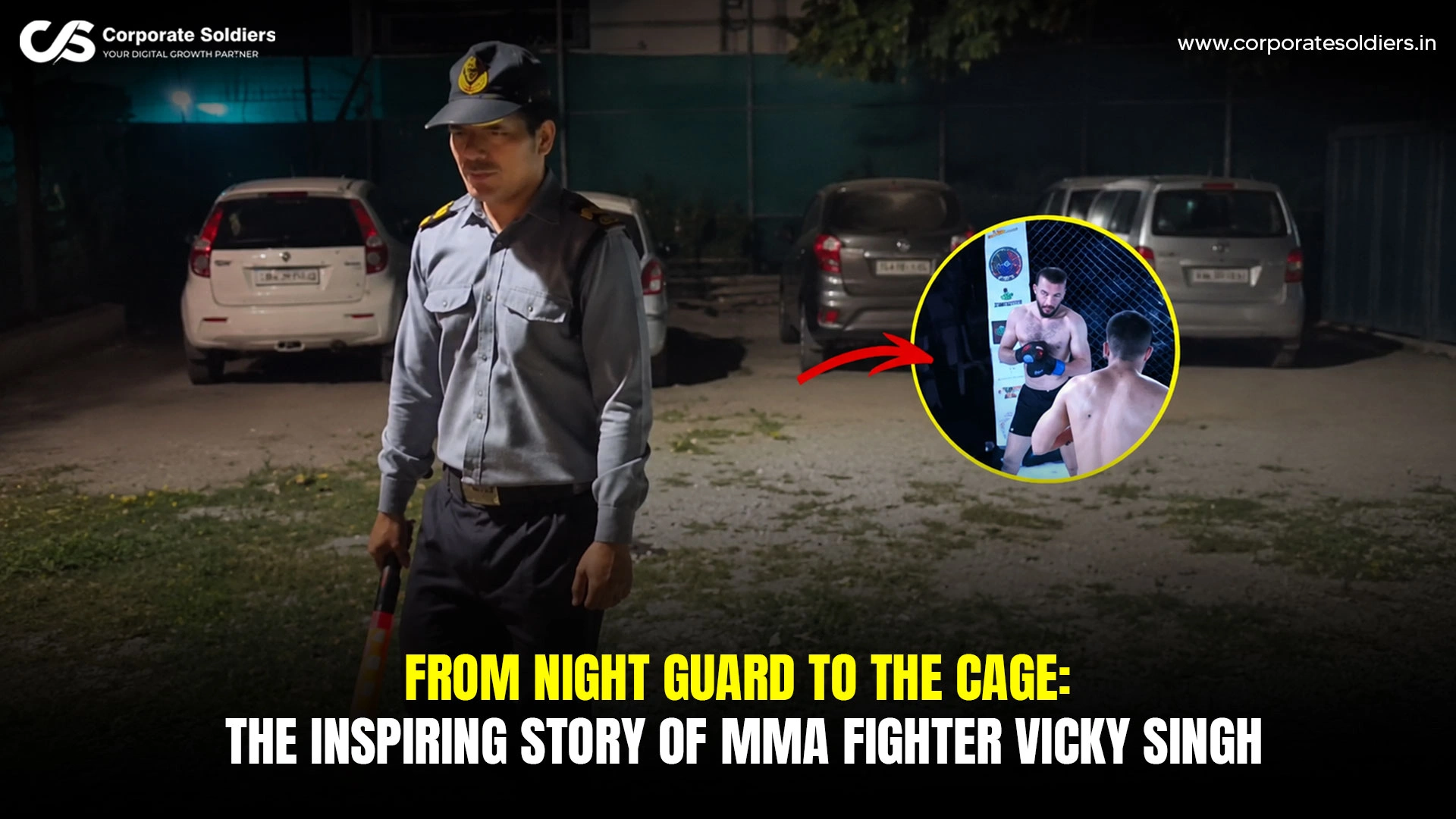
From Night Guard to the Cage: How Vicky Singh Tomkyal Is Fighting Against the Odds to Keep His MMA Dream Alive.Vicky Singh Tomkyal comes on duty as the revelers leave a wedding hall in Dehradun and guests head home. Wearing a security guard’s uniform, he spends the night watching over a venue filled with lights, music, and celebration. Before the sun rises, as the majority of the population is going home to sleep, Vicky is gearing up to fight another battle- this time in an MMA cage.
To most young athletes success is gauged in terms of medals, rankings and sponsorship contracts. In the case of Vicky, the first step towards success is mere time and resources to train. His tale is not merely on how he is chasing a sporting dream, but rather the persistence through the challenges of financial strain, physical burnout and a system that tends to abandon the grassroot athletes to do it alone.
In the recent past, videos of Vicky and his unorthodox methods of training went viral in the social media, attracting the attention of sports fans in India. It was not a well-edited fitness reel or a documentary about an athlete that was professionally done. They instead saw the truth of a fighter who could do anything to make his dream true with little to no resources.
Who is Vicky Singh Tomkyal?
The viral videos and homemade training gear are accompanied by a fighter whose story is a years-long journey. Vicky Singh Tomkyal, a budding MMA fighter of Uttarakhand, recently came into the limelight of the country due to his resolve to follow the sport, irrespective of the huge financial hurdles.
Although not much information about his early life is well known, his devotion to the mixed martial arts has been noted by his hard training and devotion. He has been able to juggle work life with his competitive sport life aiming to achieve his dream of establishing a professional career in MMA.
Despite limited financial resources, Vicky has remained committed to training under coach Angad Bisht at Mutant MMA Academy. The fact that he has been keen on continuing with the sport despite his strenuous work, has made it one of the most distinctive elements of his narrative.
Vicky has new goals beyond personal success. He would like to play to greater heights of the sport and ultimately be able to represent India at the international level. His story is an expression of an ideology that hard work and discipline can enable athletes to beat even the worst of situations.
A Fighter’s Life Beyond the Spotlight
MMA has experienced an explosion in India in the last ten years. Local promotions, gyms and organizations have assisted in providing new opportunities to young fighters as well as the popularity of promotions like the UFC and the ONE championship around the world has motivated a new generation of fighters.
But behind the stories of success there is a darker side.
As compared to professional athletes in conventional sporting events, a number of aspiring MMA fighters in India find it difficult to get stable sponsorships, good training centers and funds. The majority has to juggle their sporting careers with full-time employment in order to make ends meet. Vicky Singh Tomkyal is a symbol of thousands of other skilled sportsmen whose stories do not often end up being in the news.
Vicky, in order to earn his living, works at night as a security guard in one of the marriage halls in Dehradun, Uttarakhand. The occupation gives a livelihood, but also requires hours of work and has little free time. Sleep itself is a luxury and each day is a tightrope of making a living and training to compete.
Nonetheless, Vicky does not allow circumstances to control his destiny.
Training When Resources Are Scarce
Elite fighters worldwide spend a lot of time in facilities, with coaches, recovery, nutrition, and sports scientists, among other facilities. This is not the case with athletes at the grassroots level.
What has made Vicky’s journey resonate with so many people is his remarkable resourcefulness.
Among the most popular images of his story, there is one of him rehearsing strikes on a homemade heavy bag made out of a cooking gas cylinder covered with a pillow. The arrangement might seem unusual, yet it shows an attitude prevalent among sportsmen who cannot afford to buy costly equipment: whatever you can get, get going.
His training sessions are often conducted in open spaces and parks and not in training centres. Ordinary objects are used as a training agent. Tires, bricks and locally found materials are converted to equipment that enhances strength, endurance, and power.
The techniques do not involve making viral content. They come into being because of necessity.
Professional training might be unaffordable to most aspiring fighters. The cost of gym memberships, gym coaching, sparring equipment, nutrition, and the entry fees to the fights, the transportation expenses, and the medical care are rapidly mounting. These costs have the potential to be real inhibitors to advances without sponsorship assistance.
The financial strain is made more evident when the expenses are separated out. MMA gloves will cost between 3,000 to 8,000 and shin guards between 2,000 and 6,000. Mouth guards, hand wraps and protective equipment are additional costs. The cost of training in popular MMA schools can reach several thousands rupees per month and fighters who train to compete have to consume specialised foods, supplements, recovery and medical care too. Other costs that can push the cost even further include the cost of travelling, accommodation and registration of the tournaments and in this case, most athletes might not be able to have a competitive career without sponsorship.
The story of Vicky presents a harsh truth that talent may not be enough. The capacity of an athlete to keep on competing usually hinges on the accessibility of training, resources and finances.
The Role of Mentorship and the Mutant MMA Academy
A coach is standing behind every promising fighter and perceives potential before the rest of the world. In Vicky Singh Tomkyal’s case, such a mentor is Angad Bisht, one of the most reputed MMA fighters and coaches in India.
Bisht is considered as one of the prominent names in Indian MMA, and has been engaged in coaching and development of athletes with the help of Mutant MMA Academy. The academy has emerged as a significant training facility among upcoming fighters which offers coaching, guidance and opportunities to athletes who want to advance in the sporting activity.
To Vicky, the academy has done more than imparting technical training. It has provided him with structure, guidance and support system that can help him cope through the toughest of times trying to balance between the rigorous job and the life of a professional fighting career.
The coaches in combat sports usually have several roles: coach, trainer, motivator and strategist. To athletes who are struggling with finances, such a relationship may be the distinction between remaining in the sport and giving up the sport altogether.
Fighting More Than Opponents
Not every challenge Vicky faces lies inside the cage.
All athletes are familiar with physical exhaustion, but not many among us are exposed to the sort of prolonged exhaustion that manifests itself when we are on night shifts in addition to training at a high level. Recovery, which is an essential part of the process of athletic development, is getting more challenging as work schedules disrupt sleep patterns.
The significance of rest, mental and emotional recovery is often highlighted by sports psychologists in relation to elite performance. To a sportsman with a lot of commitments, being motivated may be as difficult as training to compete.
But narratives such as that of Vicky bring out a different aspect of sport: stamina.
The readiness to train having a sleepless night. The will not to miss regardless. Keep in mind long-term objectives in times when circumstances are challenging.
They are the qualities that cannot be put into a scorecard, but they tend to characterize the path of an athlete.
Why His Story Resonated Across India
Authenticity is a thing in a world of highly-crafted social media images.
As the videos of Vicky training started to spread around the Internet, people found something more than a desire to be an athlete. They witnessed a young warrior not allowing financial constraints to be used as an excuse.
The clips circulated widely across social media platforms, with users drawn to the contrast between Vicky’s demanding work schedule and his unwavering commitment to training. Videos showing him practising on a makeshift heavy bag and using public spaces as training grounds resonated with viewers, drawing widespread attention and engagement from people across the country.
The growing attention soon extended beyond social media. Sports pages, combat sports communities, and online publications began highlighting his journey, transforming what started as a grassroots story into a broader conversation about athlete funding and support in India.
The Larger Challenge Facing Indian MMA
The Vicky story is not just inspirational but also an indication of a bigger problem in Indian MMA.
The last ten years have seen a huge step forward in the development of sports in India, where there is more investment in Olympic sports, training facilities and government funded programs. Nonetheless, there are still structural issues in combat sports like MMA.
Fighters have few opportunities to get sponsorships early in their careers and limited opportunities to compete in established international markets. Coaching facilities, sports science services and recovery services also do not exist equally throughout the country. This has led to a situation whereby too many talented athletes have to make a decision between financial security and sporting aspiration.
Vicky is not the only one who experiences these difficulties. UFC fighter Anshul Jubli has given a talk on the sacrifices needed to join MMA in a sport that is not as commercial in support as cricket and other mainstream sports. Equally, athletes like Ritu Phogat have switched to MMA after establishing a professional career in other sports, and have had to navigate the complexities of a changing professional ecosystem. Their experiences, as those of Vicky, show the increasing possibilities and the still existing challenges in Indian combat sports.
It is not usually talent that results in the difference between an athlete who manages to stay in the sport and one who drops out, but rather access to coaching, competitions, financial assistance, and long-term development opportunities. Although some of them go to foreign countries to seek improved opportunities, others have to leave the sport altogether.
Indian MMA needs to be more collaborative and includes sports organisations, individual sponsors, training academies, and policymakers to keep growing. The grassroots athletes should have avenues through which they can achieve excellence without having to compromise their means of livelihood.
Choosing to Stay and Represent India
One of the most compelling aspects of Vicky’s journey is his determination to continue training and competing in India.
After his story went viral, most of his fans pondered that he should move to other nations with better developed MMA ecosystems. The counsel was sensible. Improved facilities, increased sponsorship prospects and a more robust professional circuit may speed up his progress.
But Vicky said that he wanted to keep on training in India and play for his country in the world arena.
That move is an indication of the pride most athletes have in serving their country with little resources. To most, success does not just mean personal accomplishment but also a part in the development of their sport back home.
Personal success is not the only thing he aims at. He also wants to show that the world-class fighters could be produced even in India, when there are limited resources and opportunities.
More Than an Inspirational Story
The story of Vicky Singh Tomkyal is a socially-emotional easy-to-like story in social media. However, it would be a mistake to do so.
His experience illuminates the sacrifices of so many athletes who are working out of the limelight. It poses significant questions of access, opportunity and the support networks that can be availed to new talent.
How many bright young sportsmen give up their hopes, as they are unable to pay for the training?
And how many future champions are never even allowed to realize his potential?
And what may be done to see to it that dedication and talent is not marred by monetary limitations?
These questions are much further than MMA.
One Shift, One Session, One Step Forward
Today, in a nation where every young athlete has big dreams and tries to achieve greatness, the story of Vicky Singh Tomkyal is a wake-up call that greatness is not always made on the spotlight. It is sometimes made during the silent pre-dawn hours when no one has an eye on them and the only thing that propels a fighter is the unwillingness to surrender.