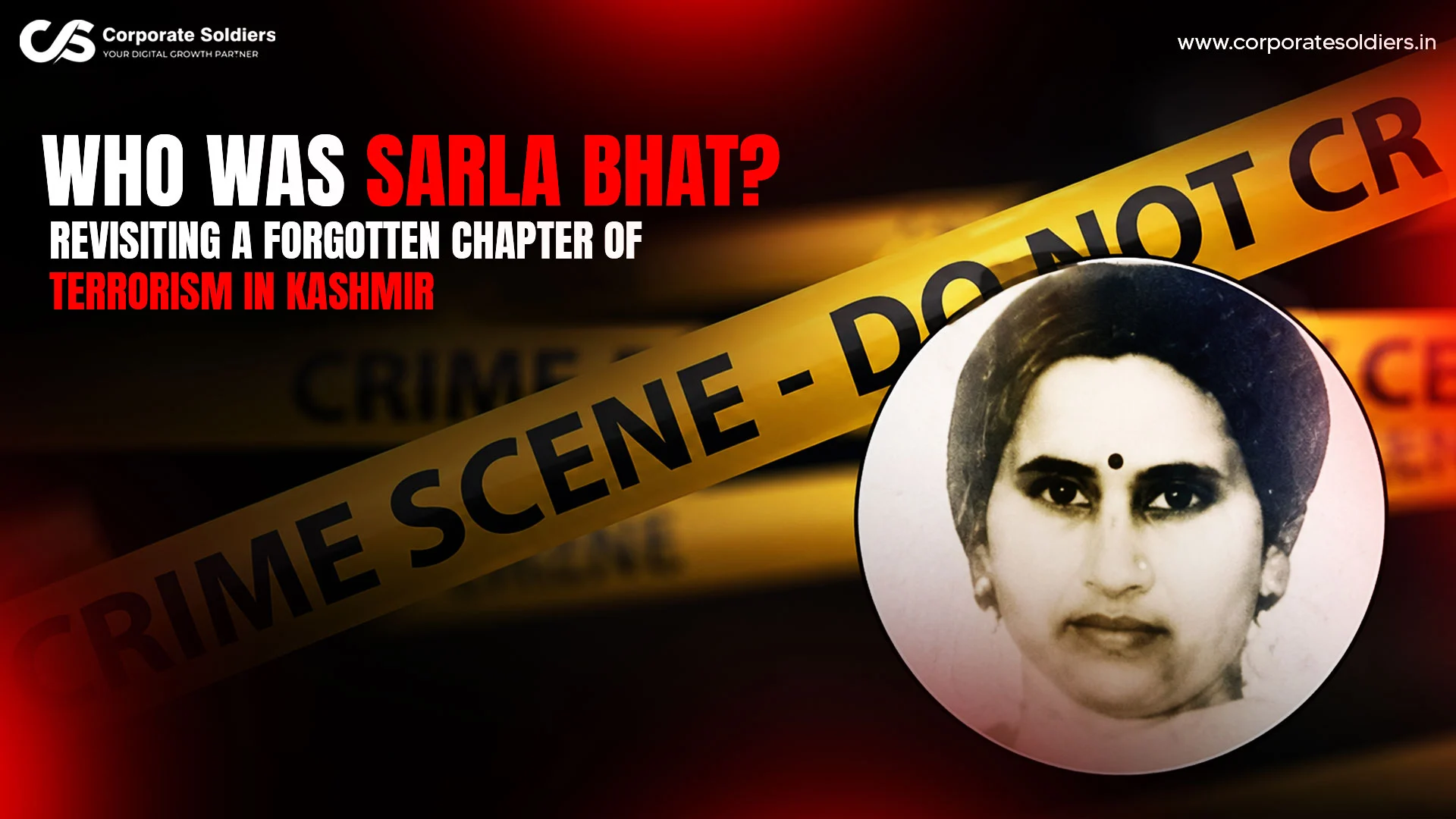
The incidents in Kashmir in the early 1990s, during the high peak of militancy there, have drawn a lot of attention and have been brought back into the public discourse after a major judicial breakthrough. In recent years, the targeting of medical professionals, especially young ones, has come to the fore, with the recent filing of formal chargesheets against medical officers in Srinagar who had been abducted and killed decades ago.
Young Kashmiri Pandit nurse Sarla Bhat, who worked in the health department, was among the first civilian victims of the growing security crisis in the Valley. Her case was one of many unclosed files of a time when mass displacement and widespread civil unrest occurred, and remained unresolved for more than 30 years. But, new investigative information from the regional police that has since surfaced has returned the details of her kidnapping and murder to public record.
This article looks at the historical context of this case, the timeline of events, and its context in the larger picture of Kashmir terrorism and the flight of the minority community. This report is based on the official records and investigative findings released by the State Investigation Agency (SIA) and gives an objective view of the critical juncture in the history of conflict in Kashmir.
Who Was Sarla Bhat?
Sarla Bhat was a Kashmiri Pandit and a staff nurse at Sher-i-Kashmir Institute of Medical Sciences (SKIMS), Soura, Srinagar, a leading medical institution in the region.
The political and social climate in the Kashmir valley was fast eroding at the time of the incident in early 1990. The armed militancy was growing in unprecedented levels in the region, with numerous demonstrations held, administrative chaos and civilian attacks becoming more common. Despite this stressful situation, healthcare workers were still able to provide the essential public services, while the security of the institutions worsened. As a nurse Bhat found herself working in a critical public area at SKIMS, making her a target for the ever-changing security situation in the area.
The Incident – What happened?
The following represents the facts as established by official investigation, and available from historical law enforcement records surrounding the death of Sarla Bhat:
Sarla Bhat was forcibly abducted from the Sher-e-Kashmir Institute of Medical Sciences (SKIMS), Soura, Srinagar, on April 18, 1990.
About twenty-four hours after her disappearance, her body, shot at numerous locations, was found dumped in Omer Colony, Malbagh, Srinagar, which is several kilometres from the medical institute.
Immediate Post-Incident Action: After the recovery of her body a formal murder case was registered at the local Nigeen Police Station in Srinagar. At the time, the scene of her death was investigated by the Forensic Section and the cause of death determined as ‘multiple gunshot wounds’.
Over the next few decades after the initial registration of the First Information Report (FIR), very little procedural progress was made as the local judicial system collapsed, witnesses left the region and the sheer number of active conflict cases in the 1990s.
Why Was She Targeted?
According to the Jammu and Kashmir State Investigation Agency (SIA), the killing of Sarla Bhat was not a random act of violence but formed part of a larger terrorist conspiracy during the early phase of militancy in Kashmir. In its chargesheet, the agency has alleged that the attack was intended to create fear and intimidate members of the minority community. These findings represent the conclusions of the investigating agency and remain subject to judicial examination.
According to the SIA’s chargesheet, investigators have alleged that militant groups targeted members of the minority community who were employed in public institutions. The agency further alleged that Sarla Bhat’s killing formed part of a broader campaign of intimidation aimed at creating fear among sections of the minority community. These allegations are part of the ongoing judicial process and have yet to be examined by the court.
Kashmir During That Period
By reviewing the Kashmir security history in general, it can be seen that 1990 marked a pivotal year for destabilisation in Kashmir. Political disturbances had been increasing over the last few years, with complaints of administrative corruption and the regular smuggling of weapons and weapons training across the border.
The armed rebellion against Indian rule peaked in early 1990. The police force, as part of the local government, was inadequate in maintaining law and order and central security forces were deployed and stringent security measures were enforced. For ordinary people, it was a time of strikes, regular gun battles and targeted assassinations of political workers, intelligence officers and representatives of ethnic minorities. When institutions failed, there was an atmosphere of great fear, and civilian workers no longer had a safe place in places of work and public gathering.
Impact on the Kashmiri Pandit Community
Such events like the Sarla Bhat murder were compounding and had immediate consequences on the Kashmiri Pandit community. The fact that a young female healthcare worker was kidnapped right in the open right in front of her workplace, highlighted the total absence of security assurances to the minority groups.
This particular murder, combined with a series of other targeted killings of community members, scholars, and professionals, increased the sense of insecurity among many Kashmiri Pandits. The incident was among several targeted attacks that contributed to growing fear within sections of the Kashmiri Pandit community before the large-scale migration in 1990. In 1990, large numbers of Kashmiri Pandits left the Valley and relocated to Jammu and other parts of India, resulting in long-term humanitarian and social consequences. It led to the long-term humanitarian problems and the shift in the demographic structure of the area, which is why Kashmiri Pandit history is an indispensable part of any research on contemporary internal displacement.
Why the Case Is Being Remembered Again
The case has re-emerged mainly due to the recent occurrences in the official investigation.
Over 30 years after the event, the Jammu and Kashmir State Investigation Agency completed its investigation and filed a 737-page chargesheet naming the alleged offenders, and summarizing the results of the investigation.
The reopened case has sparked new debate in the society about the old crimes that remain unresolved since the onset of the Kashmir insurgency.
To historians, legal experts, and conflict researchers, the case depicts the value of the conservation of documentary evidence and the continued investigation of an incident, decades after it took place.
The new focus is also indicative of more general attempts at reexamining past cases that were left inconclusive at times when the conflict was acute.
Official Investigations and Historical Record
The case of the murder of Sarla Bhat proceeded to be partially visible over a number of years.
The case was later reopened by the State Investigation Agency as part of a broader investigation of past offences dealing with terrorism.
Investigators gathered:
- Statements from witnesses.
- Documentary records.
- Historical case files.
- Where possible, technical and forensic evidence.
The agency would then proceed to file a chargesheet in a specific court accusing the presence of specific accused persons.
Currently, the case is still under the court proceedings. Like any criminal investigation, the case made by the investigators will eventually be evaluated by the court on evidence and the law.
Why This Case is Important Nowadays
The case of Sarla Bhat is important as it reveals the consequences of unresolved violence in the long term in the times of conflict.
Historical studies have a number of significant functions:
- Preserving documentary evidence.
- Providing historical clarity.
- Assistance with the judicial process.
- Recording the experiences of civilian victims.
- Enhancing social knowledge about the history of conflicts.
The re-opening of such cases does not change what happened in the past but adds to a more whole and evidence-based picture of the past.
To scholars of terrorism in Kashmir, the case also demonstrates the relevance of keeping archives and making sure that unresolved cases are still addressed by the law where feasible.
Key Highlights
- Sarla Bhat was a Kashmiri Pandit nurse who worked at Sher-i-Kashmir Institute of Medical Sciences (SKIMS), Soura, Srinagar.
- She was abducted from the SKIMS campus in Srinagar in April 1990 during the early phase of the Kashmir insurgency.
- Her assassination turned out to be one of the historical events in the Kashmir region related to the targeted violence of civilians.
- The incidence came at the time of increasing militancy, political instability and security issues prevailing in the Valley.
- The case was reopened with a chargesheet filed by the Jammu and Kashmir State Investigation Agency after a fresh investigation.
- The findings of the agency can now be tested by the courts.
- The case remains a research topic in the history of Kashmiri Pandits, Kashmir conflict history, and overall history of Kashmir terrorism.
Conclusion
Over thirty years since her death, the case of Sarla Bhat has become a significant source of history of the Kashmir conflict. Her kidnapping and murder came at a time when there were the most tense events in the modern history of the region as the growing militancy and the worsening security situation plagued thousands of civilians.
The new awakening of the investigation has made a new focus on the significance of recording the unresolved crimes in legal and evidence-based procedures. With the case underway, it is also a reminder that historical events should be analyzed by using proven documents, official inquiries and factual records and not speculations and political interpretations.
Knowledge of cases like Sarla Bhat can help to create a better-informed debate on Kashmir news, India current affairs, and the complicated history of conflict in the region, coupled with solidifying the importance of maintaining historic records and seeking justice within the legal system.