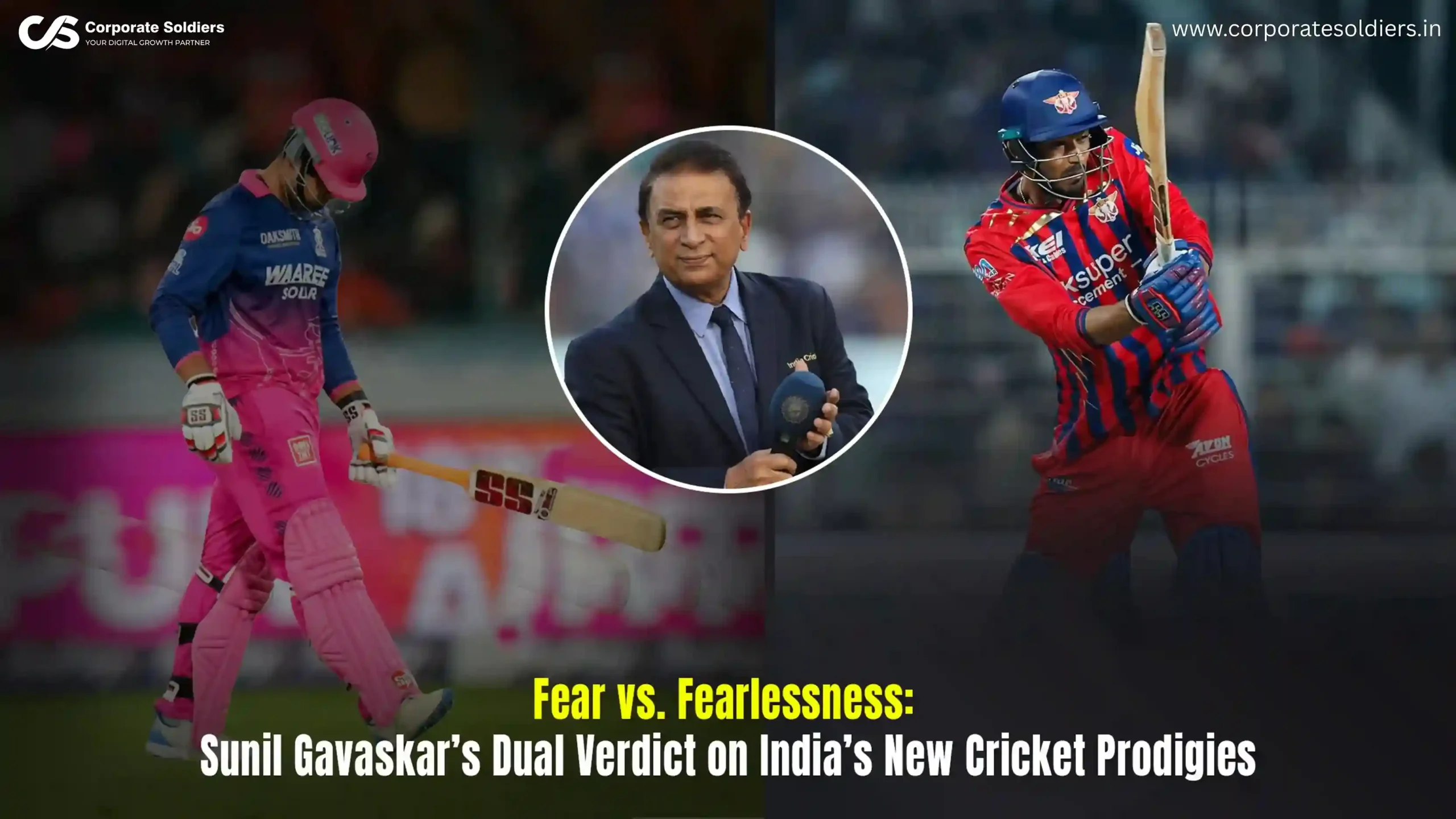
The Indian Premier League (IPL) has become the most powerful talent accelerator in world cricket, propelling previously unknown young cricketers into national prominence within a single season. The rise of Indian Young Cricketers 2024 has become both a reason for celebration and concern in an ecosystem where performances are amplified and narratives are rapidly constructed.
Amid this noise, Sunil Gavaskar continues to remain composed and authoritative. Gavaskar is synonymous with his clarity and restraint, and in recent times, has offered contrasting views on two emerging names: Vaibhav Sooryavanshi and Mukul Choudhary.
Although his caution to Sooryavanshi indicates that he was protecting him, it seems that his compliment to Choudhary signifies the respect of a brave and modern style. This dual perspective introduces a defining theme in modern Indian cricket: the equilibrium between fear and fearlessness in the development of young talent.
The Warning – Protecting Vaibhav Sooryavanshi
Vaibhav Sooryavanshi represents a teenage prodigy with strong technical ability and significant promise in youth cricket. However, speaking of Sunil Gavaskar, in relation to Vaibhav Sooryavanshi, it is not merely about short-term success, but long-term sustainability.
The pressure of expectation is the major worry of Gavaskar. The Indian cricketing ecosystem, driven by media cycles and digital amplification, often rushes to label young players as “the next big thing” at an early stage. This is a common tendency within the IPL talent hunt and would probably convert the potential into pressure.
In a technical sense, there exists a big distinction between Under-19 or domestic and international cricket. Young batters have to adjust to a high rate of speed, precision and tactical complexity. A critical test of preparedness is the dilemma of handling such short pitched deliveries particularly of the fast bowlers of the elite category.
The mental aspect is equally critical. Being exposed to fame at a tender age can cause lack of concentration, change of priorities and anxiety regarding performance. This is where structured guidance becomes essential and this is why a mentorship of people such as Rahul Dravid is regularly mentioned as a stabilising factor in the development framework of Indian cricket.
The central message is quite clear: talent cannot flourish without time, structure, and protection. The caution given by Gavaskar is not an imputation, but a plea to good development.
The Appreciation – Mukul Choudhary’s “No-Fear” Mindset
Mukul Choudhary on the other hand is an epitome of another stage in the cricketing cycle- the stage of performing under difficult circumstances. The calm and belief have been with his rise to prominence in domestic cricket and the IPL.
One of the hallmarks of The Mukul Choudhary batting style is its aggressiveness. Choudhary has demonstrated that he is an athlete who has nothing to be afraid of competing with the best of the best as seen in match-ups like Jasprit Bumrah vs Mukul Choudhary. He has shown clear intent rather than defensiveness against Jasprit Bumrah who is arguably one of the toughest bowlers in world cricket history.
It is this non-intimidation which is the topic of the praise of Gavaskar. The present breed of cricketers is influenced by franchise cricket and international exposure and hence does not have the psychological baggage of reputation. Instead, they are execution-focused.
Technically speaking, the strategy of Choudhary is representative of the existing T20 theories of batting:
- Legwork and craft with the crease.
- Immediate intent of a first delivery.
- Targeting scoring areas rather than focusing on survival.
This attitude is an indication of a more general change in the Indian philosophy of cricket – that of acceptance of calculated aggressiveness and flexibility.
Analysis – Why the Different Approaches?
Gavaskar’s views may appear contradictory, but is in reality a context based evaluation.
- Sooryavanshi (The Developmental Phase): The brain and the body at the age of 13 or 14 are still growing. Gavaskar considers this level in terms of protection. The over-hyping leads to the perception of failure and this may make a teenager stifle his or her natural development.
- Mukul (The Performance Phase): Choudhary has been in the domestic circuit longer, and is in the delivery phase. Gavaskar glorifies him because he has already passed through the molding influences and has been able to come out with the mental strength to put up with the best of the world.
Protection from external pressure is essential in the case of young players. Technical finesse and mental training should be put before societal anticipation at this point.
The standard varies in the case of players who are already playing on higher levels. The new performance measures are the measures of performance, resilience and impact of matches. There is no option in this case, fearlessness is a must.
Gavaskar’s dual philosophy can be seen as:
Protect emerging talent from premature pressure.
Encourage and recognize those players who have been prepared to play when the pressure is on.
The two arguments are on the same level of long-term excellence. They do not contradict, but are situational wisdom.
The Lessons for Indian Cricket Fans
This discussion is not limited to individual players but also about the Cricket culture in India and to viewers and spectators.
It is necessary to wait, first. The comparison with legends already in existence are likely to be premature at the expense of shaping the anticipations and facts of development.
Second, one cannot disregard the problem of media pressure in cricket. Constant scrutiny, amplified by social media, has real effects on a player’s psychological well-being. This environment is vital to be controlled just as much as technique.
Third, other players like Mukul Choudhary point out the importance of resilience and temperament. Fearlessness cannot be just aggression- it is the skill of being able to execute in pressure in a clear and controlled manner.
Lastly, responsible fandom is an aspect leading to career shaping. Fans should offer encouragement and understanding, ensuring that excitement does not turn into unrealistic expectations.
Final Thoughts
Indian cricket is at a distinctive crossroads with a number of new talents and new philosophies. The experiences of Vaibhav Sooryavanshi and Mukul Choudhary depict two facets of one story- potential and performance.
With his balanced remarks, Sunil Gavaskar emphasizes the importance of equilibrium. In a world that has turned into an instant, his voice is a reminder that greatness is achieved, rather than proclaimed.
Let them play, let them fail, and let them grow.