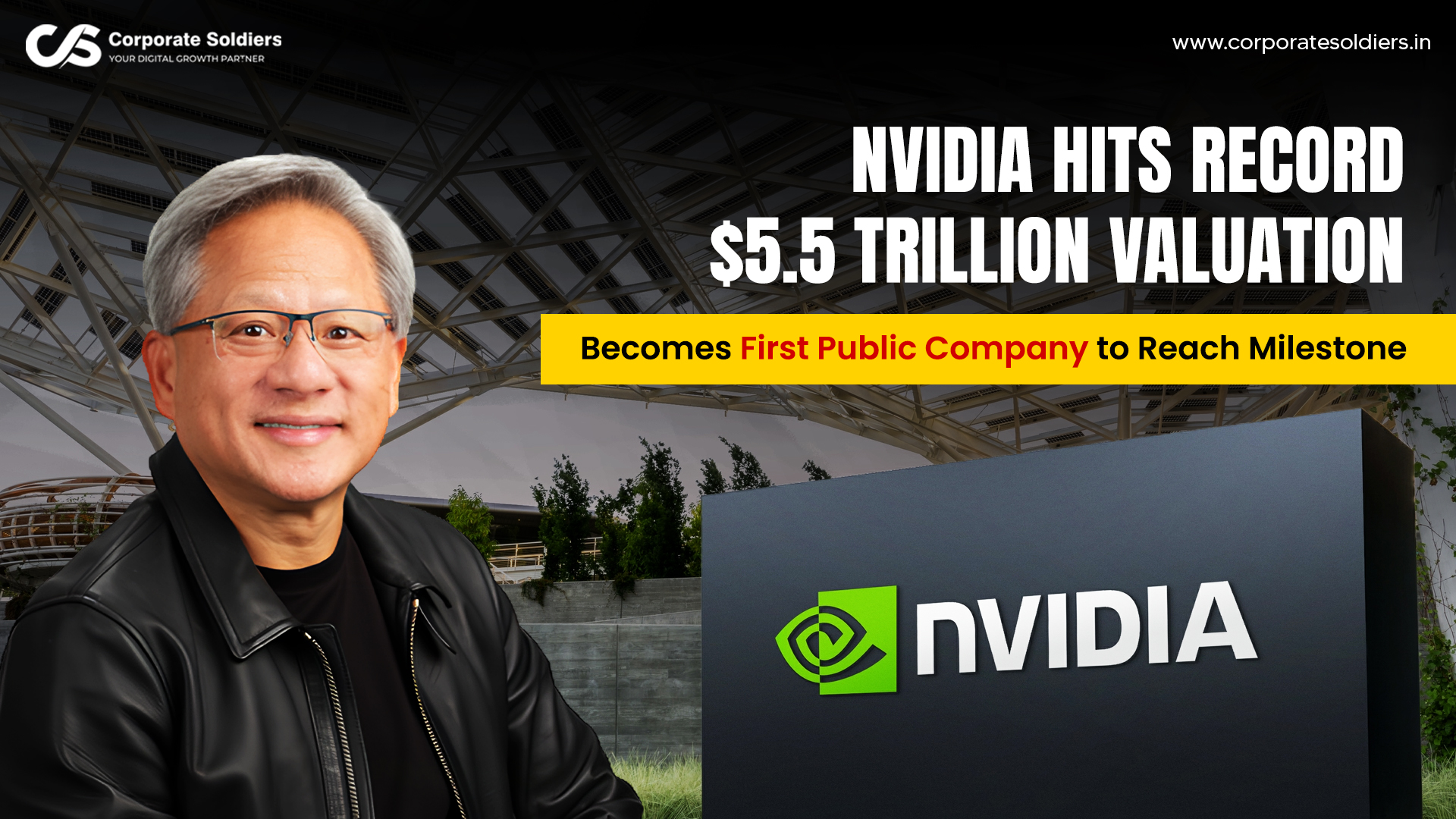
A publicly listed company in the world’s history has, for the first time, reached the milestone of $5.5 trillion in market value as further evidence of the world’s AI and semiconductor boom. The milestone was first reported by Forbes.
The move highlights the significance of Nvidia in driving the AI infrastructure economy and how AI’s most advanced computing solutions are reshaping the global financial landscape.
That’s a sign of the immense demand for AI chips, the rapid pace of generative AI’s adoption in the enterprise and the confidence of investors in these companies’ technology. A graphics chip manufacturer, Nvidia has become one of the most important tech firms in the world thanks to their meteoric rise in growth.
Nvidia Becomes the World’s First $5.5 Trillion Company
The Nvidia stock has surged by about 3% during the day to hit the market capitalization of just over $5.5 trillion on May 13, 2026. The firm’s stock price again hit a record high, the highest it has been offered to a public company.
The stock has been one of the best in global markets in the past two years. Nvidia’s share price has increased by almost 74% in the last 12 months and by almost 20% over the last month. This rally lifted the stock to over $220, after falling to $165 early this month, which shows investor interest in AI stocks.
In doing so, Nvidia has outpaced other technology giants such as Alphabet, Apple, and Microsoft.
At the time Nvidia hit the $5.5 trillion mark, Alphabet’s value was around $4.7 trillion; Apple’s was around $4.3 trillion, according to the Forbes report.
The company has had historic growth. Nvidia crossed the $4 trillion valuation milestone in 2025, followed by a $5 trillion valuation and then the new $5.5 trillion valuation in 2026.
What Is Driving Nvidia’s Massive Growth?
Nvidia’s meteoric rise can be attributed to a number of factors:
AI Infrastructure Demand
The largest factor is the skyrocketing global demand for AI infrastructure. Nvidia’s GPUs play a crucial role in training and operating large language models, generative AI systems, and advanced machine learning applications.
Nvidia-powered AI data centers are a multibillion dollar bet from the technology sector, cloud companies, governments and businesses. Business Insider reports that a group of analysts think that AI data centers could grow to be multi-trillion dollar markets in the next decade.
Data Center Expansion
Nvidia’s revenues continue to come primarily from the data center. The company reported about $62.3 billion in data center revenue in the quarter, which made up over 91% of the total revenue, according to the Forbes report.
As AI demands accelerated computer infrastructure for increasingly diverse applications such as workflows in software, automation, analytics, cybersecurity, and cloud, the need for it has likewise expanded.
Semiconductor Leadership
Nvidia is dominating the high-performance AI chips market which includes GPUs used for machine learning and inference. Hopper and Blackwell have become a de facto standard for hyperscale AI infrastructure deployments as part of the firm’s architectures.
Enterprise AI Adoption
AI is trending in the business industry and several businesses are investing in different AI technologies to improve productivity, automate processes and develop AI products. This has helped Nvidia’s customer base to diversify from top cloud players to industries like healthcare, finance, manufacturing, automotive technology and telecom.
Cloud Computing Partnerships
Nvidia has bolstered its position with alliances with key tech companies. Companies such as Meta, Microsoft, Amazon Web Services, and Google Cloud continue expanding their AI cloud infrastructure using Nvidia hardware. Meta, alone, is budgeting between $125 billion and $145 billion for AI-related infrastructure, Forbes said.
Nvidia’s Dominance in the AI Revolution
Nvidia’s GPU are also known for their parallel processing capabilities, which are essential for AI applications, particularly in the training of large AI models.
The company offers hardware which can support the following:
- Generative AI model training
- AI inference systems
- Large language models
- Autonomous systems
- Scientific computing
- High-performance cloud infrastructure
Major AI companies such as Anthropic, Meta, and Google are developing advanced AI models using Nvidia’s hardware platforms. The firm’s CUDA software ecosystem has also been a huge advantage to them for optimizing their AI workloads on Nvidia platforms.
Nvidia is one of the leading companies in the world’s AI revolution; it’s the hardware powerhouse and the software can be readily integrated.
Impact on Global Technology Markets
The Nvidia craze has been a major occasion in the global financial and tech sectors.
Semiconductor Industry Growth
AI infrastructure investments have been a key driver for the semiconductor industry. As investors turn their focus to AI spending, chip makers, memory vendors, networking companies, and data center operators are all getting a boost.
Impact on Stock Markets
The shares of Nvidia have contributed to the rise of the indexes in U.S. equities. The S&P 500 and Nasdaq also reached record highs alongside Nvidia’s stock rally, according to reports.
AI Startup Ecosystem
The company’s growth also affects the trend of start-ups investments. In recent years, investment has been growing in AI software and hardware infrastructure, as well as start-ups in the robotics and cloud AI sectors that leverage Nvidia’s GPUs.
Changing Investment Priorities around the World
AI infrastructure, Cloud Computing, advanced semiconductors and data center expansion companies are getting more attention on the market. Nvidia has emerged as a leader in the AI economy.
Competition in the AI Chip Industry
The AI chip market is dominated by Nvidia, but there is competition.
AMD
AMD’s AI accelerator business is steadily expanding, and its GPUs are becoming increasingly competitive for enterprise AI deployments.
Intel
To regain its footing in the high-performance computing sector, Intel is placing a great deal of its bets on the new semiconductors that will enable AI, foundry services and the latest in semiconductor manufacturing.
Qualcomm
The company is ramping up its efforts to create AI-powered processors for smartphones, edge computing and enterprise systems. It also has strategic partnerships with AI companies related to the development of generative AI.
Custom AI Chips
The big tech firms are also developing their own AI accelerators to reduce the need for Nvidia. Google, Amazon and other companies have developed their own internal chips which are used for AI and cloud computing.
But Nvidia does have an edge – the ecosystem, a software stack, developer support and production scale.
What This Means for the Future of AI
Nvidia’s $5.5 trillion valuation highlights the growing importance of AI in the future global economy.
AI as Core Economic Infrastructure
AI has become an important component of the infrastructure such as cloud computing or the Internet itself. AI systems, which require high-end computing, are a target of billions of dollars of investments by the government and companies.
Growth in AI Cloud Ecosystems
As cloud providers rapidly expand their AI computing capabilities, demand for cloud GPUs, networking systems, and advanced semiconductor technologies is expected to increase significantly over the long term.
Enterprise AI Growth
AI technologies are being adopted across industries including finance, logistics, healthcare, retail, and manufacturing. This is likely to drive up the demand for scalable AI infrastructure in the near future.
Raising the demand for Advanced Computing Power
With larger AI models and more complicated systems for inference emerging, it’s likely that even more of these chips, and more power, more efficient data centers and more semiconductor manufacturing capacity will be needed.
Risks and Challenges Ahead
Although Nvidia has seen its growth run at an unprecedented pace, there are still some risks.
Valuation Sustainability
While other analysts wonder if enterprise spending on AI will peak and if expectations are going to be too high, some analysts wonder if expectations are sustainable in the long term.
Supply Chain Risks
Today, semiconductors are a complex industry, with advanced semiconductor manufacturing plants, intricate materials and components, and interconnected supply chain infrastructure, all of which are essential to semiconductor production.
Regulatory Scrutiny
Increased regulatory measures by Governments around the world in relation to AI technologies, semiconductor exports and technology sector market concentration.
Geopolitical Tensions
Important threats to Nvidia’s long-term global business operations continue to be U.S.-China trade conflicts and export controls on high-end AI chips. Reports that Nvidia CEO Jensen Huang traveled with President Donald Trump to China during the rally also contributed to investor optimism.
Growing Competition
With the growing commercial significance of AI, established semiconductor firms and home-made AI chips are likely to be fierce competitors.
Investor and Market Reactions
Overall, investors’ sentiments about Nvidia remain positive, and their expectations for the future of AI infrastructure are optimistic.
In recent times, Wall Street analysts have upped their estimates on Nvidia’s stock price due to high demand for AI data centers and increased enterprise adoption of AI systems. Bank of America called Nvidia their “top sector pick” and Wells Fargo singled out the transition of Nvidia from a hardware supplier to a company that provides a wider range of AI infrastructure platform services.
It’s also boosted the wealth of CEO Jensen Huang, and others, quite a bit. Huang’s net worth was estimated to be over $196 billion by Forbes in a single day, an increase of $5.4 billion during the day.
Final Thoughts
The unprecedented global demand for AI technologies, combined with the demand for data center infrastructure and advanced semiconductor systems all over the world, is driving the current valuation of Nvidia at $5.5 trillion. Its pioneering efforts in AI computing have transformed the financial markets, boosted investments in the tech space, and highlighted the importance of AI in the economic and industrial landscape.
Despite the challenges of competition, regulation, and geopolitics, Nvidia’s advancement underscores the transformative power of AI on the investment landscape and the future of digital innovation.