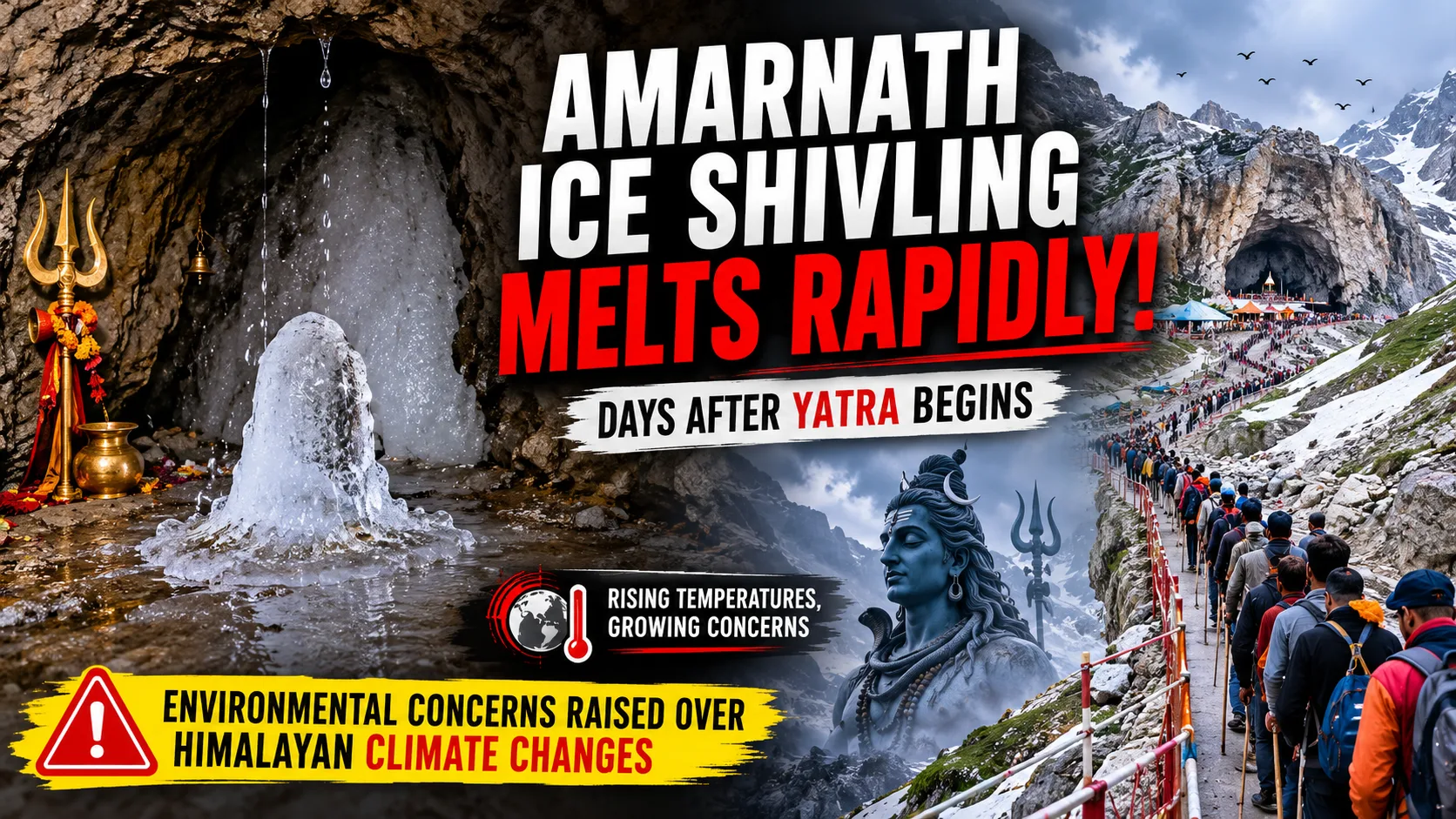
Reports of the rapid melting of the sacred Ice Shivling inside the Amarnath Cave during the early days of the Amarnath Yatra 2026 have drawn attention from devotees, environmental observers, and policymakers. Reports and images from the shrine in Jammu and Kashmir indicate that the naturally occurring ice stalagmite, revered as Baba Barfani, reduced significantly during the early days of the annual pilgrimage, which began on July 3.
This has attracted interest since the Ice Shivling is the main spiritual icon of the Amarnath Yatra and one of the most sacred natural religious sites in India. Although the pilgrimage is still being taken by large numbers of devotees, the incident has also rekindled more general discussions on climate change in the Himalayas, environmental stresses relating to pilgrimage tourism, and the sustainability of delicate mountain ecologies in the long-term.
Notably, there is no official declaration by experts and authorities that the melting was due to one cause. Scientists warn that weather conditions, snowfall patterns, cave microclimate and human activity might combine to affect the formation and the durability of the Ice Shivling. Consequently, until extensive scientific evaluation has been carried out, any conclusive explanation is premature.
Understanding the Amarnath Ice Shivling
The Amarnath Cave, 3,888 metres in the Himalayas of Jammu and Kashmir, is a naturally occurring ice, which forms each year inside the cave. It looks like a Shivling and is adored by the followers as an embodiment of Lord Shiva.
Popularly referred to as Baba Barfani, the Ice Shivling is formed by the freezing of water droplets which drip off the roof of the cave, and collect on the floor over a period of time. The formation, unlike the religious structures developed by man, is 100 percent natural and changes in size every year according to the environmental conditions prevailing in the area.
The shrine has a special position in the Hindu culture of spirituality. The pilgrimage is a form of devotion and spiritual training to millions of followers. Pilgrims engage in the tough mountainous journey in the name of their darshan at the cave shrine every year.
The Amarnath Yatra is one of the most important religious ceremonies in India, which is attended by religious believers in the country and even overseas. The pilgrimage will last 57 days, and will end on August 28, 2026.
What Happened During the 2026 Yatra?
Amarnath Yatra 2026 started on July 3 under the massive security cover and administration planning. During the first week of the pilgrimage, it was reported that the Ice Shivling had greatly receded, and, according to some, was virtually gone.
The issue drew wider public attention when political leaders and local observers expressed concern over the rapid reduction in the size of the formation. It was reported that the Shivling, which had been considerably larger earlier on in the season, had faded away considerably by July 7.
These reports notwithstanding, the pilgrimage was proceeded with. The Amarnath Cave is still visited by thousands of devotees and they offer prayers. Over one lakh pilgrims were reported to have already had darshan in the shrine by the first week of the Yatra.
Most pilgrims were disappointed that they did not see the Ice Shivling in its previous shape. Nevertheless, the stream of pilgrims did not decrease and it indicated the perpetual spiritual significance of the pilgrimage even after the physical aspect of the ice structure.
Shrine Board’s Position
The Shri Amarnath Shrine Board (SASB), in charge of pilgrimage management, has long held the view that the size and length of the Ice Shivling varies naturally each year. The Board has pointed out several times that the formation is a natural phenomenon dependent on the conditions in the environment of the cave.
There have also been changes in the size of Shivling in the previous years. The formation has been visible in most of the season of the Yatra in certain seasons and shrunk significantly before the pilgrimage ended.
This has led to the general warning by authorities to avoid making immediate conclusions based on the changes in the size of the Ice Shivling, pointing out that annual changes are not unprecedented. Snowfall, patterns of precipitation, humidity, temperature and other natural elements that may vary significantly each year affect the cave environment.
The Shrine Board is also continually working on easing the pilgrimage and keeping watch of the situation in the shrine and on the ways to it.
Could Climate Conditions Have Played a Role?
Although there has been no official agency that has definitively attributed the 2026 melting incidence to climate change, there are long-lasting records of warming throughout the Himalayan region by scientists.
The Shri Amarnath Shrine Board has historically described fluctuations in the size of the Ice Shivling as a natural phenomenon, although environmental experts continue to study whether broader climatic and human-induced factors may influence conditions inside and around the cave.
Based on the findings of several climate and glaciological studies, the Himalayas is warming at a higher rate than many other averages in the world. Increased temperatures have been part of the shrinking of glaciers, diminishing snow cover, shifts in the pattern of precipitation, and changes in the ecosystem of the mountains in the northern regions of India.
Another event that has occurred in Jammu and Kashmir over the years is the abnormally high temperatures and alterations in the snowfall patterns. According to climate scientists, climate changes such as the decrease in winter snowfall and warmer summer temperatures could influence the ice survival in high altitude places.
The above normal temperatures, less accumulation of snow and varying weather patterns have been cited by some environmental experts featured in the media reports to potentially affect the longevity of the Ice Shivling. They also point out, though, that the behaviour of the formation is determined by a complicated complex of local factors and cannot be sped up only by climate change without thorough scientific research.
To this end, climate scientists are still calling on people to be careful not to simplify the problem.
Concerns Regarding Pilgrim Footfall and Environmental Pressure
The debate about the Ice Shivling has also sparked old issues of environmental stresses related to large scale pilgrimage tourism in sensitive mountain areas.
Amarnath Yatra is the pilgrimage of hundreds of thousands of pilgrims every year. Such large numbers of people in a high-altitude Himalayan ecosystem are rather logistically and environmentally challenging to manage.
Issues that have been raised by researchers of mountain tourism include:
- Creation and disposal of waste products.
- Stress on water resources.
- Increase in temporary facilities.
- Increased vehicular movement
- Disturbance of the ecology in trekking routes.
- High human concentration in the environmentally sensitive areas.
Environmental groups have already claimed that the long term population density both in and around the cave area could affect the local microclimate. Experts have proposed that body heat, lighting systems and other related infrastructure would possibly have some effects on the conditions within the cave, but that the degree of such effects is a scientific effort as opposed to a scientific fact.
Governments have been implementing different waste-management and environmental conservation strategies in the past years. However, to environmental researchers, tighter monitoring and sustainability systems to pilgrimage tourism in the Himalayas are still encouraged.
The Larger Climate Change Debate
The issue of the Amarnath Ice Shivling is within a larger discussion of the topic of climate change in the Himalayas.
The Himalayas have been repeatedly termed as a very climate-sensitive area in the world by scientists. Increased temperatures have caused glaciers to melt faster in the various basins of the Himalayas, changed the hydrological processes, and the rate of extreme weather occurrences.
These developments are felt way beyond the personal pilgrimage locations. Changing climatic conditions influence water security, biodiversity conservation, livelihoods of the people of the mountain, and even disaster risk management.
A number of pilgrimage sites in the Himalayan belt have been exposed to environmental pressures associated with the growth in tourism, development of infrastructures and climate changes. There is an ever-growing pressure on policymakers to strike a balance between religious tourism, economic development and ecology protection.
The Amarnath case can then be echoed in a broader policy discussion of how sacred places can be made available and at the same time the vulnerable mountain environments protected.
Spiritual Significance Remains Unchanged
The spiritual value of Amarnath shrine has not been affected by the alleged melting of the Ice Shivling to the believers.
The pilgrimage in itself is a form of faith, devotion, and spiritual commitment to many pilgrims. Religious experts and community leaders have commonly stressed that the holiness of the shrine does not necessarily lie in the size of the natural ice formation.
The pilgrims kept on making the journey and attended religious activities despite the news of the melting. The presence of devotees throughout the initial stages of the Yatra was a reminder of the religious significance of the Amarnath Cave and Baba Barfani, which had a long history.
Through generations, the pilgrimage has been perceived as a highly individual spiritual event and that is not going to change irrespective of the changes in the look of Ice Shivling every year.
Security and Management During the 2026 Yatra
The Amarnath Yatra 2026 is going on under a huge security and administrative setup.
The government put in place multi-layered security in both the traditional Pahalgam route and the shorter Baltal route. The pilgrimage started with a flag off ceremony by Jammu and Kashmir Lieutenant Governor Manoj Sinha.
The disaster management teams, the local administration, and the Shri Amarnath Shrine Board have worked towards ensuring the safe passage of pilgrims.
Measures include:
- Monitoring and surveillance of routes.
- Medical assistance centres
- Emergency response teams
- Weather monitoring systems
- Crowd management protocols
- Registration systems and verification systems.
The operational advisories have also been issued by the Shrine Board and regular communication with respect to pilgrimage arrangements and safety requirements has been maintained.
Sustainable Pilgrimage -The Way Forward
The debates that the shrinking Ice Shivling evoked shows the increased significance of sustainable pilgrimage management.
There is a growing trend among environmentalists towards a model which balances both environmental responsibility and religious access. Among the recommendations may be a better waste management system, a more rigid environmental control, less carbon emissions related to pilgrimage organization, and a better study of the microclimate of the cave scientifically.
Long-term strategies such as visitor management, green infrastructure and renewable energy, and conservation-based planning are also under discussion.
Researchers believe that conservation of Himalayan ecology is not merely an environmental task, but a necessity in protection of cultural and spiritual heritage of mountain pilgrimage sites.
Looking Beyond the Ice Formation
The rapid melting of the Ice Shivling during the early days of the Amarnath Yatra 2026 has once again focused attention on the intersection of faith, environmental stewardship, and climate resilience in the Himalayas. While no authoritative body has conclusively identified the precise reasons behind this year’s development, the event has underscored the need for continued scientific monitoring and responsible management of ecologically sensitive pilgrimage destinations.
For devotees, the spiritual significance of Baba Barfani and the Amarnath Cave remains undiminished. For policymakers and environmental researchers, the episode serves as a reminder that protecting fragile Himalayan ecosystems will be increasingly important in the years ahead. The challenge lies in ensuring that one of India’s most sacred pilgrimages can continue sustainably while preserving the natural environment that makes it possible.