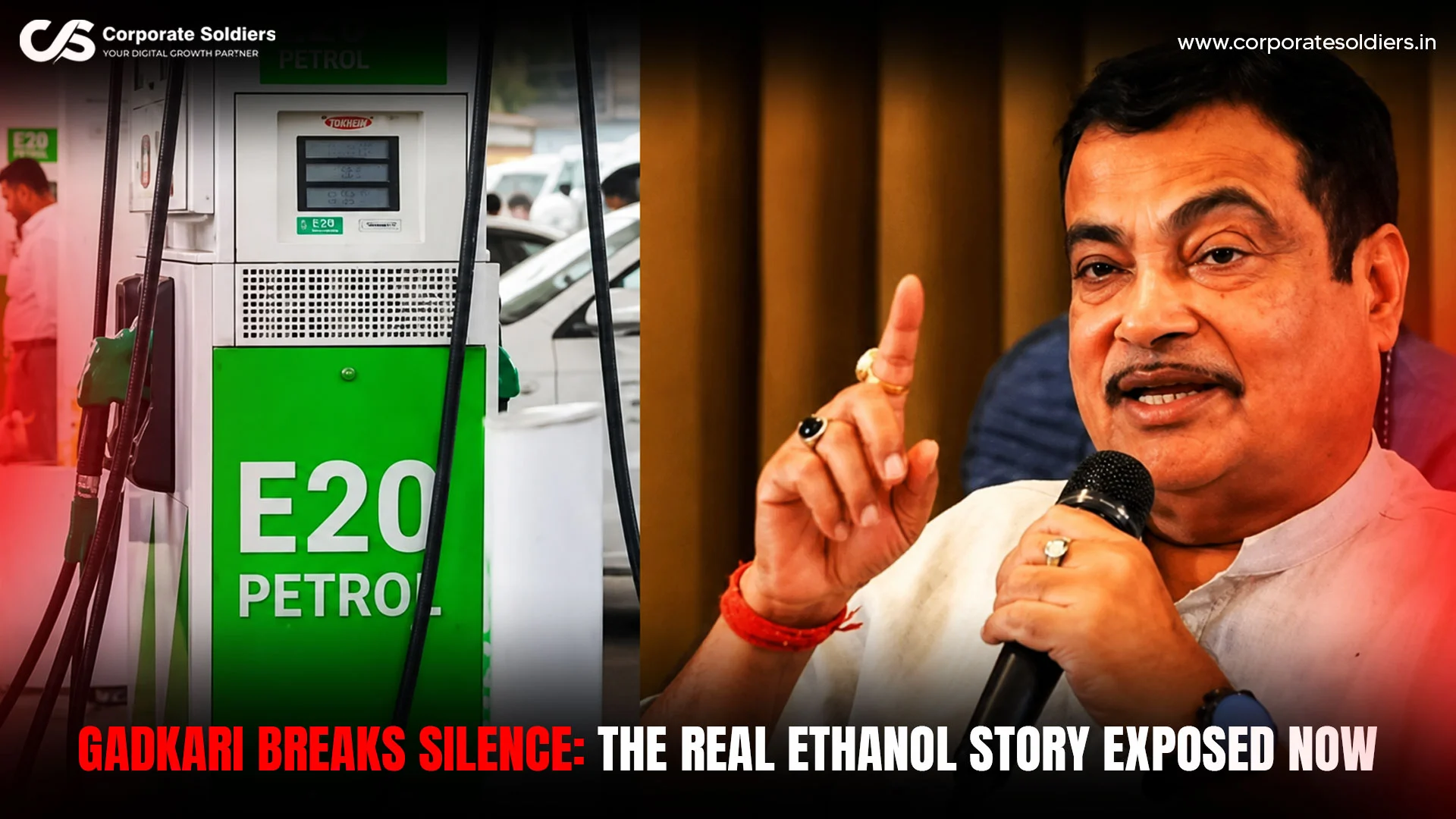
The ethanol blending programme in India has again come under the focus of the media following a wave of social media posts that doubted the intentions of the country in encouraging blended fuels. The Union Minister of Road Transport and Highways, Nitin Gadkari, was the center of most of the controversy, as it was alleged that the policymakers themselves could be interested in having ethanol-related enterprises.
The debate immediately picked up steam as millions of vehicle owners, fuel consumers, farmers, automakers and investors are directly impacted by the ethanol blending. With India increasing its use of E20 fuel, a blend of petrol and 20 percent of ethanol, the debate over the fuel efficiency, engine compatibility, economic advantages, and interests of the policymakers, has shifted out of industry circles and into the realm of everyday discussion.
Understanding E20 Fuel and Why Consumers Are Paying Attention
The E20 ethanol blending programme is one of the most ambitious energy transition programmes in India. The Ethanol Blended Petrol (EBP) Programme is the ethanol blended with petrol to decrease the import of crude oil, reduce carbon emission, enhance energy security, and provide more income to farmers.
The programme has gained a significant discussion among consumers in that E20 fuel directly affects the operation of the vehicle, its fuel economy, and subsequent design of the vehicle. The automakers have been forced to re-architecture engines, the oil marketing firms have improved the fuel infrastructure and the policymakers have increased the pace of implementation.
Simultaneously, there have been issues with respect to the loss of mileage, engine life, fuel supply, and the fact that ethanol is a bigger benefit to certain industries.
Separating Politics from Policy
This paper looks at the accusations, dissociates political accounts with policy facts and justifies the technical and economic logic behind the ethanol strategy in India.
The Controversy Explained: What Are the Allegations Against Nitin Gadkari?
The Minister’s Response
In reply to the accusations going round via the internet, Nitin Gadkari came out publicly to discredit the claims that the ethanol policy in India was meant to make personal financial gain.
Gadkari claimed that the shareholding in a company related to ethanol production that was reported by his family was less than half of 1 percent, claiming that the claims were vastly overstating ownership and financial gains.
Another point he made was the publicly available disclosures and that ethanol blending policies are enforced across several ministries, regulatory agencies, oil marketing corporations, and long-standing national programmes and not the personal initiative of one person.
The minister also claimed that India has more than just an ethanol agenda in its alternative fuel strategy, with electric mobility, green hydrogen, methanol, bio-CNG, and flex-fuel technologies all also being part of it.
Pull Quote:
The ethanol blending programme is included in a wider national energy transition strategy that includes a variety of ministries, industry players, and policy frameworks that have been evolved over decades.
Historical Timeline
The organizational architecture of the Ethanol Blended Petrol (EBP) programme in India shows that it is a multi-decade, multi-party macroeconomic program, as opposed to a unilateral ministerial order:
- 2003 (Vajpayee government): Introduced the first EBP pilot project, which required a 5 percent ethanol blend in 9 states and 4 union territories.
- 2006–2009 (UPA I & II Administrations): Unified the 5% blending to a national standard. Formally, then-Oil Minister Mani Shankar Aiyar urged the purchase of ethanol through sugarcane molasses in Parliament to help buffer the public finances against crude volatility.
- 2018 (NDA Administration): Published a reminder of the National Policy on Biofuels, which established a goal of 20% ethanol mixing by 2030 (and was subsequently escalated to a hard deadline of 2025-2026).
- 2025–2026: It is expected to reach a pan-India E20 average rollout, and transition to E85 and E100 flex-fuel design.
Financial Context
Businesses that should remain privately owned and those that should be formulated by the government are usually mixed up in publicly-sponsored discussions.
The publicly available information suggests that the businesses, which are associated with biofuels, are managed in highly regulated environment which implies:
- Ethanol procurement prices.
- Government tenders.
- Contracts of oil marketing companies.
- Environmental approvals.
- Regulatory oversight.
In his response to accusations of personal gains Gadkari has also publicly mentioned debt obligations and business financing structures.
In terms of policy, the most important question is whether there is evidence that ethanol blending policy was made according to personal gain. The current policy records, decisions of the cabinet and implementation structures show that the programme is not a policy designed to serve one stakeholder but a subset of a wider national energy and agricultural policy.
Why India Is Betting Big on Ethanol Blending
Pollution Control
The transportation sector in India continues to be a major cause of air pollution in cities.
Large urban areas like Delhi, Mumbai, Bengaluru, and Kolkata are continually experiencing air quality issues that are fueled by:
- Vehicle emissions.
- Industrial activity.
- Construction dust.
- Biomass burning.
Even though ethanol will not be a full-scale solution to the problem of urban pollution, blended fuels are regarded by policy-makers as one of the constituents of a larger reduction strategy of emission.
Based on governmental and industry evaluations, blending of ethanol can decrease some of the tailpipe emissions and decrease lifecycle greenhouse gas intensity in relation to conventional fossil fuels.
Pull Quote:
The cleaner fuels are sought as a broader strategy of India to cut down on transportation related emissions.
Energy Security
Ethanol blending probably has the best argument in the form of energy security.
More than 85 percent of the crude oil needs of India are imported and thus the economy is extremely sensitive to fluctuations in global oil prices and geopolitical impacts.
The consequences include:
- Higher import bills.
- Strain on current account deficit.
- Inflationary risks.
- Foreign exchange outflows.
According to government estimates, increased blending of ethanol has saved a significant amount of foreign exchange through the savings made on petrol usage.
Why Diversification Matters
Any percentage of domestic fuel substitution assists:
- Minimize reliance on foreign crude.
- Improve energy resilience.
- Enhance security of fuel supply.
- Facilitate strategic planning.
Pull Quote:
One of the main factors influencing the ethanol programme in India is energy security, rather than emissions reduction.
Agricultural Diversification
Another less-known but equally significant goal is the diversification of agriculture.
Sugarcane-Based Ethanol
In the past, the sugarcane and molasses were the key to the ethanol industry of India.
Benefits include:
- Extra earnings to sugar mills.
- Shorter turnaround time of farmers.
- Improved control of sugar surpluses.
Maize-Based Ethanol
The role of maize has been increased by recent policy changes.
This opens up opportunities to:
- Central Indian farmers.
- Non-sugar-producing states.
- Diversified agricultural regions.
Rice Surplus Utilisation
Sale of surplus grains has also developed an alternative route to the feedstock, without sacrificing food security.
Bamboo and Second-Generation Biofuels
India also is investing in hi-tech biofuels based on:
- Agricultural residue.
- Bamboo.
- Crop waste.
- Lignocellulosic biomass.
The interests of such technologies are to lessen reliance on food-based feedstocks.
Pull Quote:
The policy on ethanol is slowly shifting towards being a sugar policy, as opposed to the agricultural and rural development policy.
E20 Fuel Myths vs Reality: What Vehicle Owners Need to Know
Myth: “Ethanol destroys engines.”
Fact: The major chemical issue with ethanol is that it is hygroscopic (it is the fuel that captures moisture in the air) and is a solvent, and thus may damage older nitril-rubber fuel lines, and corrode uncoated aluminum carburetors. But in the case of the vehicles produced after 2021, and worldwide after April 2023, the Society of Indian Automobile Manufacturers (SIAM) required the use of new materials. In modern cars, ethanol-compliant elastomers, stainless steel lines and modified catalytic converters are used, making them totally resistant to chemical degradation when used in E20 conditions.
The Mileage Debate
The reality of ethanol, physically, cannot be disputed: it has less energy density as compared to pure petrol. Ethanol contains less calorific value, which is about 33 per cent lower than that of gasoline. Practically, E20 running would lead to a small decrease in fuel economy- it would normally be between 1.5% and 5% based on the driving habits and tuning of the engine.
- Conditions in the City: City stop and go traffic (e.g. Mumbai or Delhi) has a significant portion of efficiency loss which can hardly be measured since it is constantly in traffic and in low gear.
- Highway Conditions: Since the high-speed, cruising, is still taking place, a small decrease in tank-range can be mathematically observed. It is an engineering compromise and not a failure of the engine.
Fuel Availability
In an attempt to adjust to the transition, OMCs are implementing a segmented policy of distribution. Although the country has implemented E20 as the default base fuel in most of the retail pumps, some of the OMCs still offer E10 and higher-octane premium fuels (as high as 95 and 99 RON) to the country so that the interests of the older, and non-compliant vehicles are not negatively affected.
What India’s Leading Automakers Say About E20 Fuel
Mega re-engineering of the Indian auto industry to feature in the government plans on the use of alternative fuel:
- Maruti Suzuki India: By early next year the market leader has ensured that all its internal combustion engine line E20 is compliant. Millions of fleet kilometers are registered and no degradation of parts have been reported at Maruti.
- Tata motors and Hyundai India: The two giants in the motor industry in the passenger vehicle segment gave a testament of full material conformity of E20 in their line-ups of petrol powered vehicles. They are also in the process of testing engine control units (ECU) calibration by their engineering departments to make sure that engine ignition timing is optimum, to modify the small calorific loss of blended fuels.
- Honda Cars India: Honda has been eager to ensure that its already existing i-VTEC engines are already E20 optimised and to its customers that there will be no impact of the new fuel requirement on its existing factory warranties.
- Mercedes-Benz & BMW India: The luxury producers have been able to keep international standards of compliance. Their new engines are also designed to accept the variable ethanol blends to E20 without any adjustments to their component life-cycle although it recommends the high-octane premium blends to the high-performance sports models.
Allegations vs Facts: A Quick Reality Check
| Allegation | Official Response |
| Conflict of interest claims | Government and ministerial clarifications state that policy decisions are part of a broader national programme and not linked to personal gain. |
| Ethanol damages engines | Manufacturers and testing programmes support E20 use in certified vehicles. |
| Ethanol only benefits sugar producers | Current policy includes maize, surplus grains, agricultural residue, bamboo, and advanced biofuels. |
| Massive financial gains for policymakers | Public disclosures, shareholding information, and policy structures indicate a more complex regulatory framework than portrayed online. |
Final Thoughts
The recent controversy surrounding allegations linked to India’s ethanol blending programme shows the significance of breaking down the politics of political narratives and the politics of policy realities.
The ethanol blending programme in India did not come into being with a stroke of luck, neither was it a creation of one government or policymaker. It is the product of twenty plus years of policy formulation with successive administrations, the oil marketing community, agricultural interest, automobile industry and the regulating agencies.
The evidence that is available indicates that there are three national objectives that largely drive ethanol blending:
- Strengthening energy security.
- Reducing environmental impacts.
- Increasing farmers’ economic opportunities.
The Road Ahead: Ethanol Is Just One Part of India’s Alternative Fuel Strategy
The Indian policy on the alternative fuel is much more than blending of ethanol. It is believed that Green Hydrogen will play an important role in the heavy industry, long distance transportation and energy storage. EVs continue to play a center stage in the decarbonisation policies of India particularly regarding urban mobility and fleet electrification.
The government is also considering Methanol Economy Vehicles and Flex-Fuel Vehicles as part of an overall project to diversify the fuel sources, and reduce dependency on imported fossil fuel. Bio-CNG is also under consideration. Ethanol is a part of a multi-fuel transition strategy and not a solution in itself in this larger context.
Have you switched to E20 Fuel yet?
Have you noticed a difference in your vehicle’s performance or mileage since the rollout of E20 fuel? Share your observations and experiences in the comments below.