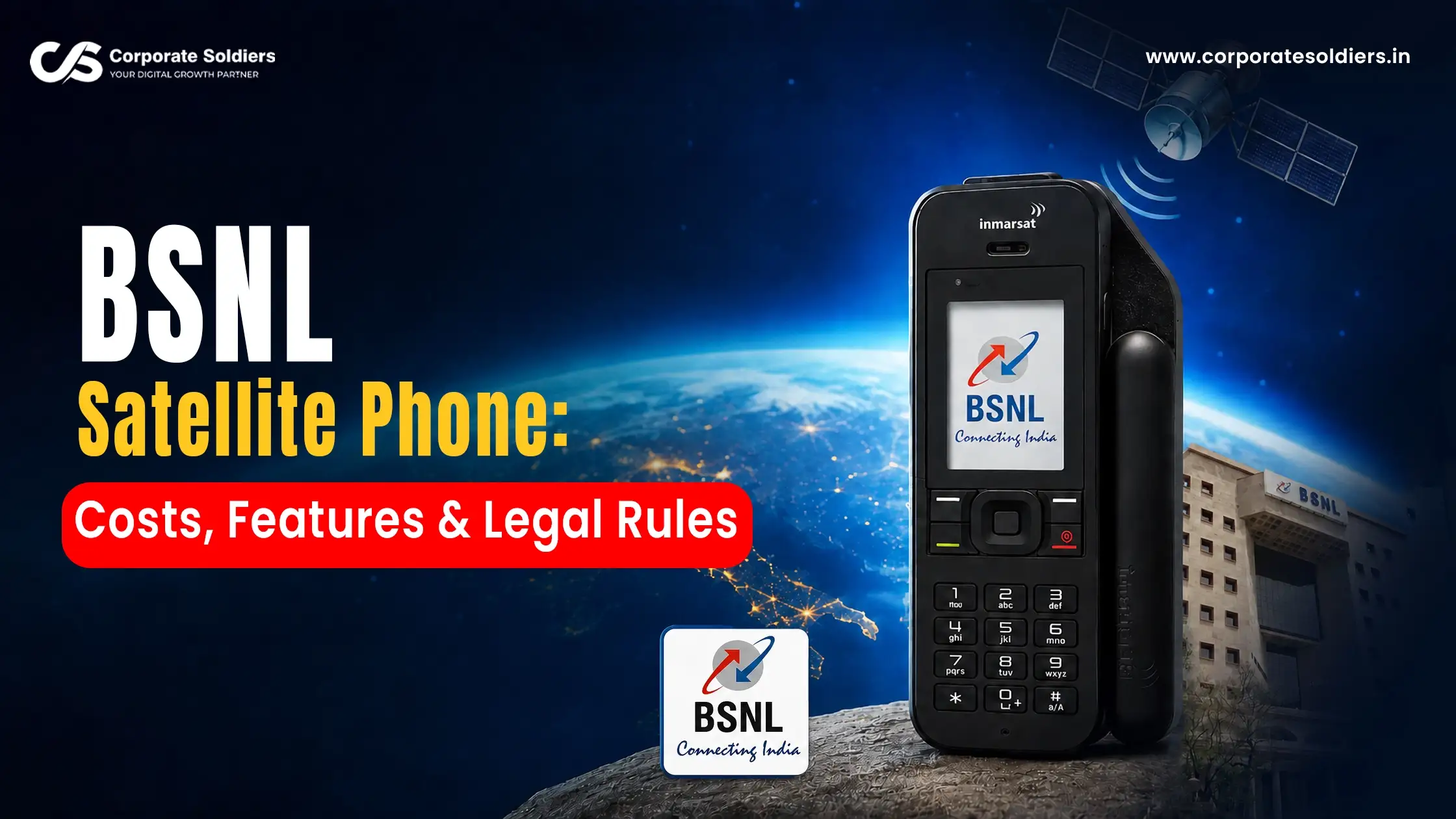
Staying Connected Anywhere: The Ultimate Guide to the BSNL ₹1.34 Lakh Satellite Phone
Imagine being on a deep-sea fishing vessel hundreds of nautical miles from shore. Consider a disaster response team operating in a flood-hit region where telecom infrastructure has been destroyed. Think of border personnel stationed in mountainous terrain beyond cellular coverage, geologists working in dense forests, or offshore energy facilities far from conventional communication networks.
In such environments, traditional mobile networks often become unreliable or disappear altogether.
Conventional telecommunications infrastructure relies on cellular towers, fiber backhaul, power availability, and terrestrial network connectivity. The breakdown of any one of those links may result in the loss of communication. It is especially problematic in cases of natural disasters, maritime emergencies, and remote area operations with connectivity being a safety-critical concern.
Satellite communication addresses this challenge by bypassing land-based infrastructure and connecting directly through satellites in orbit.
Bharat Sanchar Nigam Limited (BSNL) has a regulated satellite phone service operating on the Inmarsat satellite network, a country-regulated service in India which provides coverage in remote locations that the traditional networks cannot serve. The service has faced interest due to its high cost of acquisition, estimated at around ₹1.34 lakh for the handset and the stiff regulatory framework surrounding its usage.
This guide discusses the functionality of the BSNL satellite phone service, its target audience, the cost, regulatory conditions in India and the future of satellite communications.
Understanding Satellite Communication
A satellite phone is a cellular communication gadget, which links it directly to satellites instead of land-based cellular towers.
The satellite phone uses satellites to relay messages to communication satellites around the earth as opposed to a regular smart phone which uses base stations around the phone. These satellites transmit signals to earth stations that are linked to the general telecommunications networks. This architecture supports voice and messaging services in areas where there is no earth based infrastructure.
How Satellite Communication Works
An average satellite communication system comprises of:
- Satellite handset (mobile earth station).
- Communication satellite
- Ground gateway station
- Public telecom network
When a user makes a call, the signal is transmitted between the handset and the satellite, a gateway station and lastly into the destination network.
Satellite Networks vs Cellular Networks
| Characteristic | Cellular Network | Satellite Network |
| Infrastructure | Towers and fiber | Satellites and gateways |
| Coverage | Limited by tower deployment | Regional or near-global |
| Disaster resilience | Vulnerable to infrastructure damage | Independent of local infrastructure |
| Remote-area access | Often unavailable | Designed for remote connectivity |
| Latency | Lower | Typically higher |
Why Satellite Communication Remains Functional During Disasters
Telecom towers, power systems and fiber networks are often damaged by earthquakes, cyclones, floods and landslides. Satellites do not shut down since there is the main communications route outside the area of influence.
This is why emergency responders, disaster management agencies, maritime operators and defense organizations across the globe extensively use satellite communications.
What Is the BSNL Satellite Phone Service?
BSNL provides satellite communication services under the Inmarsat network in India within the official satellite communication network.
The service aims at offering voice and messaging accessibility in areas where the traditional telecommunication networks fail to offer such services. As it is revealed by the government, the Global Satellite Phone Service (GSPS) of BSNL mostly offers voice and SMS facilities.
Partnership with Inmarsat
Founded in 1976, Inmarsat is among the oldest satellite communication companies in the world; it provides services to maritime, air travel, government, disaster recovery and enterprise clients worldwide.
BSNL uses the satellite infrastructure provided by Inmarsat to be able to offer its communication services to areas that cannot be served by the land-based networks.
Coverage Areas
The service is aimed at:
- Sea and marine activities.
- Remote border regions
- Mountainous terrain
- Woodland and wilderness.
- Disaster-affected zones
- Infrastructure developments in remote areas.
Due to the nature of connectivity provided by the satellite infrastructure, availability of the service is not reliant on the availability of local cellular towers.
Intended User Base
The satellite phones are not aimed at consumers to replace the smartphones.
Typical users include:
- Government departments
- Emergency response agencies
- Maritime operators
- Strategic infrastructure organizations
- Oil and gas industry.
- Mining enterprises
- Remote engineering projects
- Authorized expedition teams
The service is under stringent regulatory guidelines and approvals in India.
The Price Tag -What Does It Cost?
Compared to the traditional mobile networks, satellite communication infrastructure is much more costly.
Device Cost
The BSNL satellite handset has been publicly announced as being priced at about 1,34,166 including taxes.
Monthly Plans
Commercial service plans are said to start at around ₹6,886 per month depending on the usage and provisioning needs.
Additional Charges
Other factors to be considered in organizations include:
- Activation fees
- Airtime charges
- SIM provisioning costs
- Usage-based billing
- Enterprise communication packages where appropriate.
Why Satellite Communication Costs More
The pricing is because of a number of factors:
- Launch and manufacturing of satellites.
- Ground gateway infrastructure
- Spectrum management requirements
- Regulatory compliance obligations
- Reduced number of subscribers compared to cellular networks.
- Service availability requirements are on a mission-critical basis.
Satellite services are used by relatively few, specialized customers in contrast to the consumer mobile services which distribute infrastructure costs among hundreds of millions of users.
Built for Emergencies: Key Features
The design of satellite phones is more towards reliability than convenience to the consumer.
Global Satellite Connectivity
The first benefit is the ability to connect to locations that are not within the limits of the terrestrial network such as to offshore and remote areas.
Rugged Hardware
Several of these satellite gadgets are built to operate under extreme conditions and are frequently employed in marine, industrial and expeditionary contexts.
Emergency Communication Capability
Satellite devices are usually used as an emergency communication device when other means of communication fail.
Long Battery Life
Long standby and talk-time performance is essential since users often use them in areas where there is little access to charging.
GPS Integration
Location-awareness functions are used to aid navigation, tracking assets and emergency response operations.
Mission-Critical Reliability
The technology is designed in the circumstances when communication breakdown might pose some operational or safety hazards.
Communication During Natural Disasters
After mass destruction of infrastructure on the ground, satellite systems often become one of the few operational communication channels in the aftermath of big disasters.
Industries and Users That Depend on Satellite Phones
Government Agencies
Remote working government departments often need robust communication networks.
Armed Forces and Border Security
Isolated border deployments can be very problematic with regard to connectivity.
Maritime Industry
One of the most crucial satellite communication applications is maritime communication.
Fishing fleets, merchant vessels, offshore support vessels and research vessels are also highly relying on the safety of their operations being supported by satellite connectivity.
Oil and Gas Exploration
The exploration locations tend to be in deserts, offshore and isolated areas.
Mining Operations
Remote mining projects often have the need for independent communication systems.
Disaster Management Teams
The emergency responders should have communication channels that would not be affected by the failure of the terrestrial infrastructure.
Remote Infrastructure Projects
Road construction, power transmission projects, pipelines and strategic infrastructure projects tend to be located in low network coverage areas.
High-Altitude Expeditions and Trekking Teams
Emergency communication capability may be necessary to expedition groups that are working in remote mountainous areas.
Why Traditional Networks Fail in Remote Areas
Traditional telecommunication networks rely on a vast network.
Dependence on Telecom Towers
Cellular base stations are needed close to mobile devices in order to communicate.
Power Outages
Electrical power and backup systems are needed in telecom infrastructure.
Infrastructure Damage During Disasters
Damages can be caused by floods, cyclones, earthquakes and landslides:
- Towers
- Fiber networks
- Power systems
- Switching facilities
Coverage Limitations
The installation of telecom towers in remote areas is usually costly.
Satellite communication does not have these limitations as connectivity is provided over space based infrastructure, as opposed to local tower networks.
Legal Status of Satellite Phones in India
India has stringent regulatory control in the satellite communications due to the national security factors.
Satellite communication equipment usage is under administrations of the Department of Telecommunications (DoT), Wireless Planning and Coordination (WPC) Wing, and other government bodies.
National Security Considerations
Satellite phones do not need the use of local telecom networks. As a result, the government controls the authorization of devices, providing services, verifying subscribers, and the use of services.
Regulatory Framework
India controls the satellite communication by licensing and authorizing process, which are managed by DoT and other related bodies. GMPCS and Mobile Satellite Service schemes define the needs of satellite communication processes, gateway routing, security compliance, as well as the ability of legal interception.
Restrictions on Unauthorized Devices
Illegal use or holding of non-approved satellite communication equipment can be subject to law in Indian telecommunications and security laws.
Users must also never seek to import, activate or operate satellite phones in other channels other than authorized ones.
The procurement of services to organizations that need satellite communication should only be done by approved providers and through regulation means.
The Official Approval Process
Since the services of satellite communications are regulated, acquiring a BSNL satellite phone is usually accompanied by the organized approval cycle.
Step 1: Justification
The applicant should prove that he or she has a valid operational need.
Common use cases include:
- Maritime operations
- Disaster response
- Strategic infrastructure projects
- Remote industrial activity
- Government-approved field operations
Step 2: Department of Telecommunications Clearance
The applications have to be reviewed and approved through the applicable telecommunications and security procedures.
There are also situations where satellite communication licensing frameworks refer to documentation and approvals related to security.
Step 3: Digital Certification
Before service provisioning, applicant identity checks, documentation checks and regulatory compliance checks are carried out.
Step 4: BSNL Provisioning
On approval, BSNL offers the service, sets up subscriber credentials and packages the satellite communication package.
According to government disclosures, BSNL keeps records of the subscriber information, the purpose of the usage, the place of operation, and the time of usage as a process of service.
Step 5: Activation Process
Once all the necessary compliance and provisioning is completed, the handset, SIM credentials and approved service plan are activated.
The real requirements can be different based on the type of applicant and the case of application.
How to Apply for a BSNL Satellite Phone
Those organizations interested in availing themselves of satellite communication services ought to get in touch with BSNL in the official institutional or enterprise level.
This is normally done by:
- Making a formal requirement.
- Providing operational justification.
- Completing identity and organizational verification.
- Experiencing relevant regulatory inspection.
- Finalizing the provisioning and activation of service.
By far, the main groups to such requests are enterprise customers, government agencies, maritime operators, and infrastructure organizations.
Applicants should verify the latest procedural requirements through official BSNL enterprise channels or regional BSNL offices before initiating the approval process.
Organizations seeking satellite communication services can contact BSNL through its designated enterprise support channels. Applicants may visit their nearest BSNL enterprise office or contact the satellite service support line at +91 9768866652 for the latest information regarding eligibility, approvals, and service provisioning.
Challenges of Satellite Communication
Although satellite communication has its benefits, it has a number of limitations.
High Costs
Satellite communication and airtime is still far more expensive than traditional mobile services.
Latency
The distance covered by the signals is much higher than what is covered by terrestrial communication and this may add to communication delay.
Weather Impact
The atmospheric conditions may be heavy and hence interfere with the quality of the signal especially in some instances of communication via satellites.
Device Limitations
Satellite phones are all about dependability rather than cell phone functionality.
Regulatory Complexity
Deployment may be complicated by the need to meet authorization requirements, the obligation to meet security compliance, and operational constraints.
Satellite Phones vs Smartphones
| Feature | Smartphone | Satellite Phone |
| Network Dependence | Cellular towers | Satellites |
| Coverage | Limited to network footprint | Remote and offshore areas |
| Cost | Relatively low | Significantly higher |
| Emergency Reliability | Depends on local infrastructure | Operates independently of local infrastructure |
| Disaster Use Cases | Limited if networks fail | Designed for emergency communication |
The Future of Satellite Connectivity in India
Satellite communications are in a fast technological development.
LEO Satellites
LEO constellations are expected to be lower latency and more connected than geostationary systems. LEO architectures are a key future trend of satellite communications identified by industry research.
Direct-to-Cell Technology
New satellite systems are in development that will provide direct interconnection with standard mobile devices, which may diminish the need to have dedicated satellite handsets.
Starlink Developments
As the world moves to satellite connectivity, satellite broadband providers like Starlink are seeking regulatory approvals and market entry strategies in various countries, such as India.
AST SpaceMobile
AST SpaceMobile and others are working on direct to smartphone satellite connections models that would transform communications in the future.
Future Role of BSNL Satellite Services
BSNL satellite service will continue to be significant to users of mission-critical missions who need controlled, government-licensed communication services in isolated and hazardous locations.
With the growth of the satellite ecosystem in India by the GMPCS licensing program, new satellite broadband networks, and non-terrestrial communication architectures, resilient communication services will gain more significance in the government, enterprise, maritime, and disaster-management sectors.
Final Thoughts
The existence of satellite communication is to address an issue that the traditional telecommunication networks cannot completely cope with: stable connectivity even in places where the terrestrial network is not available.
Satellite phones are used to maintain communication continuity in regions of the ocean where deep-oil well operations, emergency relief operations, border patrols, mining operations or in remote infrastructure development where cellular service availability is limited or the network is damaged.
The Inmarsat-based satellite phone service of BSNL is one of the most regulated Indian satellite phone services. However, the service is intended for mission-critical applications rather than everyday consumer use. The expensive price of the devices, the monthly fees of the services, and the rigid approval system are evidence of the complexity of satellite communications, as well as the national security implication that the implementation of this type of communication has.
With India entering a new era where LEO constellations, direct-to-cell technologies, and a wider scope of satellite connectivity are all a part of national infrastructure, resilient communications will become a more significant part of national infrastructure. In the case of organizations that are not connected to the traditional networks, satellite communication will remain as a lifeline to them when they need connectivity the most.