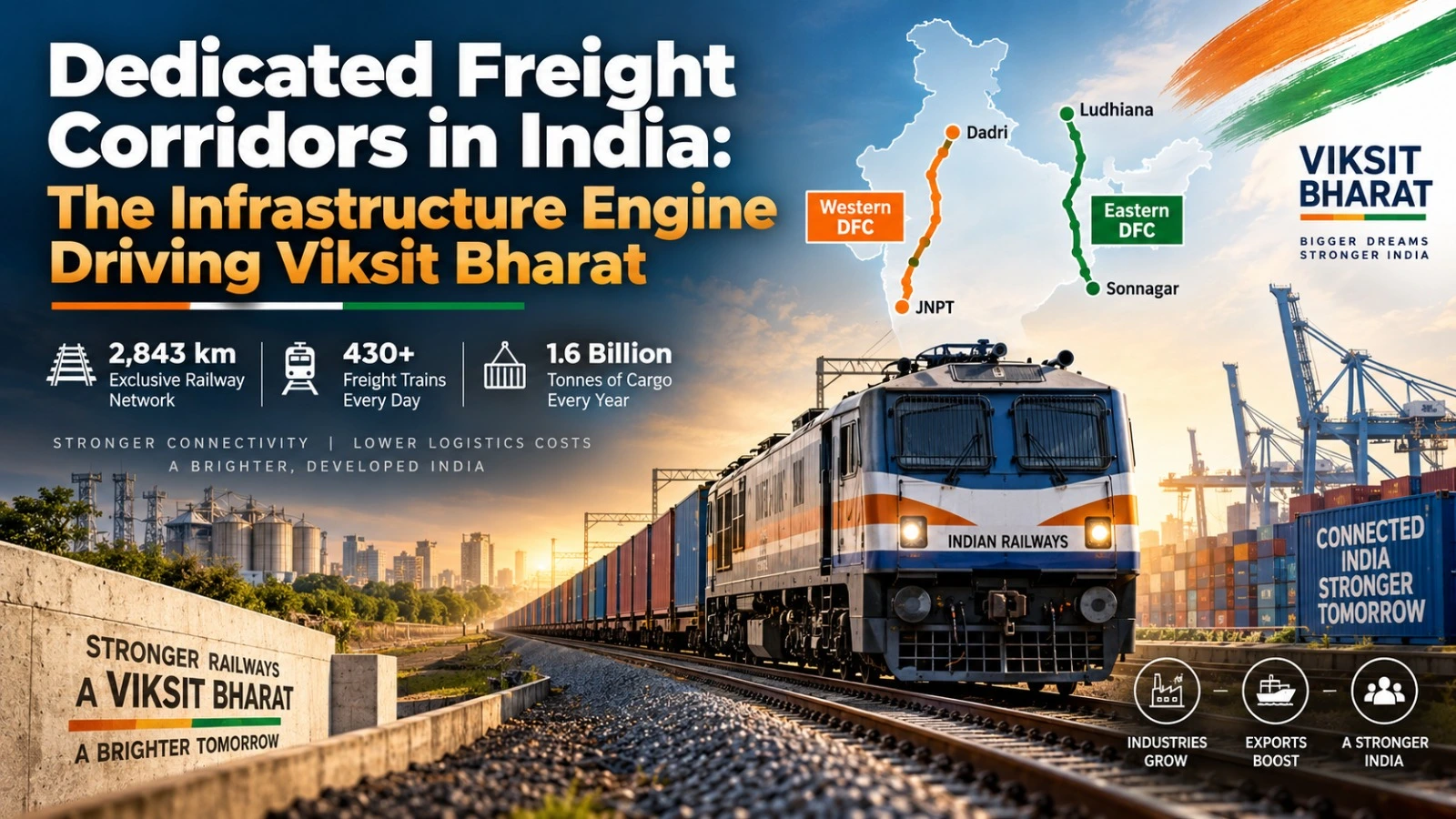
2,843 km of an exclusive railway network running with 430+ freight trains every day. And 1.6 billion tonnes of cargo being moved every year.
For a couple of decades, India’s railway network has been known to carry both freight and passengers on the same tracks.
Even though it was made for convenience but somehow turned into a congested mode of transport. Resulting in delays, slow speeds, and heavy goods loads.
But now, India’s freight corridors are the new era of progress. Let’s see how.
Vision Behind India’s First Dedicated Freight Corridors
In 2004, a vision was created for the development of India’s dedicated Freight corridor network.
But it was a slow process and was executed in 2014. However, it still struggled to move forward.
Even 1 kilometre of this corridor never saw the light of day. But after a year, this project gained momentum and speed with a renewed dedication to build the corridor in no time.
In 2026, this year, India’s First Dedicated Freight Corridor (DFC) network is completely constructed with flying colours.
This transformation perfectly supports the vision of Viksit Bharat.
India’s Freight Backbone
Western Dedicated Freight Corridor (WDFC)
Distance – 1,506 km, from Dadri to JNPT
The Western DFC focuses on:
• Container movement
• Export-import cargo
• Industrial hubs
• Port connectivity
This corridor links major industrial regions to the Jawaharlal Nehru Port Terminal with a faster link between factories and global markets.
Eastern Dedicated Freight Corridor (EDFC)
Distance – 1,337 km, from Ludhiana to Sonnagar
The Eastern DFC supports:
• Coal transportation
• Steel movement
• Foodgrain supply
• Bulk cargo movement
Dedicated to making strong connections between production centres and consumption markets.
Final Links Completing The Network
Now, the completion of these three Western DFC sections has connected the freight corridor network from end to end:
- New Asanand (N) to New Makarpura
- New Umbergaon to New Saphale
- New Saphale to New JNPT
Together, these sections cover a distance of 326 Route km, valued at ₹20,700+ Crore Investment
These links perfectly provide connectivity between industrial centres and ports.
India’s Growing Freight Power
The Indian railway industry involves the movement of 1.6 billion tonnes of freight every year with a progression rate consecutively.
Both 2025 and 2026 state this corridor as the 2nd largest rail freight carrier in the world. According to World Bank’s Logistics Performance Index:
2014: 54th Rank
2023: 38th Rank
India’s positioning is improved by 16th rank, reflecting the success in logistics infrastructure.
The Road Ahead
More than just a railway project, this Dedicated Freight Corridor serves as the foundation for the future growth of India.
The connectivity between ports, industries, markets helps in reduction of logistics costs and improvement of exports.
India’s freight system is moving the nation closer and closer to the vision of Prime Minister Narendrea Modi, Viksit Bharat.