The FIFA world cup final has always been the ultimate in football. But there are some finals that are not about the winning of a trophy but become a part of the sports overall memory. The 2026 FIFA World Cup Final between Spain and Argentina is squarely a part of that.
As it is the case with Argentina, the event is a chance to protect the title, which it won in Qatar four years ago and to secure one of the most significant periods in the history of world football. To Spain, it is an opportunity to win the most coveted football trophy once again and to prove the birth of a new era of football players who can continue the long tradition of football in Spain.
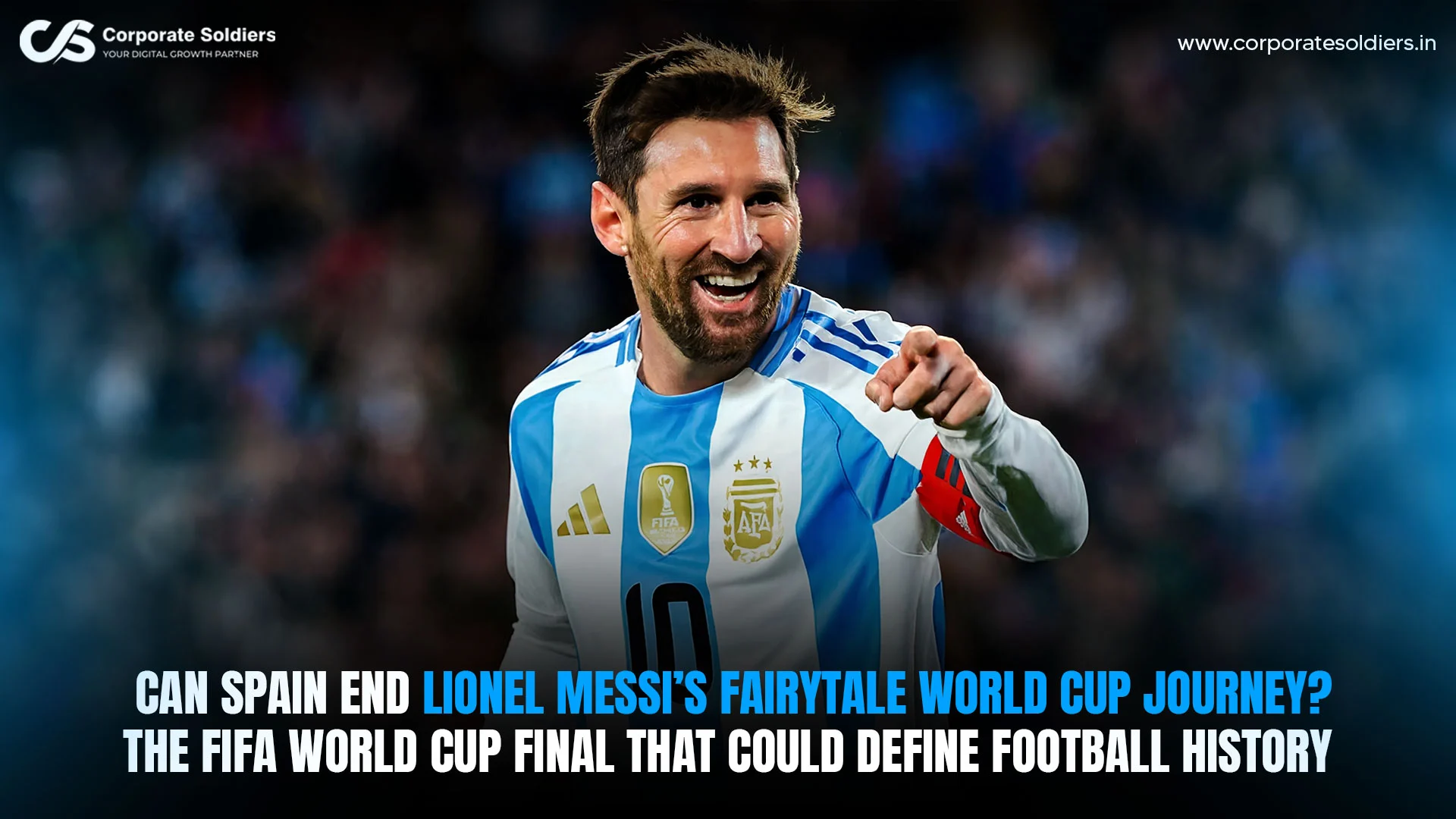
The main character in the story is Lionel Messi.
The veteran Argentina captain has redefined excellence for more than two decades. After already providing the world with the World Cup victory that most people thought would provide a culmination to his career in 2022, Messi is now just one match away from another historic feat. In his way is a Spain team that is considered by many to be one of the most complete teams in football in the world.
It is a final constructed on contrasts and symbolism and high-quality elite footballing – a match that might define how the 2026 tournament is viewed in generations to come.
Lionel Messi’s Historic Journey
No one has ever stepped into a final of a world cup with history as a burden of a player as Lionel Messi has.
The captain of Argentina has made it to the final once again by spearheading his country to the final.Messi arrives at the final having once again played a central role in Argentina’s campaign, combining creativity, leadership, and decisive attacking contributions.
His contribution has been more than just goals. Messi has been the creative pulse of Argentina, determining the rhythm, breaking down defensive lines, and providing crucial moments when games have become more and more intense.
The way of Argentina to the final has not been an easy one. The side of Lionel Scaloni has navigated a demanding knockout stage, overcoming a series of difficult challenges to reach the final. During those difficulties, Messi was able to offer direction and calmness in vital situations on numerous occasions.
This accomplishment is especially important in light of the historical context. Messi has once again added another historic milestone to his international career by reaching yet another World Cup final. FIFA reports that he is on the verge of further enhancing an already unmatched international legacy.
The only difference between this World Cup and several other tournaments before is how Messi has played up to the leadership role. Instead of dragging Argentina on his shoulders on the strength of individual brilliance alone he has acted as the emotional and tactical point of reference of the team.
This last is another hallmark chapter to many observers in a career that has already changed the history of football.
Spain’s Rise to the Final
Although a lot of the spotlight has been deservedly deserved by Messi, Spain has made it to the final due to performances that have been tactically mature, technically superior and incredibly consistent.
The side of Luis de la Fuente comes as the champions of Europe and as one of the most balanced teams in international football. The way they have been advancing through the tournament has demonstrated the level of their attacks and defensive discipline.
The semi-final win of Spain over France proved their capacities to the fullest. The semi-final win over France showcased Spain’s ability to control possession and dictate the tempo against elite opposition.
The success of Spain is still in its midfield.
Rodri is still able to offer positional intelligence and control in deep regions and the supporting midfielders of Spain maintain the continued possession and progression in the central regions. The fact that the team is in control of the territory enables them to control matches over a long time.
Spain has also been as impressive defensively. Spain have also impressed defensively throughout the tournament, combining defensive discipline with effective collective organisation.
Spain mixes form and surprises in attack. The coming up of young stars, and the experienced international performers have given rise to a team that can tear the opposing side with complex combinations or lightning transitions.
Their performances throughout the tournament have underlined the consistency and maturity of a side operating at an elite level. Spain’s composure and efficiency have been among the defining features of their run to the final.
Tactical Battle: Argentina vs Spain
The FIFA World Cup Final offers one of the most intriguing tactical match-ups in the tournament.
The main battle on its own is the confrontation between the possession-based dominance of Spain and Argentina , which is capable of surviving in a transitional situation.
Possession vs Transition
Spain will tend to have long spells in possession.
Their patient build-up play, positional structure, and midfield rotations enable them to gain a territorial advantage and restrict opportunities of the opposition. On the contrary, Argentina have typically been the most threatening in regaining the ball and rushing forward fast with Messi and the forward runners.
The most crucial issue is whether the possession of Spain can always provide any significant opportunities or Argentina can take advantage of the gaps that occur in the moments when Spain is on the offensive.
Midfield Battle
The result can be dependent on the midfield battle.
It is impossible to overestimate the impact of Rodri on Spain. His tact to dictate tempo and defend transitions is the main focus of Spain.
Argentina retaliates with an intensity-based, tactically adaptable and technical quality midfield unit. Players like Enzo Fernández and Alexis Mac Allister offer the equilibrium between defense and offensive development.
The team that has control of centre areas will have a high chance of controlling the pace of the game.
Defensive Organisation
One of the strengths of the tournament has been the defensive set up of Spain. Their form of compactness and system of collective pressing reduces the space between the lines.
Argentina on the other hand, have proved to be tough guys. Their capacity to take in tough situations and be competitive well into matches has been a common thread of the knockout round.
Pressing Systems
Spain normally presses a lot and aggressively when losing possession in order to recover the ball before the opponent can pass on.
Argentina tend to be more situational and press selectively whilst staying tight behind the ball.
The success of such opposite strategies might play a huge role in the conclusion.
Can Spain Stop Messi?
The question has been trailing Messi in his career.
Not many teams have been able to totally neutralise him, yet Spain has a number of attributes that enable them to curb his influence in a unique way.
Collective defending will probably have the greatest impact as opposed to the individual marking.
Isolated defenders are a favorite of Messi. Spain will then seek to limit the lanes in which he will be playing in but keep short distances between the midfield and defence.
One of the key tactical battles will be Spain’s effort to limit Messi’s influence in advanced areas. Nevertheless, the success of Spain will be determined by the support that is given to Laporte and not one on one fights.
The other important consideration is to restrict Argentina’s secondary creators.
Messi is much more dangerous when the runners are lengthening the defensive structures and providing a passing choice. Spain should hence avoid service towards risky central positions as well as regulating Argentina in moving around the penalty box.
It does not necessarily prevent Messi from touching the ball. It is to make sure that such touches are made too distant to allow him to influence the game.
Key Players to Watch
Argentina
Lionel Messi
The captain continues to be the center of the Argentina attack, the center of the last.
Julián Álvarez
His motion, pushing and attacking the space could bring openings towards the Spanish defensive line.
Lautaro Martínez
A time-tested goalscorer whose scoring can become crucial in a closely-fought final.
Enzo Fernández
Responsible for balancing both defensive responsibilities and the passing of the ball via the midfield.
Emiliano Martínez
One of the most influential goalkeepers in knockout football in the world, who can alter the path of a final with some key actions.
Spain
Lamine Yamal
The young phenomenon is the future of world football and comes as one of the most lethal attacking guns in Spain. The duel with the defence of Argentina will be in the limelight of the world.
Rodri
The leader of the midfield in Spain and, arguably, the most influential player as far as match control is concerned.
Aymeric Laporte
Supposed to be a major contributor in keeping Messi at bay and the formation of the Spanish defence formation.
Spain’s Midfield Unit
Together in charge of keeping dominance of possession and controlling tempo.
Goalkeeper and Defensive Core
They are capable of keeping the record of the defensive of the tournament in Spain, which is likely to be the decisive factor at the end.
What’s at Stake?
For Argentina
The stakes are huge.
A win would put a back-to-back world cup and cement Argentina as one of the most successful world teams in football. It would also give another historic moment to Lionel Messi and probably the best end to his career in the world cup.
In a country where football is a way of life, emotional value would be beyond measure.
For Spain
Spain are pursuing their second world cup victory and the heights of world football.
A win would legitimize the creation of a new generation and establish Spain as the modern philosophy of football as one of the most influential in the sport.
It would also make this team an iconic representation of the present epoch.
Expert Perspective
Tactically, Spain can have a marginal structural advantage going into the final.
Their control in the middlefield, defensive stability, and identity that is possession-based has enabled them to be one of the most complete teams in the tournament. Spain’s defensive organisation and performances against elite opponents have highlighted the maturity and balance of the side throughout the tournament.
The strength of Argentina is in other areas.
The side of Scaloni has more recent experience in the World Cup final, an ability to overcome hard times and, perhaps, the most influential player in the tournament. Their journey to the final has demonstrated time and again, their resilience, flexibility and competitive spirit.
Both sides are vulnerable to potential attacks.
Occasionally, Spain is at a disadvantage, when their rivals circumvent their press and strike the transition areas. Argentina on the other hand have been defensively weak at several times in the knockout stages.
The ultimate determinants can be:
- Domination of middle grounds.
- Efficiency in transition.
- Defensive concentration.
- Single shining instances.
And, like so many times on the biggest stage of football, the gift of being able to stay calm in the face of extreme stress.
Final Thoughts
The FIFA world cup Final 2026 is much more than the Argentina and Spain match.
It is a collision of philosophies of football, generations and legacies.
On the one hand, there is Lionel Messi, who has already made a career in the sport that has already changed its face and whose career now requires another milestone of a remarkable global career. On the other is a team of Spain which is the future–technically superior, tactically advanced, and with a will to carve a niche in the annals of football history.
Regardless of whether Messi can produce one more masterpiece or Spain can put a new chapter about the reign of power, the role of this match is far much more than the trophy itself.
When the final whistle blows, football will have a world champion. It is also possible that it can have a moment that characterizes an era.