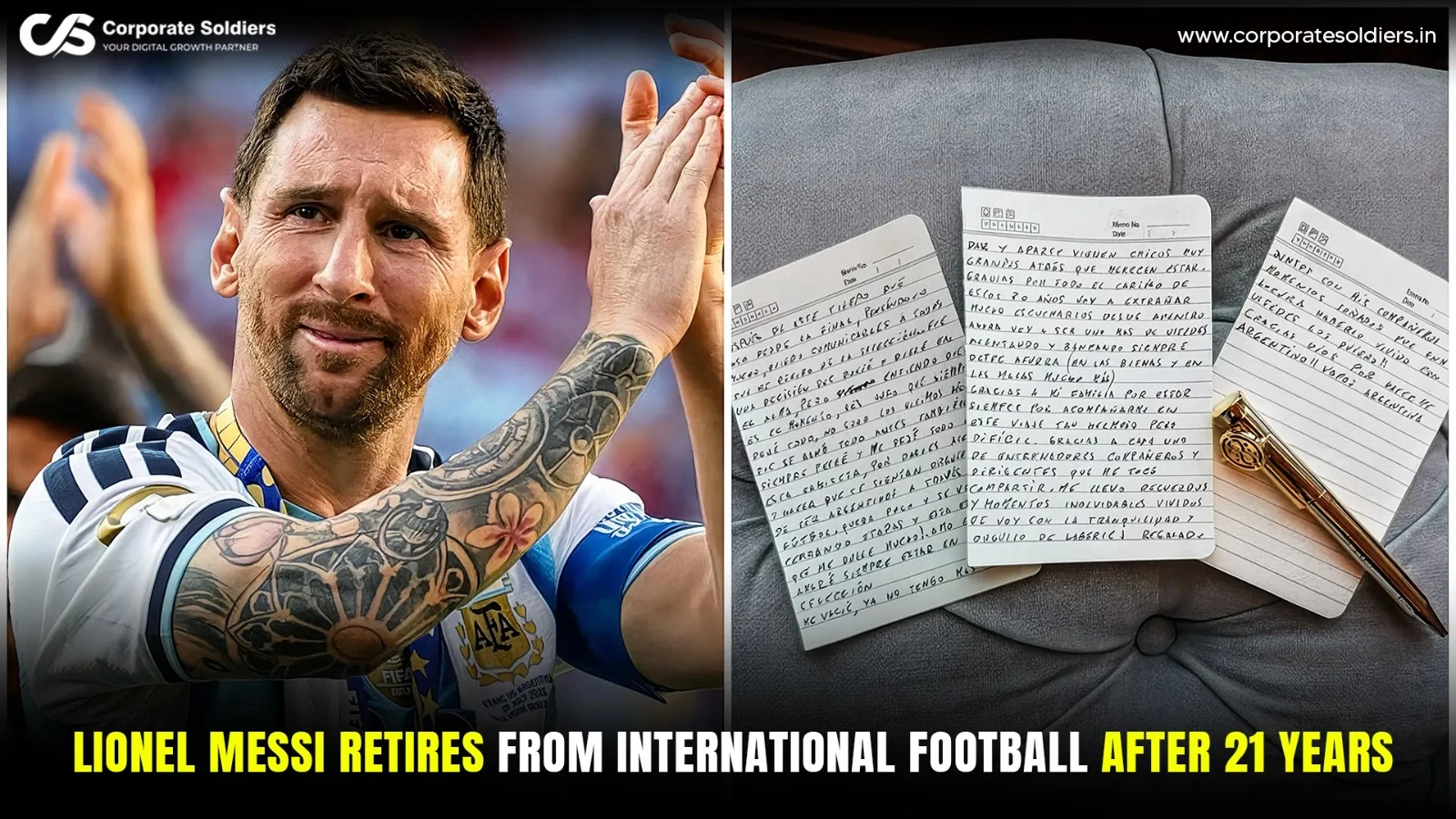
At 39, Lionel Messi has ended his international career with Argentina after an exceptional 21-year journey. This announcement, on August 31, 2026, brings to an end one of the most significant chapters in the history of modern international football.
Messi substantiated the move with an emotional post to instagram which stated that it was time to retire from the Argentina national team. The last time he played for the country was at the 2026 FIFA world cup final where Argentina lost 1-0 in extra time to Spain in New York/New Jersey.
The loss deprived Messi of a second world cup victory, but it could not take away the magnitude of his international career. He departs Argentina as the most-capped player and all time leading scorer, both in appearances and goals (207-125). He too leaves behind as a World Cup champion, two-time Copa América champion, and 2022 Finalissima champion.
Lionel Messi Announces International Retiremen
On Monday, August 31, Messi formally retired from the Argentina national team; it had been a career that had started when he first represented the country against Hungary on August 17, 2005.
His announcement came a few weeks after Argentina’s World Cup final defeat.
Messi said it was a painful decision but he knew that it was time. He also clarified that it was also a decision regarding the national team and not an announcement of his retirement from professional football altogether.
One of the key reasons behind his rationale was that he had already done all that he could do to Argentina and that a new generation was on the rise. Messi said in his farewell that he was not able to give anything more, and that young talented players should have their chance with the national team.
Why Messi Chose to Step Away
The closure, exhaustion and the coming of a new generation was the subject of explanation by Messi, not a single sporting failure.
He claimed the move was painful, however, he felt that it was time to put an end to the book. It was also an important part of his message that he had been dedicated to Argentina all these years and not only the years when the team started to win major trophies. He claimed that he had always battled to have the shirt and attempted to provide reasons to create pride with supporters.
Messi’s father, Jorge Messi, died on August 8, 2026. Messi had already written his retirement message on July 21, two days after the World Cup final. Following his father’s death, he became even more convinced that the time had come to step away from the national team
Messi had already thought about the decision as soon as the World Cup ended and later he confirmed the decision after thinking over it.
Messi’s Final World Cup and Argentina Appearance
The 2026 FIFA world cup was the last international tournament of Messi.
Argentina was the defending world champions and ultimately made it to another world cup final. The squad had not lost any of its last 13 world cup games leading to the final which highlighted the continuity of the team Messi had assisted in building towards the second half of his career.
On July 19 the last match against Spain was held at the New York/New Jersey Stadium. Spain won in the extra time by 1 goal which denied Argentina the opportunity of winning the world championship once more and deprived Messi the opportunity of completing his international career with two consecutive world championships.
This was a defeat but Messi had a great individual campaign. He had eight goals and four assists in the tournament, and ended second after Kylian Mbappé in the goal tally. Messi received the Silver Ball, while Kylian Mbappé won the Golden Boot with 10 goals and Spain’s Rodri received the Golden Ball.
Another record that Messi has added to his world cup career is the 2026 tournament. The event in the final gave him a total of 34 matches in the World Cup, adding to his record of the most matches played in the competition. He was the second-oldest player to take part in a World Cup final, and the oldest outfield player to take part in a World Cup final, at the age of 39 years and 25 days.
A 21-Year Journey With Argentina
The story of Messi in Argentina started in 2005 when he was first introduced to senior football by playing against Hungary. He would continue to be in the national team for more than 20 years as a key figure.
His foreign career was not marked at the very onset by trophies. As Argentina struggled to make the team appearances in major finals turn into titles, Messi became the key attacking player of the team, the captain and the creative leader of the team.
One of the defining features of his Argentina career was his longevity. Between 2005 and 2026, Messi represented Argentina at six FIFA World Cups: 2006, 2010, 2014, 2018, 2022 and 2026. He ended his senior international career with 207 appearances, 125 goals and 68 assists as per AFA last career statistics.
He was also the record appearance holder and all time leading scorer in Argentina and exceeded the previous statistical standards of the country by a great margin.
From International Heartbreak to Major Trophies
Even in the early part of his international career, the question on Messi was not whether he was able to conquer the matches but whether he was able to win a major senior trophy with Argentina.
The disillusionment was at its height in 2014-2016.
Argentina reached the 2014 FIFA World Cup final, where they lost 1-0 to Germany in extra time. Messi would then suffer two consecutive losses in the Copa América final to Chile in 2015 and 2016.
The 2016 Copa América Centenario final was particularly significant. Messi announced his retirement from international football after Argentina lost to Chile in penalties. He later overturned this and went back to the national team.
That return proved to be one of the greatest turning points of his career.
Argentina finally ended its major-trophy drought at the 2021 Copa América, defeating Brazil in the final at the Maracanã. Messi then helped Argentina defeat Italy in the 2022 Finalissima before reaching the defining achievement of his international career.
In one of the most memorable finals in the history of the FIFA world cup in Qatar, Argentina beat France on penalties following a 3-3 draw in the world cup final. Messi won the Golden Ball as the best player of the tournament, and scored twice. The victory of Argentina ended 36 years of waiting to achieve another world cup.
Argentina followed this up by winning the 2024 Copa América, which earned Messi two Copa America titles and made the successful era of the team a far more significant thing than a one-off tournament win.
The biggest accomplishments of Messi with Argentina.
Some of the senior Argentina honours of Messi are:
- 2022 FIFA World Cup
- Copa América 2021
- Copa América 2024
- Finalissima 2022
- 2008 Olympic gold medal with Argentina’s Olympic team
He also won the FIFA World Youth Championship with Argentina’s Under-20 team in 2005, but it is the youth team of Argentina that has won this title and not the national team. The 2008 Olympic gold medal was also the one that the Argentina Under-23 team won and must be differentiated with his senior international awards.
The importance of such successes is in the fact that they have changed the relations of Messi with Argentina.
The failure of Argentina to win major senior trophies, comparisons with Diego Maradona, and criticism of his failure to do so were part of the story surrounding him over the years. That debate had fundamentally shifted by the time Messi won the World Cup in Qatar. His international career had moved from repeated final defeats to a sustained period of success.
Messi’s World Cup Legacy and Records
Messi is walking out of the world cup as one of the most statistically relevant players of the competition.
He has been a participant in six world cups and has made 34 appearances, the highest in world cup history. He has a total of 21 goals in the world cup, which ranks him in the second position in the all-time scoring list, below Kylian Mbappé, who scored 22 by the end of the 2026 world cup.
His goals in the World Cup were spread out over six World Cups:
| World Cup | Matches | Goals |
| 2006 | 3 | 1 |
| 2010 | 5 | 0 |
| 2014 | 7 | 4 |
| 2018 | 4 | 1 |
| 2022 | 7 | 7 |
| 2026 | 8 | 8 |
| Total | 34 | 21 |
Messi has also won the World Cup Golden Ball two times, in 2014 and 2022. He is the only player that has won the award twice. He was the first player to score in the group stage, round of 16, quarter-final, semi-final and final of the same World Cup.
The 2026 tournament further extended Messi’s World Cup records, as he became the first player to make nine consecutive World Cup appearances and increased his tournament total to 34 matches.
Messi’s Argentina Records
By the culmination of his international career, Messi had a number of major records:
- 207 appearances in Argentina – a national record.
- 125 Argentina goals – the all-time Argentina scoring record.
- 34 World Cup appearances — the most in tournament history.
- 21 World Cup goals – second-most in World Cup history after 22 by Mbappe.
- 39 Copa América appearances — the most in tournament history.
- 14 Copa América goals.
- 72 World Cup qualifying appearances for Argentina
- 36 World Cup qualifying goals, the most in CONMEBOL qualifying history
Of special interest is his record in Copa América. Messi has been the player featured in seven editions of the tournament and played 39 matches, the most matches of any player in the tournament. He reached five Copa América finals — in 2007, 2015, 2016, 2021 and 2024 — and won the final two.
What Messi Said in His Farewell
The farewell of Messi was characterized by a mixture of pain, pride and gratitude.
He stated that he will always love the Argentina national team and that he would still support the country even without being part of the team. He owed his debt of gratitude to the family, team mates, coaches and officials that had been with him through thick and thin.
He also looked back at how he had established a bond with Argentina supporters over the years when his career as an international player was frequently measured by the failure of the team to reach major finals.
Messi added that he was going with the peace of mind and pride of having provided the fans, along with his colleagues, with moments they had before merely dreamed of doing. He concluded his message with an expression of gratitude to be an Argentine and a last call of support to Argentina.
His retirement therefore was not a rejection of the national team. Instead, Messi presented himself as a supporter who would continue following Argentina from outside the squad.
What Messi’s Retirement Means for Argentina
The retirement of Messi represents a huge change in the Argentina national team.
He was not just a member of the squad, as it was the case over a decade. He was its captain, main creative power and worldly icon. His impact was not limited to goals and assists to the team but also about the identity and expectations of the team in major tournaments.
But Argentina is not starting this transition at a crisis point but a strong one.
The national team has captured the 2021 Copa América, the 2022 Finalissima, the 2022 World Cup and the 2024 Copa América, and has made the final of the 2026 world cup. The record creates a good foundation to the new generation.
Messi himself in his farewell said that young talents have a right to be given a chance. The difficulty that Argentina will now have is to maintain the competitive levels that it has acquired throughout the Messi years and come up with a team that does not rely on the best player anymore.
Messi’s Club Career Continues
The retirement of Messi in international football is not to be linked with retirement in professional football.
By the time of his retirement announcement, Messi is a Major League Soccer player with Inter Miami. He has an MLS contract which expires at the end of the 2028 season, and so his choice is about his Argentina career and not the immediate termination of his club career.
It has not been confirmed that Messi will be retiring in club football at the same time.
His subsequent professional engagements will henceforth be at club level and Argentina will start without its long-time captain.
A Defining International Career Comes to an End
The international career of Lionel Messi started in the year 2005 with a slight setback but later on turned out to be one of the most awarded careers in the world of football.
Frustrations were intertwined with years of major final losses, three in a row, criticism and even a short period of retirement announcement in 2016. There were some fantastic successes as well: two Copa Américas, Finalissima, Olympic gold and, most of all, the 2022 World Cup.
His last world cup performance was in another final but Argentina lost to Spain. Messi even scored eight goals, four assists and another personal prize, to conclude the tournament, and then concluded that it was time to end the chapter.
By the time he quit Argentina, he had made 207 appearances and scored 125 goals, becoming its most-capped player and top goal scorer. What is more important, he leaves behind a national team which underwent a baseline revolution under his rule.
After 21 years with Argentina, Messi’s international journey has come to an end. Messi will no longer wear Argentina’s No. 10 in competitive international football, bringing one of the defining international careers of his generation to a close.