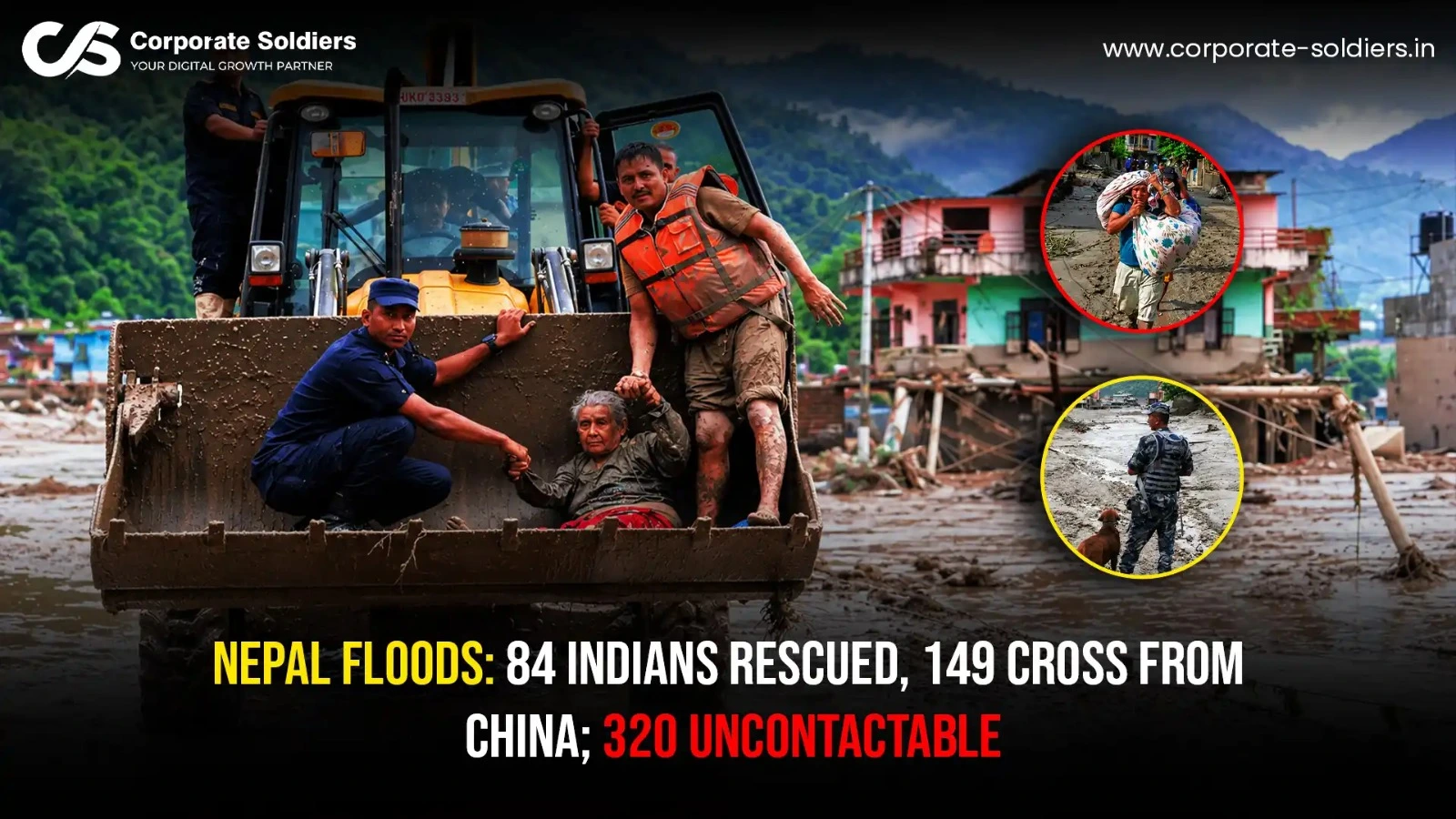
In Nepal, the rescue and relief efforts were ongoing in the areas of the floods as the government tried to access individuals trapped in the river corridors of the Bhote Koski and Trishuli rivers. According to the latest report of the Ministry of External Affairs (MEA) of India, 84 Indian citizens have been evacuated, and 149 Indian nationals safely crossed from China into Nepal on August 28. Approximately 400 Indian nationals are secure on the Chinese side, where officials of the Indian Embassy are communicating to them and trying to get them evacuated. Meanwhile, some 320 Indian nationals are out of contact, and the telecommunications have been largely disrupted, meaning that the authorities are struggling to get in touch with them.
The figures are announced as Nepal is still on a massive search-and-rescuing mission in the wake of destructive flash floods that have left roads, bridges, hydropower plants and other vital infrastructure in ruins. Over 15,000 security personnel have been deployed in Nepal and helicopters and ground teams are still assisting the affected communities.
84 Indians Rescued From Flood-Hit Nepal
MEA spokesperson Randhir Jaiswal announced that 84 Indian nationals had been evacuated out of the flood-impacted regions.
The figure comprises 21 Indian citizens from Tamil Nadu who returned to India on Friday and 63 Indian workers associated with the Trishuli-I hydropower project. The two groups are the 84 Indian nationals of the latest update by MEA.
The rescue of workers associated with the Trishuli-I project is especially great since hydropower sites and tunnels within the affected area have been one of the areas that need to be searched intensively. The Nepalese officials have reportedly rescued hydropower tunnel workers separately as part of the overall disaster response.
The rescue figure of Indians must not, however, be added to those 149 Indians who safely crossed from China into Nepal on August 28. Those developments were independently reported by the MEA, and the official information at hand does not prove that the 149 were included in the previous 84-person figure of rescue.
149 Indians Safely Cross From China Into Nepal
A second significant development was that 149 Indian nationals safely crossed from China into Nepal on August 28.
In an official update, MEA spokesperson Randhir Jaiswal has provided the names of the 149 nationals. The movement offered a secure path to Indians who had found themselves on the Chinese side of the region of the affected boundary as the flood crisis halted the flows and communications.
One of the crossing groups included a group of 53 Indian nationals (37 of Maharashtra) who later arrived in Kathmandu, as reported on the MEA update.
This is independent of the progress made on the 84 Indian nationals already registered to have been rescued in Nepal and should be seen as part of the overall operation to relocate to safer places the affected Indian nationals.
Around 400 Indians Remain Safe in China
The MEA has also indicated that some 400 Indian nationals are still safe on the Chinese side.
The officials of the Indian Embassy are in touch with them and are trying to get them evacuated. Their position is thus not similar to the very 320 Indians with whom authorities have been unable to get in touch.
This is further indicated by the fact that even at the Chinese side, hundreds of Indian nationals continued to be found, indicating that the disaster is cross-border and that the Indian, Nepalese and Chinese governments needed to work together to reestablish evacuation routes.
Around 320 Indians Remain Uncontactable
The status of the about 320 Indian nationals who are still unreachable despite the crisis is one of the most severe unresolved issues of the crisis.
The MEA has explained that widespread telecommunications disruptions in the flood-affected area have made it difficult to establish contact. The destruction of infrastructure, inaccessible roads and communications has complicated the process of knowing where and the status of individuals in the rural regions.
Being uncontactable does not mean that someone is confirmed dead. Nor should it in itself be considered as an ultimate or confirmed count of missing-persons. The government is still working on getting in touch with those who are not accessible at the moment and figuring out what has happened to them.
It is a dynamic situation, and the figures can vary when communication will be restored, and rescue teams will have access to isolated locations.
Fresh Flood Warning Along the Trishuli River
New flood dangers have complicated the rescue operation.
The flood forecasting authorities of Nepal cautioned the people residing on the river riparian areas of Trishuli River up to Mugling to avoid going to their homes and remain on high alert until further notice. This alert was issued after the Chinese side had issued information to the District Police Office in Rasuwa that Bhote Koshi River had exceeded once again in flooding.
The warning further increases the risk of the rescue team already in the challenging terrain. On August 29, heavy rainfall also increased the level of water in the Trishuli, which also halted rescue operations temporarily and compelled helicopter activity in some places due to unfavourable weather.
The authorities have been forced to weigh between the requirements to access stranded individuals and safety of the rescue teams and residents in the at risk river basins.
Nepal Deploys More Than 15,000 Security Personnel
Nepal has placed a national response scale to the disaster.
Prime minister Balendra Shah or Balen, as he is commonly referred to, had announced that 15,431 security officers had been deployed to aid in search-and-rescue. The deployment consists of 6,755 Nepali Army, 4,473 Nepal Police as well as 4,203 Armed Police Force Nepal personnel.
The wider operation saw 4,451 people being rescued, reported by Nepalese authorities. This numbered 191 people who were saved in hydropower tunnels and 517 people saved by helicopter operations, based on the most recent operational report of the prime minister.
Helicopters of Nepali Army and the private-sector have been involved in the air operation. The authorities had reported that 16 helicopters were in operation in shuttle activities in places such as Dhunche, Trishuli, Timure and Syabrubesi and 99 flights were made in the reported operation.
Ground teams also strive to access remote communities and hydropower locations where access routes such as roads were destroyed.
India’s Disaster Assistance Expands
India has increased its aid of humanitarian supplies to specialised operational aid.
The third humanitarian aid flight by the Indian Air Force was loaded with 10 tonnes of relief supplies to Kathmandu. The shipment consisted of portable generator sets, dignity kits, food packets and water-purification pills.
An 11-member team (doctors, paramedics and a reconnaissance team) was also on the same flight to carry out operations on tunnel-rescue missions. The specialised team has already reached Nepal and they are on the ground as the authorities evaluate the needs of rescue operations in the hard and possibly dangerous areas.
The deployment is especially pertinent as a number of hydropower stations in the impacted area have tunnels and underground works, which has been affected by floods and debris.
India has also offered National Disaster Response Force (NDRF) teams and associated equipment to support Nepal’s search-and-rescue efforts, subject to Nepal’s requirements.
Relief Supplies Handed Over in Nepal
The humanitarian aid provided by India has been officially handed to Nepalese authorities.
The MEA update reports that the shipments of relief supplies were given to Mahabir Pun, the Minister of Science, Technology and Innovation of Nepal. External Affairs Minister S. Jaishankar also verified the arrival of the medical and tunnel-rescue team and the latest assistance flight.
The new shipment was the next consignment after the previous humanitarian aid. By Wednesday, a 10 tonne consignment of HADR was already shipped by India, and another 37.5 tonnes on Thursday, with the third 10 tonne consignment being shipped on Friday.
This aid entails supplies to help in emergency medical services, simple relief and operations in the regions where power and communications and access have been affected.
Why Communication Has Become a Major Challenge
Disruption of telecommunications has been a significant impediment to rescue and tracing missions.
Roads and communication links have been damaged in some of the areas of the disaster zone due to floodwaters, damages to infrastructure and debris. In the case of rescue agencies, the issue does not just stop at being able to reach out to the affected places, but also whether people in remote areas are okay, and where help is required.
The communication issue to the Indian authorities is directly related to the fact that there are about 320 nationals that cannot be contacted.
That is why the existing number is to be handled. Someone who is unreachable now can be trapped in a place with no connection, could have gone elsewhere or just be out of the reach of the communication networks at hand. The uncontactable term is the right one till the authorities define their status.
Extensive Damage Across Flood-Affected Areas
The disastrous flash floods which hit the Bhote Koshi River region on August 26 have left a trail of destruction in some regions in Nepal.
The Ministry of Foreign Affairs of Nepal has reported destruction of houses, roads, bridges, hydropower plants and other vital infrastructure. Disruption of transport and communications networks have made it more difficult to access certain communities affected and have complicated the transportation of aid.
Foreign nationals, tourists and workers have not been spared by the disaster, as well as the local communities. The authorities in Nepal have been undertaking search-and-rescue missions and retrieving bodies and attempting to determine the location of individuals who are yet to be found.
According to Nepal’s disaster authorities, 579 people had died and 1,924 remained missing as of the latest reported update on August 29. These figures relate to the wider disaster and should not be confused with the approximately 320 Indian nationals who remain uncontactable.
The figures are only subject to change as search activities are underway and the law enforcement agencies get new leads.
India-Nepal Coordination Continues
It is responded to more and more by the coordination of Indian and Nepalese government agencies, security forces, diplomatic officials and special rescue teams.
Indian Embassy officials are responding to the needs of affected nationals in China, with Indian assistance teams responding to the overall emergency response in Nepal. The Nepal Army, Nepal Police and Armed Police Force Nepal remain on the frontline of search-and-rescue operations within the country as the Nepalese authorities.
China is also not left out in the evacuation effort considering that hundreds of Indian nationals are already safe on the Chinese side with 149 already crossing to Nepal.
The urgent operational need is to maintain clear exits, as well as reestablish contact where there is communication and make sure the rescue and rescue teams have access to the area isolated by broken roads, bridges and floodwaters.
What Happens Next
Since rescue operations are at a very critical stage, the authorities have laid emphasis on the following steps in the operations:
- Re-establishing Contact: Continuing efforts to establish contact with approximately 320 uncontactable Indian nationals and determine their status.
- Evacuation out of China: Finalizing the logistical preparations to evacuate the Indian nationals numbering about 400 who are on the Chinese side safely.
- Specialized Tunnel Operations: The 11-member Indian specialised medical and tunnel-rescue team will support rescue and assessment efforts where required.
- Hydrological Surveillance: Round-the-clock monitoring of the Bhote Koshi and Trishuli rivers after receiving fresh flood warnings.
- The Sustained Relief Distribution: Resuming IAF and Nepal helicopter flights in the delivery of isolated communities with medical supplies and food rations.
Key Takeaways
- 84 Indians Rescued: 21 of the citizens of Tamil Nadu (repatriated to India) and 63 workers of the Trishuli-I hydropower project.
- 149 Safe Border Crossings: 149 Indian nationals had entered Nepal safely out of China on August 28, 2026.
- 400 safe in China: About 400 Indian nationals are safe in China, evacuation efforts being guided by the Embassy.
- 320 Uncontactable: Destruction of telecommunications severely impacts around 320 Indians; search is underway.
- Massive Nepal Deployment: More than 15,000 Nepalese security personnel were deployed; 4,451 overall rescues reported by PM Balen Shah.
- Indian Specialized Aid: 11-member Indian medical and tunnel-rescue team that is deployed to the ground by IAF assistance flights.
- Fresh Flood Warnings: Vigilance alerted along the Trishuli River up to Mugling following rising Bhote Koshi water levels.
Rescue Efforts Continue Amid Renewed Flood Risk
Recent events indicate that the Nepal flood crisis is still ongoing despite the tremendous achievements in the rescue of thousands of lives. In the case of Indian nationals, the situation has taken several parallel paths: 84 have been rescued, 149 have crossed safely out of China into Nepal, some 400 are still safe on the Chinese side and some 320 remain unreachable.
The overall next step of the authorities will rely a lot on restoring communications, covering the isolated areas and reacting to the varying river and weather conditions. The security forces in Nepal are still active in search and rescue, and Indian diplomatic, medical and specialised rescue aid is still active to aid the overall emergency response.
The status of the about 320 Indian nationals will continue to be a key area of concern in the current Nepal flood rescue operation until contact is also made with those who are also inaccessible.