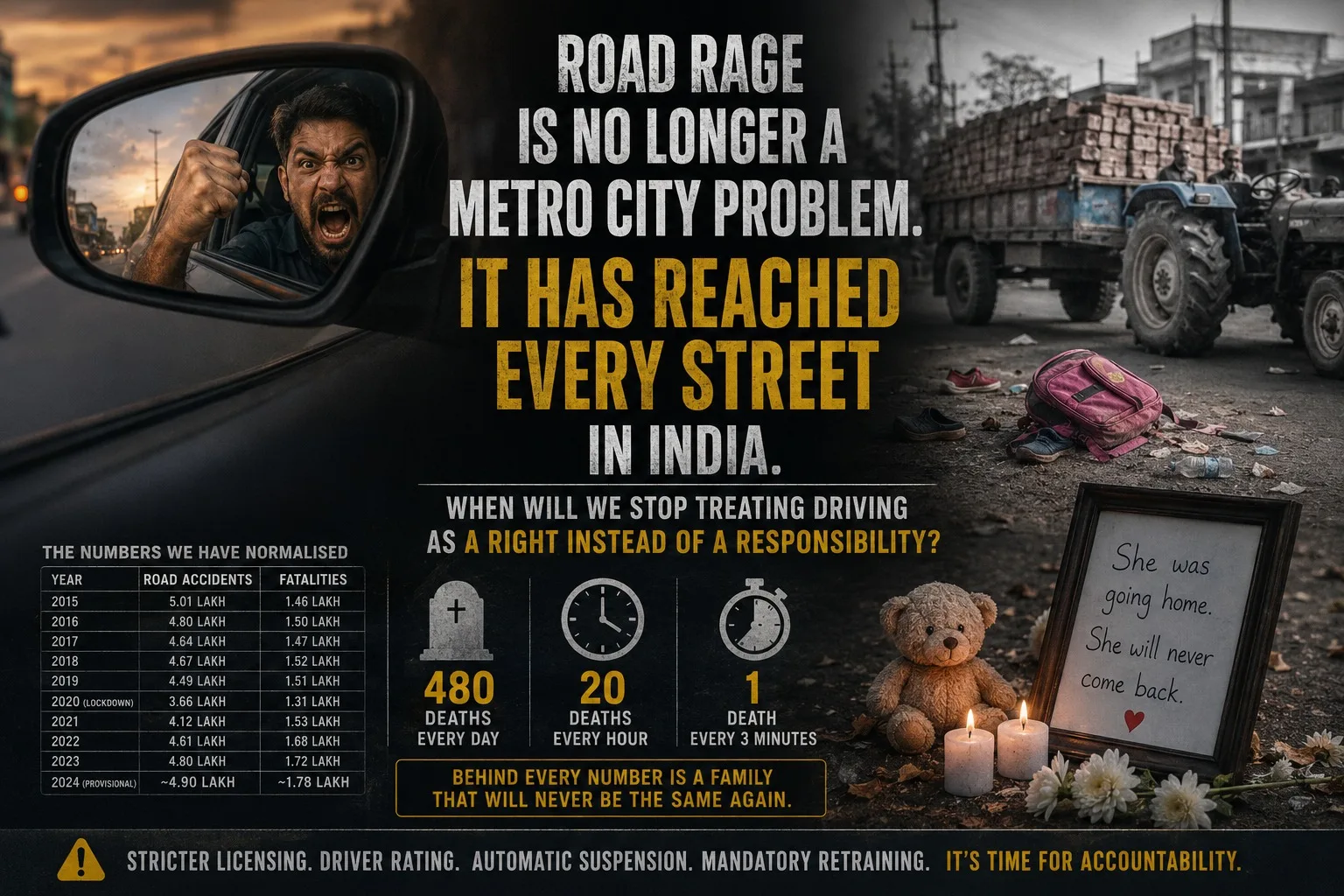
Road Rage Is No Longer a Metro City Problem. It Has Reached Every Street in India,When Will We Stop Treating Driving as a Right Instead of a Responsibility?
Yesterday, I attended the funeral of a seven-year-old girl in Muzaffarnagar.
She and her two young sisters were returning home from school with their father.
Within a matter of seconds, their lives changed forever when a tractor-trolley loaded with bricks collided with them. One sister lost her life; the other two are currently fighting for theirs in a hospital room.
As I stared at the photograph in the morning newspaper, one chilling thought refused to leave my mind: This did not happen on the Delhi-Mumbai Expressway. It did not happen on the Bengaluru Outer Ring Road or the Yamuna Expressway. It happened in a Tier-3 town.
That is what should terrify us.
For years, we comforted ourselves with the myth that dangerous driving and lethal road rage were exclusive to hyper-congested tier-1 metros. Not anymore. Today, that same toxic aggression has permeated our small towns, village roads, and district lanes places where children still cycle to school, the elderly cross without traffic signals, and families expect their neighborhoods to be safe.
The tragedy in Muzaffarnagar isn’t an isolated anomaly; it is an alarm bell for a country quietly losing its mind on the asphalt.
The Numbers We Have Normalised
Every year, the Ministry of Road Transport and Highways (MoRTH) releases accident statistics. Newspapers print them, citizens express brief outrage on social media, and the collective consciousness moves on.
But these numbers are not mere data points. They represent empty chairs at dinner tables, parents identifying bodies in cold morgues, and dreams snuffed out in milliseconds.
When you look at India’s road safety trajectory over the last decade, the reality is staggering:
| Year | Road Accidents | Fatalities |
| 2015 | 5.01 Lakh | 1.46 Lakh |
| 2016 | 4.80 Lakh | 1.50 Lakh |
| 2017 | 4.64 Lakh | 1.47 Lakh |
| 2018 | 4.67 Lakh | 1.52 Lakh |
| 2019 | 4.49 Lakh | 1.51 Lakh |
| 2020 (Lockdown) | 3.66 Lakh | 1.31 Lakh |
| 2021 | 4.12 Lakh | 1.53 Lakh |
| 2022 | 4.61 Lakh | 1.68 Lakh |
| 2023 | 4.80 Lakh | 1.72 Lakh |
| 2024 (Provisional) | ~4.90 Lakh | ~1.78 Lakh |
The only reprieve in the last ten years came during nationwide COVID-19 lockdowns when vehicles were forcibly cleared from the streets. The moment normal traffic resumed, fatalities climbed straight back to record-breaking highs.
Consider the math of our current daily reality:
- 480 deaths every single day.
- 20 deaths every single hour.
- 1 death every three minutes.
Imagine a commercial airliner carrying 480 passengers crashing in India every single day. The nation would come to a grinding halt. Ground operations would face massive scrutiny, committees would be formed overnight, and public fury would demand immediate structural change. Yet, because these road deaths happen incrementally one by one, spread across distinct pin codes we have quietly accepted them as the cost of doing business.
A Crisis of Ego, Not Infrastructure
Whenever a horrific crash makes the news, public anger immediately pivots to infrastructure. Potholes, poor lighting, and blind spots are easy, visible targets. While those factors certainly matter, they obscure a far uglier truth: our primary crisis is behavioral.
India has invested billions of dollars in state-of-the-art expressways, flyovers, and highways. Simultaneously, vehicle technology has leaped forward. Cars are now equipped with crumple zones, dual airbags, Anti-lock Braking Systems (ABS), electronic stability control, and advanced collision warnings. Yet, body counts continue to mount.
Why? Because advanced engineering cannot compensate for broken human behavior.
Today, a vehicle is rarely treated as a tool for transportation; it has become a weaponized extension of the driver’s ego. Road rage no longer requires a major collision to ignite. It triggers over an tight overtake, a prolonged honk, a sudden lane change, or a minor parking dispute. Within seconds, minor impatience escalates to verbal abuse, physical assault, and occasionally, murder.
Our Licensing System is Fundamentally Broken
To solve this, we must confront an uncomfortable truth: obtaining a driving license in India is often easier than keeping a library card active.
Once a license is printed and handed over, long-term accountability effectively vanishes. A driver can rack up automated electronic challans for years, habitually overspeed, run red lights, text while driving, and threaten fellow commuters. The current legal framework treats traffic fines as a mere transaction—a minor “driving tax” to be paid off via an SMS link. It does absolutely nothing to alter future behavior.
We need to fundamentally shift our philosophy. Driving is not an unalienable birthright. It is a high-responsibility privilege that should be continuously earned.
[Traditional System] -> Fine Paid -> Zero Behavioral Correction -> Same Dangerous Driver
[Accountability Loop] -> Violation -> Point Deducted -> Automatic Suspension -> Re-Training Required
The Solution: A National Driver Rating System
India does not need to reinvent the wheel. We already possess the digital infrastructure required to build a robust National Driver Rating System. By linking existing state traffic databases, AI-powered surveillance cameras, ANPR (Automatic Number Plate Recognition), DigiLocker, and the Vahan/Sarathi platforms, we can introduce true accountability.
- The Demerit Framework: Every driver begins with a perfect baseline score. Serious traffic violations (reckless overtaking, driving under the influence, mobile phone usage, habitual speeding) don’t just cost money—they deduct points.
- Automatic Suspension: The moment a driver’s score plummets below a strict threshold, the license must be suspended automatically by the system. No manual bureaucratic intervention, no avenues for bribery.
- Mandatory Re-Certification: To reinstate a suspended or cancelled license, the offender must be treated as a novice. They should undergo mandatory behavioral training, retake the theoretical learner’s examination, and pass a rigorous, monitored practical driving test.
We already enforce this standard in other high-stakes professions. Commercial airline pilots undergo strict medical and simulator evaluations regularly. Doctors must maintain active, clean medical registrations. Even food delivery apps track and penalize their riders based on behavioral metrics. Yet, a private citizen operating a two-tonne metal machine capable of instantly ending lives faces almost zero ongoing scrutiny.
Moving Past the Viral Video Cycle
Every few weeks, a horrific dashcam video or a street-brawl clip goes viral. It dominates social media trends for 48 hours, prime-time news anchors debate it for a night, politicians offer boilerplate condolences, and then a new headline replaces it.
Meanwhile, families continue to bury their children.
Many of these incidents are not “accidents.” They are the predictable, preventable outcomes of an enforcement system that has lacked teeth for decades. The ultimate question we face as a society isn’t whether we need wider highways or faster cars it is whether we are willing to demand better drivers.
If an individual repeatedly demonstrates that they cannot respect traffic laws or value human life, society has no obligation to let them remain behind the wheel. The greatest hazard on Indian roads today isn’t speed; it is the absolute certainty of impunity. Until we replace that impunity with real, systemic consequences, the tragedies will continue not just in Delhi or Mumbai, but on the quiet streets of Muzaffarnagar, Khatauli, and every small town in between.