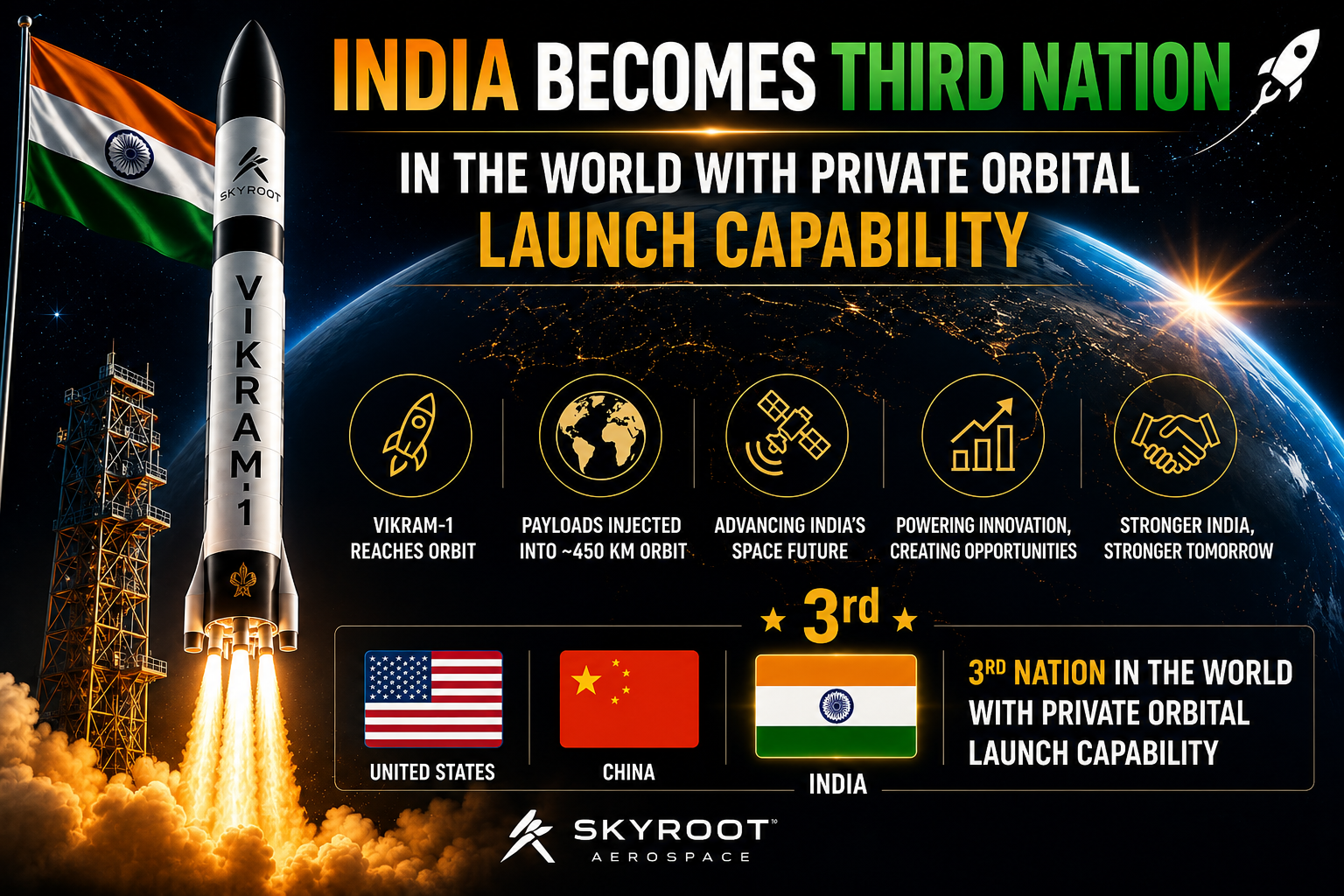
India has achieved one of the biggest milestones in its modern space journey. Hyderabad-based Skyroot Aerospace has successfully placed its Vikram 1 launch vehicle into orbit, making it the country’s first privately developed orbital rocket to complete an orbital mission. The rocket injected its payloads into an orbit of around 450 kilometers after completing its final burn, opening a completely new chapter for India’s private space industry. Nearly five decades after ISRO began building India’s launch capabilities, the country now has a private company capable of independently developing and launching an orbital rocket.
The achievement places India among a very small group of nations where private companies have successfully developed orbital launch capability. Until now, such capabilities were largely associated with countries like the United States and China through companies that work alongside their national space agencies. Skyroot’s success demonstrates that India’s space reforms are beginning to produce tangible results and that private innovation is becoming an important pillar of the country’s long-term space ambitions.
The Vision Behind Skyroot Aerospace
Skyroot Aerospace was founded in 2018 by former ISRO scientists Pawan Kumar Chandana and Naga Bharath Daka. Both founders spent years working on propulsion and launch vehicle technologies before deciding to build a private launch company after India’s space sector gradually opened to private participation. Their vision was simple but ambitious: build rockets that can offer rapid, affordable, and flexible launches for small satellites across the world.
The company’s journey has been remarkably fast. In November 2022, Skyroot launched Vikram-S, India’s first privately built rocket to reach space on a suborbital mission called Mission Prarambh. That mission validated critical technologies including carbon composite structures, avionics, and propulsion systems. Vikram 1 builds upon those learnings and represents a fully orbital launch vehicle capable of deploying commercial satellites into Low Earth Orbit.
Mission Aagaman: A Historic Orbital Flight
Mission Aagaman, the maiden orbital flight of Vikram 1, was designed not only to place payloads into orbit but also to validate propulsion systems, stage separation, telemetry, navigation, guidance, control systems, and overall flight performance under actual orbital conditions. The successful mission demonstrates that India now possesses a private launch platform capable of supporting commercial satellite missions in the future.
Technical Highlights of Vikram 1
Technically, Vikram 1 is one of the most advanced launch vehicles developed by an Indian startup. The rocket stands approximately 22 meters tall and uses three solid propulsion stages followed by a liquid-fueled Orbital Adjustment Module for precise orbital insertion.
It features an all-carbon composite structure that significantly reduces weight while increasing performance. The launch vehicle can carry payloads of up to 350 kilograms to Low Earth Orbit and around 260 kilograms to Sun Synchronous Orbit, making it ideal for the rapidly growing small satellite market. The rocket also incorporates 3D-printed liquid engines, a technology that reduces manufacturing complexity while improving production speed and reliability.
Commercial Payload Deployment
The mission carried multiple payloads, including technology demonstration satellites from Indian and international customers. These payloads are intended to test robotic technologies, satellite systems, and future commercial applications in orbit.
Demonstrating successful deployment is particularly important because satellite customers primarily judge launch providers based on reliability and orbital accuracy rather than only launch capability.
India’s Space Reforms Fuel Private Innovation
This milestone would not have been possible without significant institutional support. India’s space reforms over the past few years fundamentally changed how private companies interact with the national space ecosystem.
The creation of IN-SPACe allowed startups to access ISRO’s testing facilities, launch infrastructure, and technical expertise. Skyroot’s launch from the Satish Dhawan Space Centre in Sriharikota reflects the collaborative model where government infrastructure supports private innovation while maintaining national standards for safety and reliability.
Strong Investor Confidence
Financial backing has also played a major role in Skyroot’s rise. Over the years, the company has attracted investments from several leading global and Indian investors.
In 2026, Skyroot became India’s first space technology unicorn after raising 60 million dollars in a funding round that valued the company at around 1.1 billion dollars. The round included primary equity investments alongside structured financing, reflecting growing investor confidence in India’s commercial space sector. Earlier funding rounds had also attracted participation from prominent venture capital firms and strategic investors who believed in the long-term commercial opportunity of private launch services.
Capturing the Growing Small Satellite Market
The timing of Vikram 1’s success is particularly significant because the global small satellite industry is expanding rapidly. Thousands of satellites are expected to be launched over the coming decade for broadband internet, Earth observation, agriculture, disaster management, climate monitoring, defense applications, and scientific research.
As satellites become smaller and more specialized, customers increasingly prefer dedicated launch services instead of waiting for rideshare opportunities on larger rockets. Skyroot is positioning itself precisely in this growing market by offering flexible and faster launch options.
Economic Benefits for India
For India, the economic implications are substantial. The global launch services market is worth billions of dollars annually, and until now much of this business has been dominated by American, European, Russian, and Chinese providers.
A successful domestic private launch ecosystem allows India to compete for international commercial launches while creating high-value engineering jobs, strengthening manufacturing, and attracting global investments into aerospace technologies. The benefits extend beyond launches themselves to propulsion systems, advanced materials, electronics, software, robotics, and precision manufacturing.
Inspiring the Next Generation
The success of companies like Skyroot also changes how young engineers view career opportunities. Traditionally, India’s brightest aerospace graduates looked primarily toward government organizations or overseas companies.
Today they have the opportunity to work on cutting-edge launch vehicles, propulsion systems, and deep technology startups within India. This helps retain highly skilled talent while encouraging entrepreneurship in sectors that were previously considered inaccessible.
A Shift Toward Deep Technology
At the same time, India’s startup ecosystem has recently witnessed headlines around restructuring, layoffs, and leadership exits across several sectors, particularly consumer technology and ecommerce. Those developments are often driven by slowing funding cycles, profitability pressures, and changing investor expectations.
Deep technology companies like Skyroot operate under a very different model. They require longer development timelines, higher research investments, and greater technical risk before generating revenue. While this means patience is essential, successful breakthroughs can create technologies that remain globally competitive for decades.
The emergence of companies like Skyroot signals that investor interest is gradually shifting from purely consumer-focused startups toward innovation-driven sectors such as aerospace, semiconductors, artificial intelligence, and advanced manufacturing. This diversification makes India’s startup ecosystem more resilient over the long term.
Strategic Importance for India
There are also strategic implications. Every successful private launch increases India’s self-reliance in space access. Domestic satellite operators no longer need to depend entirely on foreign launch providers.
Defense applications can benefit from faster launch readiness, scientific institutions gain additional launch options, and emerging satellite companies receive a domestic partner capable of supporting frequent missions. This strengthens India’s overall space infrastructure while improving national technological independence.
Looking Ahead: Vikram 2
Looking ahead, Skyroot’s roadmap extends beyond Vikram 1. The company is already developing Vikram 2, a larger launch vehicle powered by a cryogenic engine capable of carrying significantly heavier payloads into orbit.
This demonstrates that the company is not treating Vikram 1 as a standalone achievement but as the beginning of a broader family of launch vehicles designed to compete globally across multiple satellite categories.