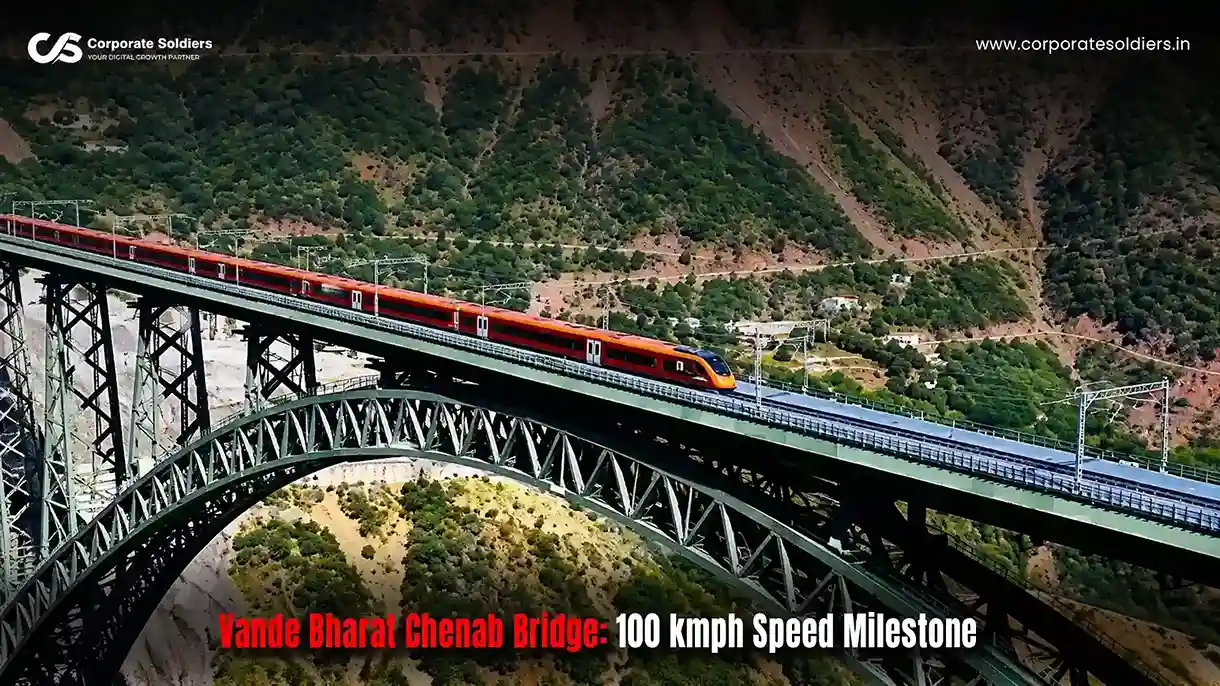
The Jammu-Srinagar Vande Bharat Express has crossed the iconic Chenab Railway Bridge at 100 km/h, following an increase in the maximum permissible speed on the Katra-Banihal railway section.
The development marks an important step in improving rail connectivity between Jammu and the Kashmir Valley. Why is the Vande Bharat Chenab Bridge 100 km/h crossing significant?.
Vande Bharat Crosses Chenab Bridge at 100 km/h
The maximum permissible speed on the 111-km Katra-Banihal section was increased from 75 km/h to 100 km/h on October 2, 2026. Following the speed upgrade, Vande Bharat crossed both the Chenab Railway Bridge and Anji Khad Bridge at 100 km/h.
Railway Minister Ashwini Vaishnaw confirmed the development, and multiple news organisations reported it.
How Fast Did Vande Bharat Run on the Chenab Bridge?
The train reached 100 km/h, the new maximum permissible speed on the Katra-Banihal section. This does not mean that 100 km/h is the average speed of the entire Jammu-Srinagar Vande Bharat journey. The speed limit applies to the upgraded section of the railway route.
What Makes the Chenab Railway Bridge Special?
The Chenab Railway Bridge is one of the most significant engineering structures on the Jammu-Kashmir railway network.
The bridge is approximately:
- 1,315 metres long
- 359 metres above the riverbed
- The world’s highest railway arch bridge
The structure carries the railway line across the Chenab River in Jammu and Kashmir.
Vande Bharat Also Crosses Anji Khad Bridge at 100 km/h
The speed milestone was not limited to the Chenab Bridge. The Jammu-Srinagar Vande Bharat also crossed the Anji Khad Bridge at 100 km/h after the Katra-Banihal section received the higher permissible speed.
Anji Khad is India’s first cable-stayed railway bridge and forms another important part of the challenging railway infrastructure connecting the Kashmir Valley.
What Does the Speed Increase Mean for Jammu-Kashmir Rail Travel?
The increase from 75 km/h to 100 km/h allows trains to operate at a higher permissible speed across the upgraded section.
For passengers, the development could contribute to improved journey times and more efficient train operations between Katra and Banihal. However, the 100 km/h figure should not be interpreted as the average speed for the complete Jammu-Srinagar route.
Why Is This Important for Vande Bharat?
The Jammu-Srinagar Vande Bharat operates on one of India’s most technically challenging railway corridors.
The route includes major bridges, tunnels, and difficult mountain terrain. Increasing the permissible speed on the Katra-Banihal section marks another stage in developing the railway connection to Kashmir.
The successful 100 km/h crossing of the Chenab and Anji bridges demonstrates that these major structures are now part of a section cleared for higher-speed operations.
What Changed on the Katra-Banihal Section?
Earlier, the maximum permissible speed on the section was 75 km/h. It has now been increased to 100 km/h, covering the 111-km Katra-Banihal section.
The change provides the operational basis for Vande Bharat trains to travel at speeds of up to 100 km/h on the relevant section, subject to railway operating conditions.
The Bottom Line
The Jammu-Srinagar Vande Bharat’s 100 km/h crossing of the Chenab Railway Bridge is a significant railway milestone. More importantly, the achievement follows the increase in the maximum permissible speed on the 111-km Katra-Banihal section from 75 km/h to 100 km/h.
The development marks further operational progress in the rail connection between Jammu and the Kashmir Valley while highlighting the operational progress of one of the most challenging railway routes operated by Vande Bharat trains in India.