Introduction
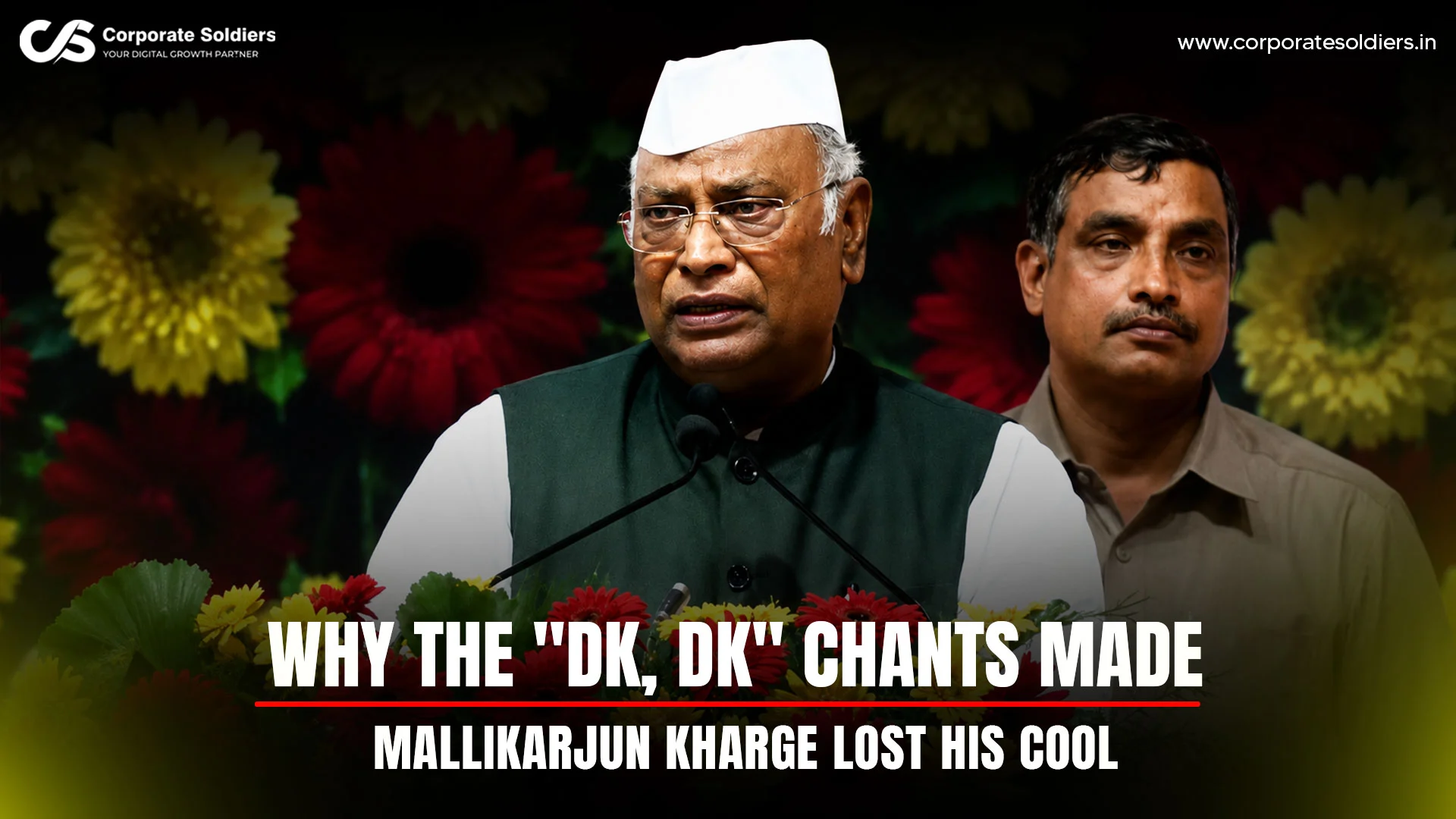
Everything in politics is optics, till the microphone remains on and the emotions take the centre-stage. The party president Mallikarjun Kharge publicly chastised those who were chanting in support of Karnataka Deputy Chief Minister DK Shivakumar during the Congress Sankalpa Samavesha in Bengaluru, which produced one of the hottest videos of the day. What was supposed to be an organisational meeting with the focus on the party goals and unity momentarily switched as the audience sections kept screaming the DK, DK slogans, which interrupted the process, and elicited an unusually harsh reaction on the part of the long-time Congress leader.
Kharge’s visible frustration and his warning against indiscipline soon went viral, TV stations and online media playing the interview over and over again. The viral clip was just one of the many other conversations that the incident led to concerning Congress leadership, party discipline, and the central authority-regional popularity balance that exists in the organisation.
Although the incident was brief, a few minutes long, it provided an eye-opening glimpse into the intersection of leadership, loyalty, and organisational culture, in contemporary Indian politics. A political analysis of the episode in the style of AI can justify the popularity of the episode.
AI Political Drama Meter
| Indicator | Rating | Explanation |
| Drama Index | 7/10 | The public reprimand transformed a routine event into a national headline. |
| Leadership Friction | Medium | No open leadership clash was visible, but slogan chanting highlighted competing centres of popularity. |
| Media Attention | High | Video clips and reports were widely circulated across television and digital media. |
| Party Discipline Risk | High | Kharge himself warned of disciplinary action and emphasised organisational order. |
| Internal Faction Signal | Moderate | The incident reflected strong local enthusiasm for DK Shivakumar rather than an explicit factional confrontation. |
The Trigger: What Sparked the Outburst?
This confrontation was a part of the Sankalpa Samavesha of the Congress party in Bengaluru, which was well planned as a demonstration of unity and a unified political purpose. The forum, attended by a high-profile group of leadership, including state chiefs, senior ministers, and state in-charges was meant to strengthen the alignment of the institutions. However, the atmosphere changed when a section of supporters began repeatedly chanting slogans in praise of DK Shivakumar, shifting attention away from the collective purpose of the event.
The repeated “DK, DK” chants grew louder, interrupting the proceedings and disrupting the decorum of the Congress event. Instead of being a backdrop display of excitement, the synchronized chanting started to overwhelm the planned speakers, and proactively redirect focus off the multi-regional stage and onto an individual regional leader. This emphasis on an individual leader within a party structure tested the authority of the national leadership.
AI Political Analysis
Local Leadership Vs Central Leadership
The event is a classic example of a systemic dilemma of contemporary Congress internal politics: the balancing of a mass appeal that is local and the central control of an organization.
- Power based on personality: In regional units, powerful leaders are known to establish strong, emotional, loyalty bases. The local followers see their allegiance in terms of a particular person and not an ideology of a party.
- The Counterweight of the Institution: On the other hand, the leadership of the national Congress has to underline institutional hierarchy at all times. In the eyes of the high command, permitting the free functioning of individual personality cults on official platforms weakens the central command, disintegrates organizational discipline and is an ominous sign of disintegrating systemic control.
The Climax: Kharge’s Strong Rebuke Under the Microscope
Faced with repeated interruptions, Kharge responded sharply in an attempt to restore order and refocus attention on the party programme. The Congress president did not ignore the disruptions and used the microphone to sharply rebuke the slogan-chanting workers in an effort to regain control of the stage.
According to media reports and televised footage, Kharge told the crowd:
Will the whole country know if you shout here? This is not a programme of a man, but a party programme. You hopeless men. We do not worship individuals here, we are here to this party programme which unites us all.
Clearly annoyed by the disruption, Kharge went on to ask what the purpose of the larger gathering was if a few workers were going to dominate the proceedings. When one individual goes and says one thing and another individual yells something different, why do the other people come here? Have they come to sweep the floor, he retorted, who ordered that a return to order, at once.
The “Party First” Philosophy
Kharge’s response represented a clear defence of institutional authority over individual popularity. The president of the party, by saying that there is no cult of personalities here, directly hit on the nurturing of personality cults in the party. In mass-mobilization politics, letting local loyalties prevail over the party banner will tend to divide the organization into competitive feudal domains, making it virtually impossible to have overall central management in such a crucial election period.
The Leadership Assertion
Kharge’s remarks also reflected an effort to reinforce authority by invoking his long political experience. During his response, the Congress president reminded workers of his decades in public life and organisational politics, using that experience to underline the importance of discipline and collective functioning. Such interventions are common among senior leaders, who often draw upon their political journey to reassert command during moments of internal disruption and remind workers that organisational unity remains central to party operations.
AI Sentiment Analysis
Perspective 1
The reason why is that his supporters think that Kharge responded decisively to issues.
Supporters argue that:
- He was speedy to bring about order.
- He strengthened organisational discipline.
- He made sure that the programme was not overshadowed.
- He said that party identity must be in the foreground and not the individual leaders.
Perspective 2
Reasons why critics think that the popular disapproval could have hurt optics.
Critics contend that:
- This criticism of the workers publicly was an awkward sight.
- The use of strong language was used as a headline rather than an event.
- Unfavourable coverage was enhanced by viral clips.
- An intervention that is less aggressive would have prevented undesirable attention.
The two perspectives were post-incident as they demonstrate the different expectations on leadership in politics.
The Threat Matrix: CCTV Review and Disciplinary Warning
Kharge threatened to check CCTV videos to identify those who had disrupted the programme. He indicated that disciplinary action could be taken against those involved.
The message was that organisational norms were to be applied and indiscipline could not be overlooked.
Strategic Political Analysis
The possible sanctions might have two opposite effects:
Strengthen organisational discipline
- Delivers a message that collective programmes need respecting.
- Strengthens leadership of the central leadership.
- Discourages future disruptions.
Alienate local workers
- Punitive action might be seen as a lot by supporters.
- Sometimes strict enforcement can even quash the grassroots enthusiasm.
- Discipline can be perceived to be selective and this may result in internal resentment.
It has been the same case with political organisations across the world, where there has been a dilemma of maintaining discipline, and mobilising at the grassroots.
AI Leadership Scorecard
| Authority & Leadership | Grade | Explanation |
| Boundary Setting | A | Reasserted organisational authority clearly. |
| Communication | B | Delivered the message directly but emotionally. |
| Public Relations | C- | Strong language generated negative headlines. |
| Conflict Management | B | Addressed disruption rather than ignoring it. |
| Party Discipline | A- | Reinforced institutional authority. |
Overall Leadership Score
B+
Kharge exhibited a lot of command and loyalty towards organisational discipline but the emotional tone of his statements posed a communication problem to the public-relations aspect.
What This Incident Reveals About Congress
The Bengaluru episode brings to the fore a number of more overarching themes in Congress internal politics.
To start with, upholding organisational discipline is an issue of concern among the national leadership. Second, the interaction of central and regional leaders also has to be carefully controlled, and in a situation where state leaders are very popular in the country.
The event also demonstrates the effect of optics of leadership on political discourse. Even the events that take only seconds can take the center stage and impress the masses.
The biggest political parties have a long-standing problem of dealing with a number of influential leaders. With the upcoming electoral competitions, keeping the unity and making organisational identity much stronger than divisiveness based on personalities will continue to be significant to the Congress.
Conclusion
The DK, DK chants controversy was not just a Twitter moment. It arose out of an incident that was set to demonstrate organisational unity but in the short run, it turned into a leadership and discipline ordeal.
Kharge’s strong response reflected his belief that the party should take precedence over individual personalities. Although those who supported the intervention saw the intervention as a necessity, critics raised questions about whether the language affected optics.
Finally, the incident exposes larger facts regarding leadership, organisational discipline as well as nuances of dealing with influential regional figures in the national political parties. It illustrates how the stories in politics actually stretch much farther than the few seconds that headlines are made of.
Reader Poll
Did Mallikarjun Kharge have a basis to publicly criticize the factional chanting?
- Yes, good leadership was needed
- No, it was too rude
- He would have done it in another way
Comment Prompt
What do you believe this incident says about leadership, party discipline and in-house politics in big political parties? Discuss your opinion below.