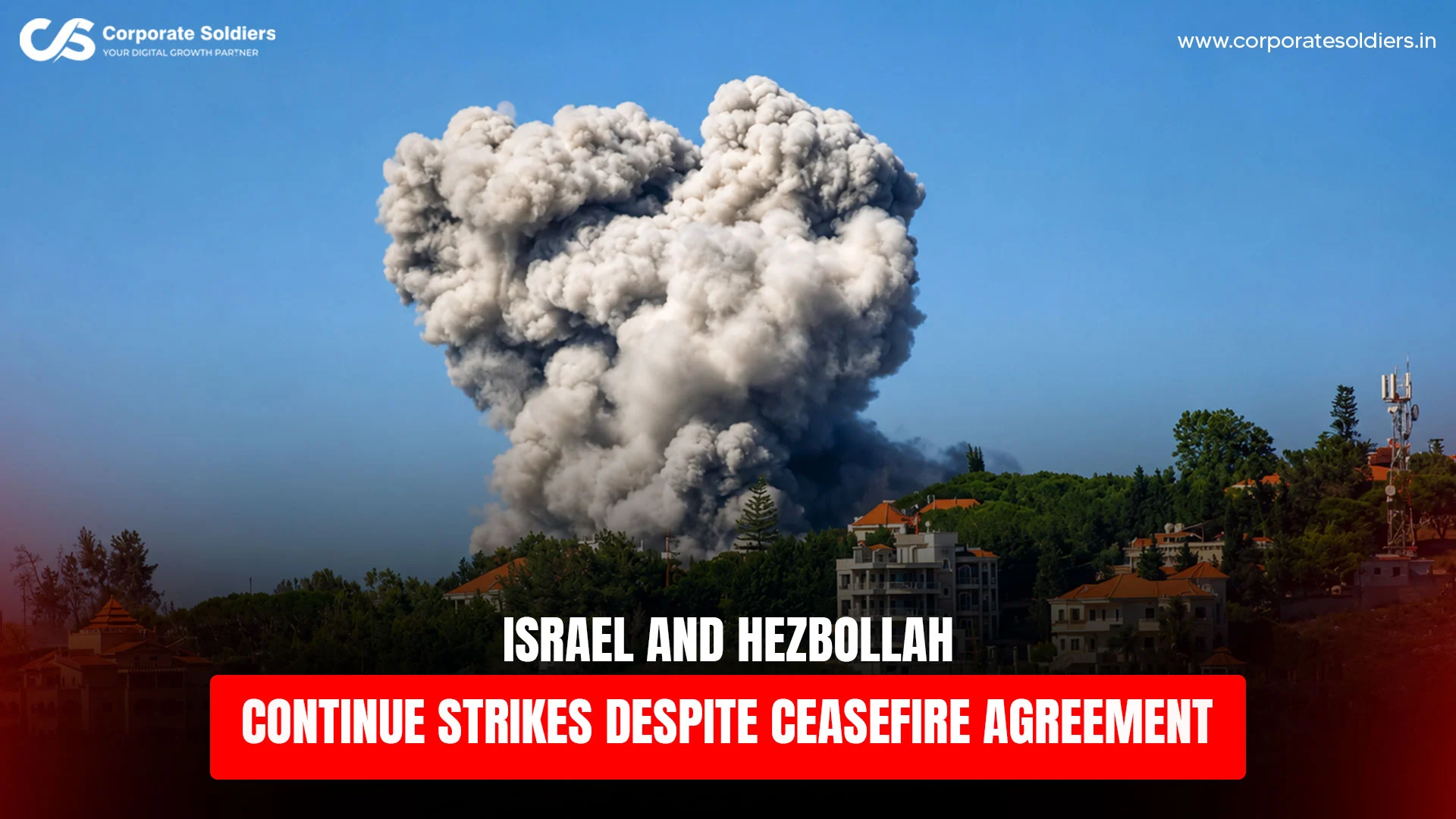
Even after the recommencement of hostilities, the signing of a ceasefire agreement to minimize hostilities, Israel and Hezbollah kept trading blows along the Israel-Lebanon border. Israeli air attacks led to dozens of deaths reported by Lebanese authorities, and four Israelis were announced dead in the battle with Hezbollah members within the borders of Lebanon by Israel Defense Forces. The new wave of violence is the concern of international mediators to maintain ceasefire setups and to avoid the further escalation of violence in the region.
Main News Coverage
Chronological Escalalation and Casualties
Lebanon and northern Israel continued to engage in cross-border military attacks after the official declaration of the ceasefire deal even though the military attacks across the borders had been stopped.
In Southern and Central Lebanon: Lebanese Health Ministry: Lebanese Health Ministry has confirmed that there were at least 47 people killed in different locations in Lebanon during (concentrated) Israeli air attacks that were initiated in the middle of the night. Lots of overstretched infrastructure with rescue teams in piles of debris in targeted areas was reported by local emergency services.
Ground and Projectile Battles: According to Israel Defense Forces (IDF), four Israeli soldiers died as a result of constant operational fights inside the Lebanese territories by members of Iran-sponsored Hezbollah.
Rocket Fire Interception: According to the Israeli army, after the official end of the partial ceasefire, two of the projectiles that were launched on Lebanese soil and were heading to the northern region of Israel were intercepted.
Military Assertations and Counterclaims
Both groups have come out publicly in defense of their continuous use of kinetic operations even with the international pressure to stop hostilities. The official spokesman of the Israel military claimed that the IDF would keep on eliminating immediate threats to its sovereign borders and its citizens. Directly in reaction to claims of launching unprovoked explosions, the Israeli military said that its troops made controlled hits on Hezbollah terrorist targets after the militant group fired over 50 projectiles, directed at Israeli forward positions.
Hezbollah leadership on the other hand rejected that the operations of this organization has been ruined. In an address to the populace, Hezbollah Secretary General Sheikh Naim Qassem announced that the geopolitical strategic model that aimed at neutralizing the group had failed, indicating clearly that the project to do away with Hezbollah had failed. By attacking Israeli troops in the south of Lebanon Hezbollah reasserted that it was taking action in self defense against the unrelenting foreign military intrusion.
Background
The underlying condition of conflict can be traced to the structural instability after the structural regional escalations which started on October 8, 2023, when Hezbollah launched cross-border operations towards the northern part of Israel in support of Palestinian forces in Gaza. This began a 14-month long cycle of kinetic exchanges between the two sides, leading to an all-out Israeli ground offensive into southern Lebanon on October 1, 2024, to drive back Hezbollah troops north of the strategic Litani River.
The signing of a 60-day hostilities cessation under US mediation, on November 27, 2024, was one of the most important diplomatic breakthroughs in the past. Even though the initial agreement could temporarily reduce the massive city bombings, in some instances, violations and distrust on a structural level were still evident in the next year. On November 27, 2024, the large-scale fighting was temporarily reduced with the help of the ceasefire agreement mediated by the US. Nevertheless, there were still occasional exchanges and accusations of violations, which signified ongoing tensions between Israel and Hezbollah, despite worldwide attempts to preserve the truce.
Official Statements
State and Institutional responses
The Israel Defense Forces (IDF) Spokesperson:
The military will still be getting rid of imminent threats, our troops attacked specific targets of Hezbollah terrorist organizations when the group launched more than 50 projectiles at the Israeli troops.
Sheikh Naim Qassem, Hezbollah Secretary General:
The operation to wipe out Hezbollah has been unsuccessful, our resistance forces are still on the ground to deal with the constant threats of operations in the region.
International Mediation Oversight
United States diplomatic sources tracking the activities of the United States teams in the nation observed that further military tension seriously threatens the overall diplomatic understanding attained between Washington and Tehran. The representatives of the United Nations have once again urged that there is need to observe international border procedures as they have observed that localized skirmishes quickly destabilize international high-level diplomatic agreements.
Why This Development Matters
The fact that active warfare continues between Hezbollah and Israel has dire national, regional and international consequences:
- Threat to Global Diplomacy: Continued fighting has raised concerns among international mediators that renewed violence could complicate broader diplomatic efforts aimed at reducing tensions in the region.
- Humanitarian and Civil Costs: As hundreds of thousands of internally displaced persons (IDPs) are reported to have returned to both sides of the Blue Line at least 47 additional dead, the humanitarian footprint is growing, making it more difficult to relocate hundreds of thousands of people.
- Geopolitical and Economic Instability: The continued exchanges have highlighted the fragility of ceasefire arrangements and renewed concerns about the risk of a wider regional escalation.
What Happens Next?
No immediate next steps were announced following the latest exchanges between Israel and Hezbollah. International mediators and monitoring bodies are expected to continue efforts to preserve the ceasefire, while both sides remain on alert amid concerns that further violations could undermine diplomatic efforts aimed at reducing tensions in the region.
Conclusion
The unremitting kinetic fighting between Israel and Hezbollah is a harsh lesson on the extreme challenges that the international conflict resolution encounters. Although there were official reports of a negotiated ceasefire, the killing of 47 people in Lebanon and four Israeli soldiers on the ground illustrates that there is yet to be a change of political rhetoric into a field stabilization. With each party accusing the other of sparking the most recent series of projectile attacks, the larger international system which has been established to establish long-term peace in the region is in a very fragile state.