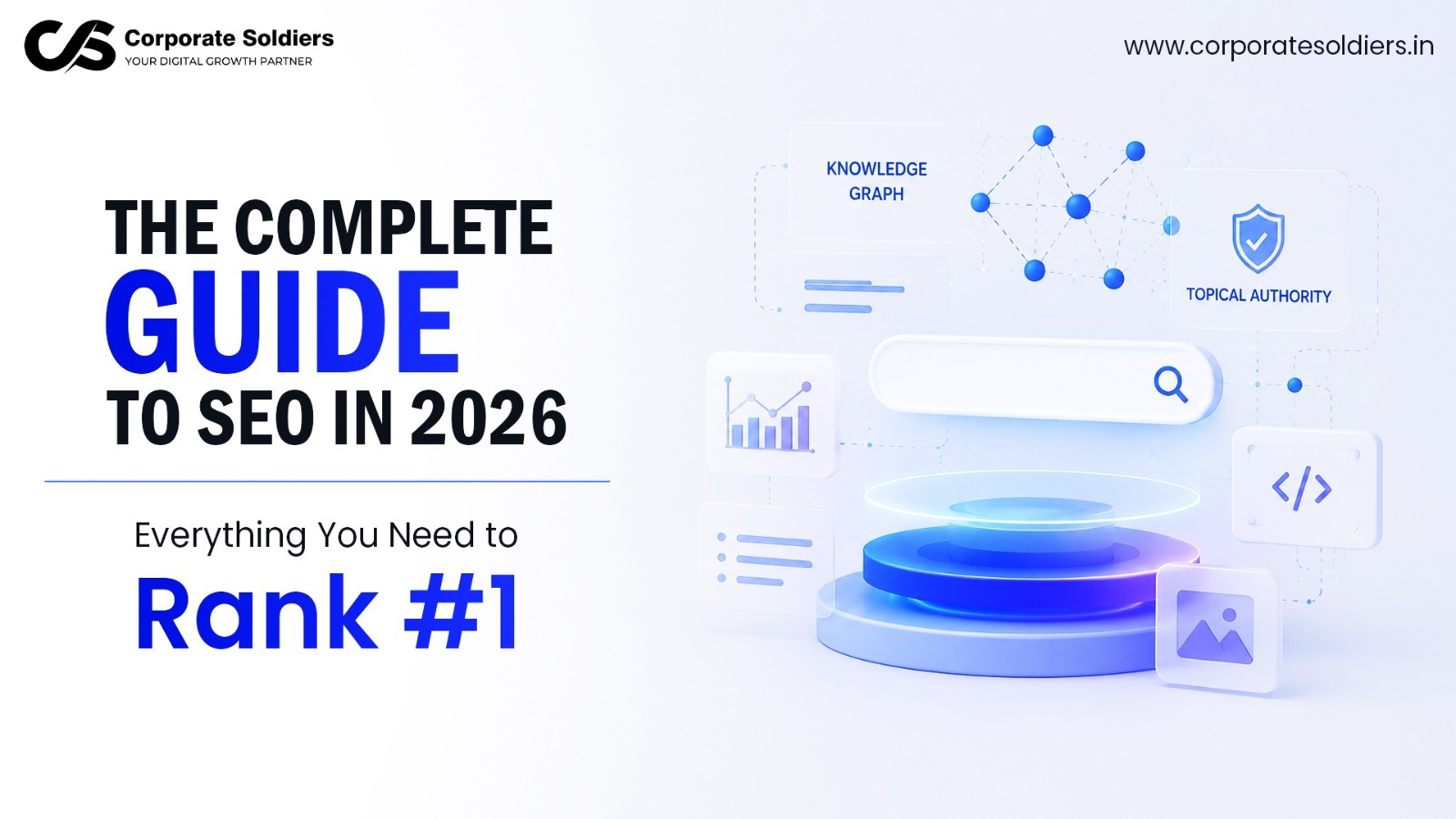
In the year 2026, SEO is not a set of single strategies anymore. It has turned into a multi-level field in which artificial intelligence systems, semantic recognition systems, and user-centered ranking systems make a difference. Keywords are no longer hailed as the sole significant parameter in search engines since they examine the context, authority, user satisfaction and entity relationships on the web.
Expert knowledge, knowledge that fulfills intent, and knowledge that is a part of the knowledge graph are rewarded in the new digital environment. The change has been a shock to the way marketers think of visibility and is a completely novel way to do so beyond merely using keywords.
It is, therefore, essential to cover some of the fundamental elements of SEO, such as search algorithms, ranking signals, structured and authoritative content ecosystems in a modern SEO Guide.
What is an Entity?
An entity is a clearly defined object that Google is aware of e.g. a person, a place, brand or an idea.
Entities, unlike keywords, are meaning, not words.
Example:
- Apple to Company (not fruit)
- Eiffel Tower → Landmark
- SEO → Concept/discipline
Why this matters:
Entities assist Google to comprehend meaning, context and relationships not only between words.
How Google Understands Entities
Google uses entity-relationships in order to acquire meaning and context.
Examples include:
- Apple → Company
- Apple → Fruit
- Google → Search Engine
- SEO → Digital Marketing
- HubSpot → Marketing Software
Such connections include Knowledge Graph of Google that can help search engines to understand the concepts that cannot be simply determined by a mere match of a key word.
Modern ranking systems and semantic search are coming to focus on entity relationships.
The following are some of the most crucial consideration points of SEO today:
- Having entity based search understanding rather than simple key word matching.
- AI-generated summaries which have an impact on visibility (zero-clicks)
- Strong credibility indicators (E-E-A-T).
- Machine-learning-based context-aware ranking.
- Integration of multimodal content (text, video, pictures, voice).
How Search Engines Have Evolved
In the modern era with the advent of the search intent mapping along with the content depth, the shallow search techniques have been substituted with the new phenomenon.
Neural models and semantic indexing are interdependent and will be key to the success of search engines in 2026. Google has developed AI engines to construct its knowledge graph, the search layers, and they comprehend meaning, not just trimming down search phrases.
However, the most important one to keep in mind is the advent of generative search experiences, where AI is able to generate answers directly in search results. Experience: Generative experience with Google search experience.
This change has resulted in:
- Reducing the use of traditional search results.
- Internet sales will ensure that they put more emphasis on this structured data.
- The featured snippets and AI citations were competitive (increasing).
- Increasing brand, and topicality awareness.
Instead of checking whether there are individual signals, checking whether content is useful to knowledge systems and what is of interest to the search engines.
Understanding Search Intent in Modern SEO
Ranking is the core principle of 2025 whose core principle is complete compliance with the search intent. The real time knowledge that Google holds in understanding user psychology has now reached a level where content form is mismatched with the intent of the user will lead to a ranking penalty.
Intent can be classified into four main buckets, although nowadays optimization needs a more multi-layered approach:
[informational] ── Deep guides, calculators How to calculate churn rate
[Navigational] ──> “HubSpot login” ──> Branded landing pages
[Commercial] ── “Best enterprise CRM in tech” – Comparison tables, reviews.
[Transactional] 50 Buy Salesforce license” 50 Frictionless checkout pages
Optimizing for Zero-Click and Fragmented Journeys
As the generative summaries have emerged, zero- click searches (when the user gets their answer on the search page, without clicking on the link) are at historic highs. Your content approach will need to evolve to grab value in this ecosystem:
- Offer Quick Facts Snippets: Summaries that are only a few lines and are designed to give a definition of a particular concept at the top of information pages can win Featured Snippets and AI Overview citations.
- Construct Business Fences: To address commercial and transactional inquiries, develop highly organized data tables, transparent price contrasts and genuine consumer critiques that AI algorithms tap into their comparison functionalities.
On-Page SEO Fundamentals
The future of on-page SEO in 2026 revolves around clarity, meaning and the structure.
Key elements include:
- Semantic Content Optimization
The search engines do not relate to the keyword density but are rather relatable to context. Related entities, concepts and variations should be involved in the content.
- Structure of Title and header
Established H1-H3 hierarchy enhances the readability as well as machine interpretation.
- Internal Linking Architecture
Connecting Strategy will help engines in understanding topic connecting and pages structuring.
- Multimedia Integration
Video, diagrams and interactivity are useful to increase interaction and time.
- Short-form Video SEO (2026 Trend)
YouTube Shorts, Instagram Reels, and TikTok can be found in search engines more and more often (SERPs). Short-form videos embedded enhance dwell time, engagement, and visibility indicators, which are significant ranking factors in 2026.
- Natural Language Optimization
It ought to be written in a way that it is comprehensible by humans and not by algorithms.
An effective guide on SEO is geared towards elucidating rather than duplicating the key words to ensure that each of the sections would have independence of each other so as to achieve the purpose of the users.
Technical SEO Essentials
Technical SEO will remain one of the cornerstones in 2026. Even good contents struggle to rank without a really good and prudent site.
Key focus areas:
- Managing crawlability, control of indexation, and site accessibility.
- Clean URL structure.
- Schema Markup and Structured Data.
Schema assists search engines to comprehend the content and can enhance a better position in SERPs.
The types of crucial schemas are:
- FAQ Schema
- Article Schema
- Organization Schema
- LocalBusiness Schema
- Product Schema
Rich results can be improved using structured data and can boost the click-through rates.
- Security and compliance with HTTPS.
- JavaScript rendering optimization
- Maximization of structure and hierarchy of the site.
The Search engines are also giving more emphasis to the contextually available information i.e. pages must be easily read by the bots and artificial intelligent systems.
Content Optimization Strategies
The content strategy will be based on the topical authority and semantic depth in 2026.
Best practices include:
- Topic Clusters
- Building Topical Authority
Topical authority is constructed around networks of related content as opposed to single articles.
Typical framework:
Pillar Page
↓
Supporting Articles
↓
Internal Linking
↓
Entity Reinforcement
↓
Authority Growth
With enhanced topic associations and better understanding of the relationships by search engines, deep content clusters can contribute to building expertise and long-term visibility.
Create more content based on groups on the pillar pages to enhance the authority.
- Entity-Based Writing
Incorporate pertinent ideas, brands and systems into the content intuitively.
- Depth Over Volume
Top-frequency superficial content is no longer as effective as in depth high quality content.
- Continuous Updates
A lot of competition is equivalent to freshness cues as never before.
The new SEO guide is based on in-depth, systematic and relevant rather than repeating the key words and employing the old school methods.
Content Decay and Content Refreshing
The tendency is natural that as old as the information is the less searchable it is. This is referred to as content decay and can reduce the ranking and organic traffic.
Common causes include:
- Outdated statistics
- New competitors
- Changes in the purpose of the search.
- Algorithm updates
Best practices include:
- Updating content regularly
- Revising pictures and screenshots.
- Reviewing rankings quarterly
- Performing historical optimization
Freshness has now been more a crucial aspect in competitive niches.
AI and SEO in 2026
Having an impact on artificial intelligence, the creation of content, its ranking, and consumption have undergone a complete change.
AI has a number of implications on SEO:
- AI-generated summaries (SGE) are hastening the zero-click age, diminishing the conventional organic traffic chances.
- Search engines have also shifted their content assessment to depth, originality and real world value.
- Search systems actively filter and demote low-quality or repetitive patterns of AI-generated content.
- The signs of human dexterities are increasing in significance.
Meanwhile, AI technologies facilitate marketers to:
- Keyword clustering
- Content gap analysis
- SERP intent analysis
- Automated technical audits
The trick is in the fact that it is possible to establish the balance between the efficiency of AI and editorial decisions of human workers.
AI as an influencer of the ranking factor and a tool cannot be left out of the current SEO guide.
E-E-A-T and Human Experience
Search engines are also giving preference to content that reflects real-life experience. Although AI can be used to summarize information, it can not personally test products, visit restaurants, and provide first-hand information. Original experiences, case-studies, authority, and real-life examples can be used to create Experience, Expertise, Authoritativeness, and Trustworthiness (E-E-A-T) which are important quality indicators in contemporary SEO.
With the rise of AI-generated content, proving actual experience and expertise in the subject has emerged as a major distinguishing factor in long-term search presence.
SEO Case Study Example
A site that was receiving decreasing organic traffic applied both technical and content enhancements to restore the visibility.
Problem
The website experienced:
- Organic traffic had decreased by 35% per cent.
- Decline in the ranking of a number of informational keywords.
- Less user interaction with the site because of the outdated information and more competition.
Actions Taken
The search engine optimization plan entailed:
- Enriching the intra-page connections.
- Adding topic clusters to enhance topical authority.
- The change of old statistics and screenshots.
- Optimizing technical performance and Core Web Vitals.
- The refreshing of content to more effectively reflect search intent.
Results
After several months, the site has realized:
- An organic growth of 42%.
- Then more prominent positions of key words.
- Increased number of pages that are ranked on the first 10 pages of search.
- Better engagement rates and increased length of stays.
This case shows that a combination of technical SEO, content optimization, and ongoing updates could result in long-term growth. Practical experience and quantifiable results serve as an addition to the E-E-A-T signals, which are becoming more significant in search systems nowadays.
Generative Engine Optimization (GEO)
As the concept of AI-based search experiences continuously evolves, a new type of relevant search optimization has started to appear as an essential addition to search engine optimization Generative Engine Optimization (GEO).
GEO aims at enhancing the visibility of answers given by AI and citation systems.
Most recent AI systems such as Google AI Overviews, ChatGPT, Gemini, Perplexity and Claude are increasingly using authoritative sources in the production of responses.
In order to have more citation opportunities, an individual should incorporate:
- Original research and statistics.
- Opinions and quotes of experts.
- Logical reactions and good structure.
- Local authority and extensive coverage.
- New and reliable data.
One of the competitive advantages of the AI-first search age will be citation-worthy content.
Link Building Strategies That Still Work
Link building is still a significant ranking aspect, although the application has transformed to a great extent.
Effective strategies in 2026:
- Digital PR campaigns
- Data-driven content assets
- Work experience and references.
- Industry partnerships
- High-authority guest contributions
The search engines now have the ability to look at the context of the links, their relevance and authoritativeness and not necessarily in terms of volume.
Bad quality of back links or unnaturally constructed back links are rendered useless as they have now come up with improved spam detecting applications.
Brand SEO and Entity Authority
Search engines are also considering brands, as opposed to single web pages. Strong brands have more trust indicators, superior entity recognition and visibility in the search engines.
Major Brand SEOs factors are:
- Branded searches
- Digital PR campaigns
- Mentions of brands all over the Internet.
- Knowledge Panels
- Entity recognition
- Consistent online presence
As a case in point, Google has confidence in HubSpot since it recognizes HubSpot as an established brand that has great power and connections in the Internet.
Brand authority is proving to be one of the most optimal long term ranking assets in SEO.
Local SEO & Mobile SEO
Search local and mobile are still leading the search patterns of users.
Local SEO priorities:
- Optimization of Google Business Profile.
- Local references and formatted information.
- Review management and sentiment analysis
- Location-specific landing pages
Mobile SEO considerations:
- Fast-loading mobile pages
- Responsive design standards
- Thumb-friendly navigation
- Core Web Vitals-compliance.
The default method of evaluation is no longer mobile-first index, but the default.
Core Web Vitals and UX
User experience has now become a driving rank. The search engines have been developing to measure the interaction measures in the real world.
The most important Web Vitals:
- Loading performance
- Interactivity
- Visual stability
Signs of engagement, as dwell time, are increased, and bouncing rates are decreased by the powerful UX plan.
Today, SEO systems consider UX and SEO as a unified system and not two processes.
Common SEO Mistakes to Avoid
Despite the best practices which have been evolving, the majority of websites still make errors which are vital:
- Over-optimization of keywords
- Spammy or skimpy material
- Disregarding the similarity of search intent
- Poor inside linking network
- Poor mobile experience
- Lack of topical authority development
A guide to SEO that is too old tends to fail since it is not thinking in a systemic way, but rather about the tactics.
SEO Tools that Should be used in 2026
The current SEO is becoming data oriented. Various activities demand various tools to produce actionable insights and optimize the search performance.
| SEO Task | Recommended Tool |
| Keyword research and competitor analysis | Ahrefs |
| Technical audits and site crawling | Screaming Frog |
| Site speed and Core Web Vitals analysis | Google PageSpeed Insights |
| Search performance monitoring | Google Search Console |
| User behavior and heatmaps | Hotjar |
| Content optimization | Surfer SEO |
| Backlink analysis | Semrush |
| Topic clustering and content planning | Ahrefs and Semrush |
Future SEO Trends
AI-First Search Interfaces
Search engines will increasingly provide generative and conversational responses instead of traditional lists of links.
Entity-Driven Ranking Systems
Search algorithms will prioritize entity relationships and contextual understanding over simple keyword matching.
Zero-Click Search Expansion
More answers will be displayed directly in search results, reducing reliance on traditional organic traffic.
Multimodal Search
Image, voice, and video-based search experiences will become more interactive and widely adopted.
Authority-Based Ranking
Brand credibility, expertise, and trustworthiness will often outweigh traditional backlink metrics.
A future-focused SEO roadmap should prepare for a landscape where visibility is driven by authority ecosystems, trusted entities, and comprehensive topic coverage rather than individual pages alone.
Frequently Asked Questions
What are the impacts of AI Overviews on SEO?
AI Overviews encourage zero-click searches while rewarding authoritative, well-structured, and trustworthy content that directly answers user queries.
What is Generative Engine Optimization (GEO)?
Generative Engine Optimization (GEO) focuses on optimizing content so it can be referenced, cited, and surfaced within AI-generated responses on platforms such as Google AI Overviews and ChatGPT.
What is Entity SEO?
Entity SEO focuses on relationships between concepts, brands, people, places, and topics rather than relying solely on keyword repetition.
What is Topical Authority?
Topical authority is demonstrated by publishing comprehensive, interconnected content clusters that showcase deep expertise in a specific subject area.
Is keyword density still important?
Modern search engines prioritize relevance, context, user intent, and content quality over keyword density.
Will ChatGPT affect website traffic?
Yes. AI assistants and citation systems can drive referral traffic, increase brand visibility, and help users discover authoritative sources.
Final Thoughts
SEO in 2026 is an AI-driven discipline built around search intent, entity relationships, topical authority, and user experience optimization. Success comes from creating interconnected content ecosystems, demonstrating expertise, and adapting to how modern search engines process and understand information.
The future of SEO is no longer about keyword manipulation—it is about contextual authority, content quality, and delivering exceptional search experiences.
2026 SEO Quick Checklist
- ✅ Have you optimized for search intent?
- ✅ Are you using entity-based content writing?
- ✅ Have you created topic clusters and content hubs?
- ✅ Is your website optimized for Core Web Vitals?
- ✅ Are you building topical authority within your niche?
- ✅ Have you structured content for AI search visibility?
Question for You
Which SEO strategy will you focus on in 2026? Content SEO, Technical SEO, or Link Building? Share your thoughts in the comments below!