Introduction: The Bombshell Announcement
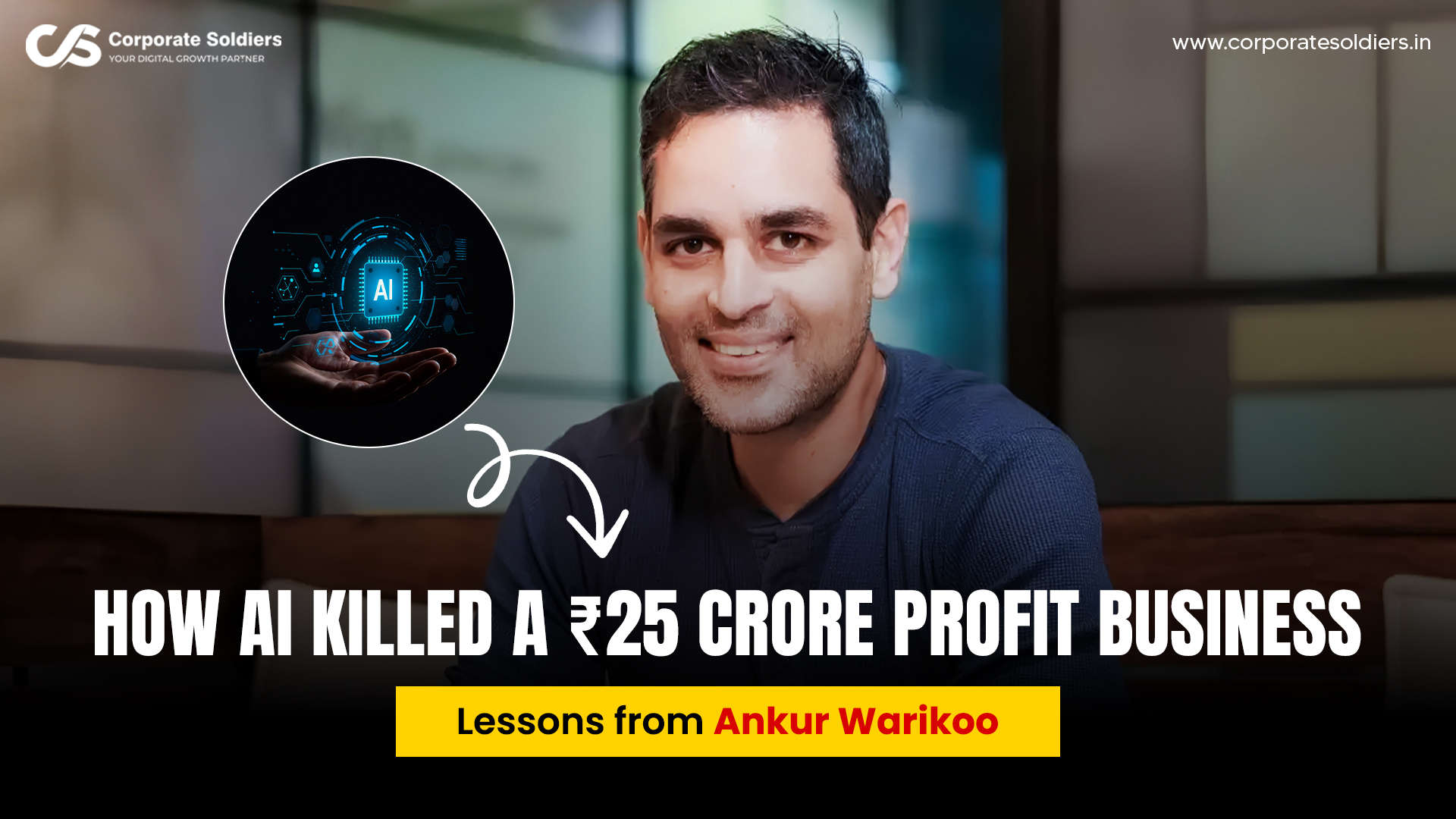
The buzz in India’s creator economy and EdTech sector has gone into overdrive after a jaw-dropping announcement from one of its own. Warikoo dropped a bombshell in a short video and some cryptic social media posts: he’s shutting down his incredibly successful online course business, WebVeda.
This business has done something truly remarkable – few businesses can say they’ve done as well as WebVeda has in the digital space. Take for instance:
- Over ₹100 crore in revenue since its inception way back in 2020.\
- Profit after tax of ₹25 crore is pure gravy.\
- More than half a million students have registered across a wide ranging array of cohorts – proof that the business had a real impact.
So in the tech world, particularly in the startup sector, it makes no sense whatsoever that you’d just throw away a business that’s raking it in. The general rule of thumb is to milk an asset that’s yielding a 25% profit for as long as you can. But Warikoo was having none of that – he consistently maintained “Let’s wrap it up” was his mantra.
This has sparked a huge debate and polarisation in the tech and business community in India. You’ve got two camps trying to make sense of it: those who think it’s a sensible and forward thinking way to address AI’s disruption of business, and those who reckon it’s just a sneaky marketing ploy to get rid of old inventory and rebrand.
Anyway, it’s worth keeping an eye on what happens next in the digital business world.
The Official spin: What’s Behind The Sudden Closure?
The mainstream media (NDTV Profit, Financial Express & Livemint) is saying it’s all about the fast changing tech landscape. The official line is that tech is becoming irrelevant and businesses and jobs have cycles.
The AI Disruption Theory is in full swing
When asked straight out online if the AI revolution had anything to do with the decision, Warikoo said straight out: “Absolutely huge”.
The mainstream narrative is that Generative AI has sucked the value out of information products that were traditionally created once and then repurposed. The traditional online learning business model is based on “asymmetric access to structured data”, but with the arrival of super sophisticated language models, the way people learn has been turned on its head.
AI can now create completely individualised learning pathways that are tailored to the learning style, pace and gaps in knowledge of each learner.
Interactive learning systems are the new norm these days and static video modules just don’t cut it anymore – they can’t offer you real time feedback.
The static content is no longer relevant in an age dominated by AI.
Old fashioned non-interactive video modules are quickly losing their appeal when people can get AI-generated coaching and real time educational support – like chatbots that can offer a real time solution to a problem, code debugging , or text optimisation.
Time To Move On – The Business Did Its Thing
A core value of Warikoo’s business philosophy is that there is a finite lifespan of businesses and a founder should know when it’s time to pull the plug. Warikoo thinks it’s best to take the cash off the table when you’re winning, rather than dwindle it down gradually.
Shutting down WebVeda is just a down-to-earth understanding of legacy infrastructure and overheads – keeping an old system running in the digital world is a massive waste of resources. I reckon that’s how business owners are – agile and adaptable, not some long term stability – it’s just a project that’s addressed a specific issue before moving on.
Personal Growth & Reinvention
Warikoo’s always been one to take on new challenges – from being a corporate executive to a Venture-backed CEO (Groupon India, nearbuy.com) to a top content creator, best selling author and angel investor – it’s clear he’s not one to sit still for long. With traditional courses fading away and AI startups and AI based businesses paving the way – creators now have to be more personal with the delivery medium, static courses are becoming a thing of the past. It’s a very real challenge for founders who want to remain a thought leader for tomorrow – if you’re not pushing the cutting edge for productivity & technological capacity anymore, how can you keep your head up?
The “Counter” Perspective: A Whole Lot Of Skepticism Out There
While they say it’s all about tech advancements, a lot of people out in the digital world are scratching their heads and thinking that something fishy is going on. Moneycontrol, X (Twitter to you & I) and corporate users are all scratching their heads saying when a business is making a tidy profit like WebVeda was, it’s a pretty big sign that they’re changing up their strategy. That’s no small deal in the crazy world of online, right?
The “Marketing Master-stroke” Theory
Many people were initially under the impression that it was the AI that was behind this pull, but as it turned out, a huge chunk of the internet was just being plain skeptical about the whole thing.
There’s an idea that’s getting a lot of airplay right now, and that’s the notion that all of this may well be a clever marketing stunt by the creator economy.
I’m not entirely sold on it, but it does look like it’s a mix of consumer psychology and some pretty sound theory behind it.
Now, can anyone tell me about conversion drivers ? You know, the ones that really get people moving – like urgency. That’s what happens when you say something is closing for good, and as conversions go up, so does the revenue.
One of the big marketing tricks that digital businesses have been using to make this sense of urgency pop up is – scarcity. The internet has got loads of tricks up its sleeve to make this happen such as:
- Limited time offers (think flashing red lights saying “BUY NOW OR FORGET ABOUT IT”)\
- Final Signing Days (one last shot to get in on the action before it’s too late)\
- Countdown launches (countdown to the end – you’d better move fast, mate)\
- Last chance promotions (hey, one last try before you miss out for good)\
- Exclusive access windows – limited spaces – don’t even think about missing it!
These all play on one of the strongest motivators of online buying habits – FOMO (fear of missing out). And from a marketing POV saying you’re going to shut up shop can create an absolute maelstrom of hype, momentum and chatter about your business.
Now, I’m not saying the creator is being manipulative here, but what it does mean is they’re firmly in control of what they’re creating. Scarcity marketing is a pretty standard practice in loads of industries, and we’ve all seen it before.
But on the flip side of that, that skepticism you see on the other side of the internet – well that’s just a reflection of how the internet’s changed the way we connect with creator announcements – we’re no longer just reading them, we’re reading between the lines too.
The Inventory Clearance Comparison
Brick and mortar stores – retailers – have been doing this inventory clearance thing for ages – it’s a way to shift stock before it becomes unsellable and rake in some cash. But in the digital world, pre-recorded units of learning are like assets that depreciate over time – they go stale, they become irrelevant and if you’re not on the ball, they become a liability.
So, it does make sense to monetise those courses while they’re still hot – to cash in before the course goes out of date and moves on to the next.
The Pivot Theory
Warikoo’s got loads of experience and expertise in ed-tech – but is he basically bailing on the industry for good? I don’t think so. Everyone’s talking about an intelligent pivot of the business – into business models that will give them a consistent stream of recurring revenue.
The creator economy is all about trading in one-off and low-ticket sales for long-term sales with higher ticket values and defensibility. Forecasters are saying the big trends are going to be:
- Subscription Based Communities – bigger ticket communities where peers support each other & stay engaged over the long-haul.
- AI powered Mentorship Platforms – SaaS platforms with AI agents that can dish out personalized guidance to users.
- Premium Coaching Cohorts – higher ticket coaching programs with fewer members, more exclusive and a focus on long-term relationships with people who are super-committed to achieving their objectives.
What does the ‘Makes No Sense’ quote even mean
The Great Fall of the ₹25 Crore EdTech Venture
To make sense of how a business that raked in a ₹25 crore profit can suddenly go under, take a step back and take a hard look at the way the online learning market is rapidly changing – for the worse
The Economic Reality of EdTech
The numbers just don’t add up like they used to when it comes to running a generic online course business. The past 3 years have been pretty brutal.
$$Net Profit = Revenue – (CAC + Delivery Costs + Everything Else)$$
Delivery costs for stuff that’s already been pre-recorded is still super low. But the cost of getting customers – that’s the CAC – has skyrocketed. Since every Tom, Dick and Harry is competing for the same eyeballs on Meta, Google, and YouTube, ad space is getting sold out, and that means ad prices are way up, conversion rates are going down, and the whole shebang is getting a lot more expensive to run.
The Content Saturation Problem
When just about anybody can get decent answers from a chatbot, it’s hard to see the value in a generic “here’s how to do it” digital course. People are spoiled by apps like ChatGPT, Claude and Perplexity that can dish up instant, top-notch advice on anything. This makes the generic “how-to” course a lot less appealing.
It means the idea of a business moat is a whole lot tougher to defend now. If all you’re selling is structured text and pre-recorded video, then there’s no real barrier to entry – and that means there’s no real way to make it stand out in a crowded market where AI is cutting through the noise. The days of just selling information are over.
Lessons for Digital Entrepreneurs
Exit While You’re Ahead
The trick is this story is all about being able to sell out while you’re on top.
It’s a willingness to cut and run while you’re at your best.
You’d think that many businesses would have a track record of failing to keep up with change when it comes to technology – and this usually ends in disaster.
Two words: brick and mortar
- The rise of online shopping knocked off a load of storefronts.
- The DVD rental stores got creamed by the shift to streaming.
- Digital media disrupted the traditional media.
- And feature phones were replaced by smartphones.
Many companies that are profitable today may not be relevant in the future.
Clings to sentimental reasons can be costly.
Getting the timing right is crucial.
Adaptability is the New Survival Skill
What the revolution of AI is doing is forcing businesses to adjust at a quicker and quicker rate – especially in these industries.
Flexibility has become more important than ever before – stability has well and truly gone out the window.
These days the essence of digital entrepreneurship is all about:
- Consumer behaviour is constantly changing.
- The technology life cycles are becoming shorter and shorter.
- Platforms are taking all sorts of unexpected twists
- Companies must continuously strive to stay ahead of the competition.
Back in the day, when the founders were themselves, they couldn’t be too clingy to their means of earning money anymore, or to one single identity of their business.
The ability to change course fast can literally be the difference between life and death.
This is particularly the case for sectors such as information, education, and content creation – the sectors where AI is having the most impact.
Brand Is Bigger Than the Product
One thing to take away from this story is just how important personal branding is.
Businesses that focus on the product are different from those that focus on the audience.
- Product-first businesses
- Audience-first businesses
People with a unique personal brand are multi-purpose – they are able to adjust to new situations.
With a solid personal brand, it is possible to transition from one business model to another without losing out on your audience.
An example of this is Ankur Warikoo, who started off designing courses and has since turned to having a loyal fan base through several platforms.
That kind of trust can be a real asset to any business.
What Happens at 8:30 PM?
This story will be repeating itself time after time with new technology and new waves of disruption. Its timing is really making people in the creator economy and startup space wonder what is going on.
There are loads of options available – do you believe:
- You’re no longer doing the same type of online courses as you’ve always done.
- You’re moving to an AI-powered approach to learning – an AI-powered learning system!
- It’s a brand new company that makes use of AI.
- An excellent mentorship program that really is worthwhile.A High Tech New Web Based Learning System You Can Subscribe To
- Maybe the whole creator economy is on the verge of a massive shake up.
- Or – who knows – it’s something else entirely.
But regardless, this has given a pretty big boost to the debate about where AI is headed in education.
And possibly – just possibly – that’s what’s really important here.
Final Thoughts
Ankur Warikoo taking the road less travelled and giving the boot to his one creator/one online course business is no small thing.
It’s a wholesale shift in the way the digital economy works
No question there’s going to be a massive impact from AI coming into the way we make, distribute, consume and sell information. And on top of that, all the education companies run by creators trying to figure out where to put their money in a world where AI is everywhere – and teaching, and supporting, and tailoring knowledge to an individual in real time, on demand.
Not to mention the skepticism and doubts over the announcement just confirm that the creator economy is a lot more mature than it used to be – people now get the psychology of marketing, the art of making things scarce and the business of pivoting in response to changes in the market.
Will Ankur Warikoo be “Ankur the Teacher” no more, or is he about to start writing a whole new chapter as “Ankur the AI Innovator”? Only time will tell.
But one thing is for sure – this is something that will never be forgotten.
And in this age of AI, it’s not just about delivering information – you also need to have some other tricks up your sleeve. Companies that get technology, that’ve got trust on their side, that deliver a personalized experience, that can adapt, and that can’t be easily replicated by a machine – those are the ones that are going to come out on top.